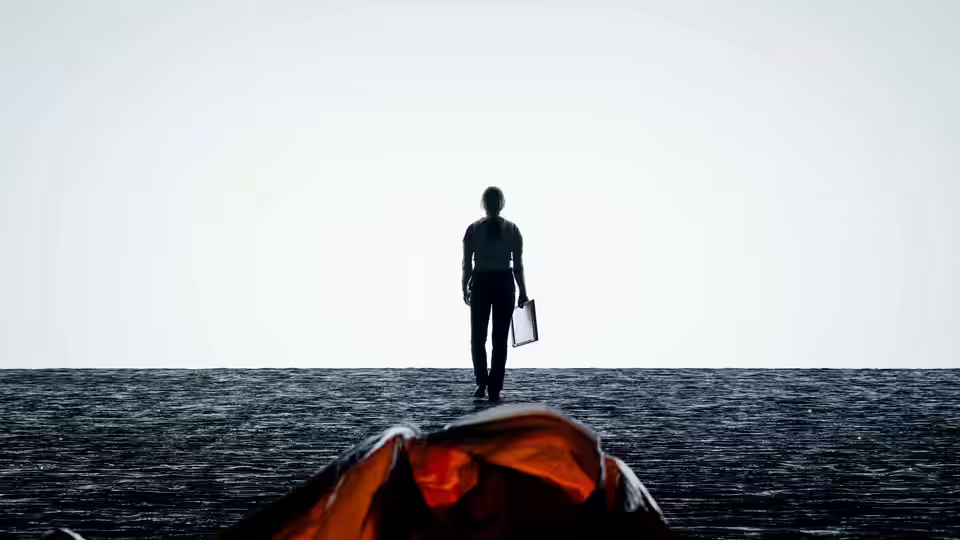
Every decade has good science fiction. What made the 2010s unusual was the kind of film that got made and the people who got to make it. The twenty titles below run from Inception in the summer of 2010 to Annihilation and A Quiet Place in the spring of 2018, and between them they cover a heist inside a dream, a linguist in a tent, a woman in a van in Glasgow, a man in love with his operating system, a planet coming to kill two sisters, and a train. Eighteen of the twenty score 78 or better on Fi1m. The average across all twenty is exactly 80. That is not a run of luck. Something about the decade made it possible, and it is worth saying what before the conditions are forgotten.
The mid-budget original
The first thing is money, and specifically the money nobody makes films with any more. Most of these cost between fifteen and sixty million dollars, were written for the screen or adapted from a novel nobody had heard of, and were sold on a premise and a face rather than a franchise. Ex Machina was fifteen million; Attack the Block thirteen; Under the Skin less than that; Looper thirty; Snowpiercer thirty-nine; Annihilation forty; Her and Arrival somewhere in the forties. Studios still had a slot for that film in 2012, and independent financiers (Film4, A24, Annapurna, CJ) were building businesses on it.
Even the big ones were originals. Inception was a hundred and sixty million dollars spent on Christopher Nolan's own screenplay about a corporate espionage job carried out through dreams, and it made eight hundred. Interstellar followed at the same scale with a father, a daughter and a lot of physics. Gravity was a hundred million for ninety-one minutes of one woman trying not to drift away, and it made seven hundred. The lesson the industry drew from these was the wrong one, that audiences wanted spectacle, when what they had turned up for was an idea they had not seen before. By the end of the decade the slot had closed: Annihilation was sold to Netflix outside North America because Paramount lost its nerve, and that is roughly the moment the golden age ends.
The British and the Europeans
The second thing is who was directing. Nolan is British, and so is Alex Garland, who wrote Sunshine and Never Let Me Go before directing Ex Machina and Annihilation, the two films on this list most interested in what a person is made of. Jonathan Glazer made Under the Skin in Glasgow with hidden cameras and men who did not know they were in a film. Joe Cornish put an alien invasion on a south London estate and cast John Boyega. Doug Liman is American, but Edge of Tomorrow is written by Christopher McQuarrie and the Butterworth brothers and plays like a British comedy about a coward learning a job.
Then the Europeans arrived and used the genre for their own purposes. Lars von Trier made Melancholia, a film about depression in which the planet is also, quite literally, coming to end the world; the critics were split (55 from them, 80 from us) and we think they undervalued what Kirsten Dunst and Charlotte Gainsbourg do with the gloom. Bong Joon Ho, before Parasite, put a class system on a train in Snowpiercer and gave Tilda Swinton the most repellent bureaucrat of the decade. Denis Villeneuve, from Quebec, made Arrival and then took on the one sequel nobody wanted and made Blade Runner 2049 patient, sad and mostly earned. Alfonso Cuarón made Gravity. None of these directors came to science fiction as a career move; they came because the genre let them do something a realist drama would not.
Spectacle you could follow
The third thing is that the action got legible again. The 2000s had ended in a slurry of digital noise where you could not tell who was hitting whom. Mad Max: Fury Road is the corrective, and our review says why it scores 88: George Miller and editor Margaret Sixel keep a two-hour chase clear at its most frantic, with practical stunts that make the impacts feel heavy. Gravity did the same for space, with a long opening take that took away your sense of up and down and never let the effects look like a computer. Inception folds a street and you can still see it is a street, which is why the image lands. Even Edge of Tomorrow, the most conventionally action-shaped film here, cuts its repeated battle shorter each time because it trusts you to remember. Clarity was the decade's virtue, and the films that have dated worst since are the ones that abandoned it.
Grief, loneliness and other alien subjects
What were they about, though? Read the twenty together and a pattern appears that has little to do with spaceships. Five of them are about grief: Arrival most directly, then Gravity, Interstellar, Melancholia and Annihilation, in which an expedition into a mutating forest is also a marriage being examined. Three are about loneliness and desire, and what happens when the object of desire is not human: Her (84, and we came prepared to pity Joaquin Phoenix and left presumptuous), Ex Machina, in which Alicia Vikander's Ava has better manners than the men, and Under the Skin, in which Scarlett Johansson's alien learns what a body costs. Two are about parenthood under threat: A Quiet Place and Interstellar. One, Contagion, is about how a virus travels, made in 2011 and watched very differently nine years later; we scored it 78 and washed our hands twice on the way home.
This is the decade's real distinction. The 1980s used science fiction for adventure and the 1990s for paranoia; the 2010s used it for the subjects a prestige drama would have taken to Sundance. The genre let the films be about feeling without being about feeling, which is why Arrival can make you cry over a grammar and Her can make you defend a man who is dating his phone.
The procedurals
A smaller strand, and a pleasure: films in which competent people solve problems. The Martian is the purest, a survival film run as a series of homework questions, with Matt Damon's jokes keeping the explanations lively and the potatoes more gripping than the explosions. Gravity and Contagion belong here too, and so does the middle of Interstellar, when the film stops lecturing and docks a ship. These films trusted an audience to enjoy watching someone think, which the previous decade had largely stopped doing.
The ones that did not work, and why they matter
We have kept two films on the list that we scored low. Prometheus gets 60: an hour of Ridley Scott's pictures good enough to carry the question of where we came from, then a script that has to answer it and cannot, with Michael Fassbender's android the reason to stay. The Adjustment Bureau gets 64: a Philip K. Dick premise about men in hats who quietly correct the world, made kind, with the romance the good part and the rules the bad. They belong here because they fail the decade's way, by reaching. A studio spent a hundred and thirty million dollars in 2012 on a film whose subject is the origin of the species, and George Nolfi's debut asks whether free will survives a bureaucracy. Neither is cynical. The 2010s' failures were failures of ambition, and that is the last thing you can say about most of what replaced them.
Where to start
If you have seen none of them: Arrival first, because it is the decade in one film, a big idea, a small human response to it and a director who trusts the audience to feel before it understands. Then Ex Machina for the conversation, Mad Max: Fury Road for the chase, and Her to be surprised by your own sympathy. If you have seen the famous ones: Under the Skin, Attack the Block and Snowpiercer are the three most people missed and the three we would most like to have made you watch. Save Melancholia for an evening with room for something difficult, and leave a little quiet afterwards.
The full list, in release order: Inception (2010), Attack the Block, Melancholia, Contagion, The Adjustment Bureau (all 2011), Prometheus, Looper (2012), Gravity, Her, Snowpiercer (2013), Edge of Tomorrow, Interstellar, Under the Skin (2014), Mad Max: Fury Road, The Martian, Ex Machina (2015), Arrival (2016), Blade Runner 2049 (2017), A Quiet Place and Annihilation (2018). Every one has a page on Fi1m with the review, the critics' verdict and where it is streaming where you are.
Features are written by AI in Fi1m’s voice, checked against our reviews before publication, and corrected in the open. How we use AI