BoJack Horseman is as good as any live-action series. The critics watched six episodes.
A horse in a jumper, a glass house above Los Angeles, and six seasons that became as honest about depression, self-sabotage and the slow business of growing up as anything made with actors. The reviews that fixed its reputation were written on the first six episodes, which are the only ordinary ones.
Fi1m · 13 October 2026 · 7 min read
In the summer of 2014 Netflix sent critics the first six episodes of a new animated comedy about a horse, and the critics did what critics do with six episodes of an animated comedy about a horse. They watched them, found a Hollywood satire with animal puns and a rich, self-pitying lead they had met before in other shows, and gave it a shrug. Our own page for BoJack Horseman still carries the arithmetic: the critics’ score sits at 57, from reviews written almost entirely that August. Ours is 91. The gap is the subject of this piece, because it is not a disagreement about taste. It is what happens when a series is judged by the only part of it that was ordinary.
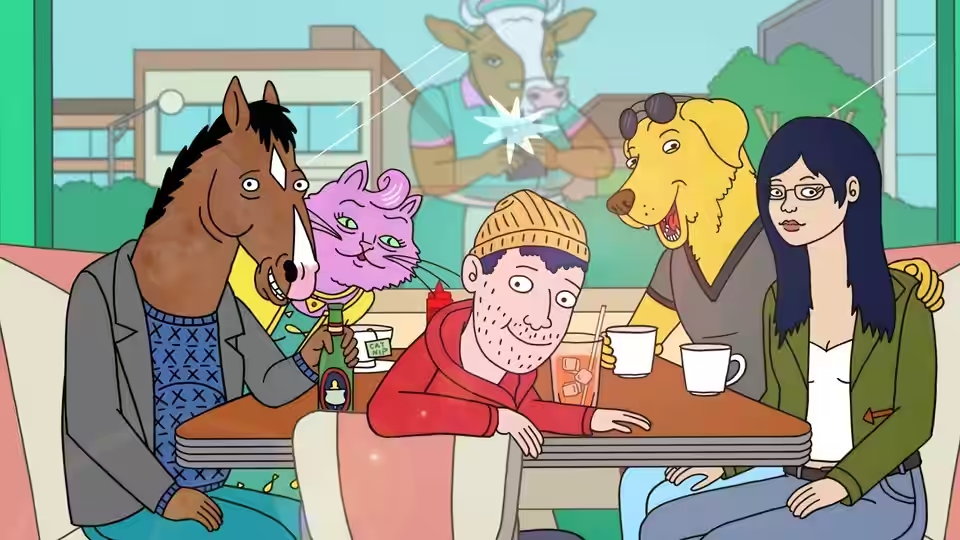
The ordinary part is real. BoJack Horseman (Will Arnett) starred in a 1990s family sitcom called Horsin’ Around, lives in a glass house above Los Angeles, drinks, and watches his own repeats; a ghostwriter (Alison Brie) arrives to extract a memoir; a slacker (Aaron Paul) lives on the sofa; an agent who is also a pink cat (Amy Sedaris) tidies up after him. For five episodes that is roughly all it is, and the jokes about agents and awards shows are the jokes anyone could make. If you stopped there, and most of the reviewers did, you would have described the show accurately and missed it completely.
Where it turns
Episode eight, “The Telescope”, is where it turns. BoJack drives out to see Herb Kazzaz, the man who created Horsin’ Around, gave him his career and was fired from it, and whom BoJack did nothing to defend. Herb is dying. BoJack has come to be forgiven. Herb declines, at length and without raising his voice, and the episode ends with the two of them having said everything and settled nothing. A sitcom had just refused to let its lead off the hook, and had done it quietly, in a sunlit bedroom, with a man who happened to have the body of a human and a horse for a visitor. Three episodes later BoJack asks Diane to tell him he is a good person, and the series cuts away before she answers. The first season ends there, more or less, and everything that follows is the answer being worked out.
That is the structure the show kept for six seasons and seventy-seven episodes. Raphael Bob-Waksberg and his writers build each year as a comedy with a long fuse: the running gags, the background signage, the farce that Todd wanders into, and under all of it a single question being asked of a man who does not want to hear it. The pacing is the thing the first reviews could not see, because pacing is a property of the whole. The series takes its time the way Mad Men takes its time, letting a scene in which nothing happens sit beside a scene in which someone’s life changes and declining to tell you which was which until later. You can only know that an hour was patient if you were still watching when it paid off.
The episodes people cannot stop talking about
The ones that get named are the ones that broke the form. “Fish Out of Water”, in the third season, sends BoJack to an underwater film festival and plays twenty-five minutes almost without a word: a silent comedy, a Jacques Tati picture with a horse, that ends on a single line that undoes it. “That’s Too Much, Man!”, later that year, is a bender with Sarah Lynn, the child star of Horsin’ Around whom BoJack helped ruin, that ends in a planetarium with her saying she wants to be an architect and then not saying anything else. People who saw it when it arrived remember where they were. An animated sitcom had made the most frightening episode of television that year, and had earned it, because it had spent three seasons showing you exactly how this would happen.
“Time’s Arrow”, in the fourth, is told from inside the dementia of BoJack’s mother, with the faces of the people she cannot place scribbled out. “Free Churro”, in the fifth, is a eulogy: Arnett, alone at a lectern, for the whole running time, talking about a woman who never once told her son she was proud of him, and it is as complete a piece of acting as anything on television that year, delivered by a man you never see. “The View from Halfway Down”, the penultimate episode, is a dinner party among the dead that the series has been setting the table for since the first season. These are not stunts. Each one is the show finding the only form that could hold what it had to say, and each is possible because the characters had been given the room to become people whose deaths, memories and eulogies you would care about.
The characters are the point
Which is the argument. A great deal of television is about one person, with others arranged around them to produce plot. BoJack Horseman is about five, and it lets them grow up at five different speeds. Diane leaves Los Angeles, goes to Vietnam looking for a self she does not find, writes a book that fails and then a different one that does not, and ends up in Houston, married to a man the show has the decency to let be kind. Princess Carolyn spends six seasons wanting a child and a life that is not BoJack’s, loses more than one pregnancy, adopts, and marries the only man who ever did what he said he would. Todd, who begins as a joke on the sofa, works out that he is asexual in the fourth season and the series treats it with a straightforwardness that live-action comedy had not managed. Mr. Peanutbutter, the Labrador with the sunny disposition, is slowly revealed to be as frightened as anyone, and happier only because he has never looked.
And BoJack is let off nothing. It is Todd, of all people, who says it to him at the end of the third season: it is not the alcohol or the drugs or what happened to him as a child, it is him, and he has to be better. The series then spends three further seasons on whether he can, and refuses to arrive at yes. The last scene is a rooftop and a silence with Diane, and when the closing song plays you understand that the show has given you an ending without giving him one. The Sopranos did something like it in a diner. Six Feet Under did it with a car. This is in that company, and the only reason it is not usually mentioned in that company is that the man on the roof has a long face and ears.
Why the prejudice persists
Television has a place for animation and it is a separate room. The Emmys have an award for Outstanding Animated Program, and BoJack was nominated for it twice, in 2019 for “Free Churro” and in 2020 for “The View from Halfway Down”, and lost both times, to The Simpsons and to Rick and Morty. It was never nominated for Outstanding Comedy Series, where it belonged. No animated series has been since Family Guy in 2009, and before that not since The Flintstones in 1961. The assumption underneath is that a drawing cannot act, and the show is the plain refutation of it: Arnett’s pauses, Sedaris playing competence as a kind of grief, Brie refusing to make Diane easier to like. Lisa Hanawalt’s designs, thick outlines and flat colour and animal heads on bodies in ordinary clothes, are not a limit on the performances. They are what let the show put a horse at a lectern and have you forget, within a minute, that it was a horse.
The other reason is the first six episodes, and the habit, which the streaming era made worse, of reviewing a season from the part a publicist sent over. The reviewers in 2014 were not careless. They were describing what they had been given, and what they had been given was the show before it became itself. Netflix ended it after the sixth season, splitting the last year in two and sending it out in October 2019 and January 2020, a season sooner than its creator had wanted. By then nearly every critic who had shrugged in 2014 had written the reappraisal. The aggregate never caught up, because aggregates do not go back.
Where to start
Episode one, and keep going. The first six are the price of admission and they are a reasonable price: the jokes are fine, Arnett is already good, and the house, the agents and the city are being built for a reason. If you have seen it, Arrested Development is where Arnett learned the voice, Anomalisa is the one film that takes animation as seriously about adult unhappiness, and Fleabag and The Leftovers are the live-action series most often set beside it by people who have stopped drawing the line. Our review is on the title page, with where it is streaming, and it says the same thing we are saying here, in fewer words: stay past the first six episodes.
Don’t listen to the critics
Third in an occasional series about films and series whose reputation was fixed early by people who were not really looking at them, and the first about a series. The others so far: Howard the Duck and Four Lions. We are the critics, so we will try to be honest about how that happens. Nominations to the contact page.
Features are written by AI in Fi1m’s voice, checked against our reviews before publication, and corrected in the open. How we use AI