The Dark Crystal built a world with no people in it, and told its story through the bodies of the creatures
In 1982 Jim Henson and Frank Oz made the first feature film in which not one living thing on screen is human. Every character is a puppet with a person inside it, every landscape was built, and the story of a cracked crystal and a race split in two is told almost entirely by how things look and move. The second in our series about films that tell a story the way only a film can.
Fi1m · 4 October 2026 · 8 min read
About twenty minutes into The Dark Crystal (1982) the Emperor of the Skeksis dies. He is a vulture in brocade, propped up in a bed the size of a chapel, and he dies the way the whole species lives, clutching: his claw tightens on the sceptre and his courtiers, nine more vultures, lean in to see which of them will get it. Somewhere else, in a valley of sand paintings and slow music, an old four-armed creature called a Mystic lies down and dies at exactly the same moment, without fuss, and his body goes to light. The film cuts between the two deaths. Nobody explains them. You have just been told the single most important fact about this world, that these two races are halves of one thing, and you have been told it with two puppets, one edit and no words.
That is the film's method, and it is why it belongs in this series. The City of Lost Children, where we started, built a town so that a strongman could find his brother. The Dark Crystal goes further. It builds a planet, with three suns, its own animals and plants and weather and a thousand years of history, and then it refuses to put a single human being in it, so that there is nothing on screen you can read by habit. Everything has to be designed to be understood, and it is.
How it was made
Jim Henson was the most successful puppeteer alive and he was tired of being thought of as the Muppet man. He had seen the drawings of Leonard Baskin, dark things, crows and old men, and had an idea for a fairy tale with no jokes in it, and when he found the illustrator Brian Froud, whose goblins and faeries looked like they had been dug up rather than drawn, he had his designer. Froud drew the world for several years. Henson and his company then built it, in a workshop in Hampstead that grew into the Creature Shop and in the sound stages at Elstree, with Gary Kurtz, who had just produced two Star Wars films, running the production, Oswald Morris, who had shot Oliver! and Fiddler on the Roof, lighting it, and Frank Oz, Henson's partner of twenty years and the man who had just made a nine-hundred-year-old puppet carry the middle of The Empire Strikes Back (1980), directing alongside him.
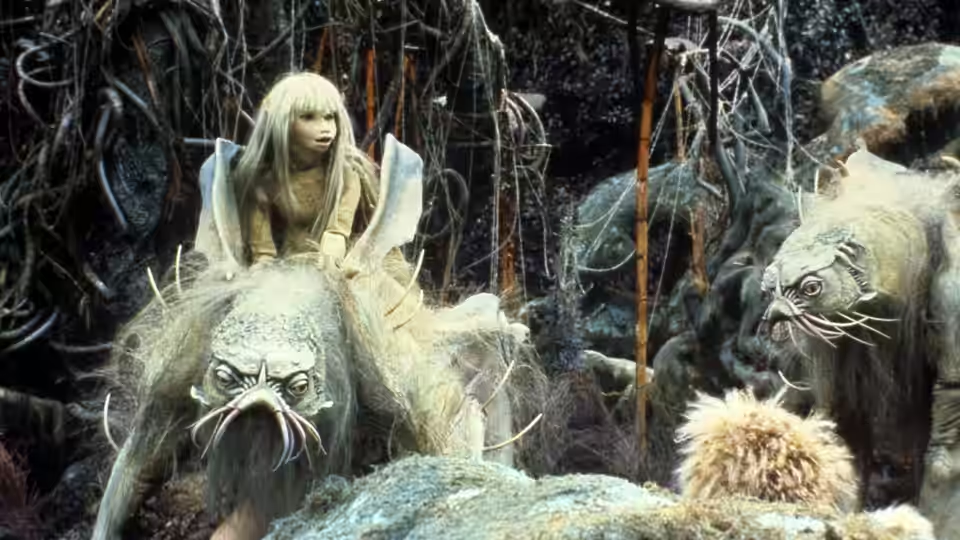
The result is a film in which the credits list performers and voices separately, because almost nobody did both. Jen, the Gelfling hero, is Henson's hands and another actor's voice. Aughra, the one-eyed astronomer who takes out her eye to look at you with it, is Oz inside and Billie Whitelaw outside, which is why the most terrifying thing in the film is also the funniest. The Skeksis took two or three people each: one in the body working the head and one arm, one working the other arm, sometimes a third for the eyes. The Garthim, the beetle soldiers, were suits so heavy the men inside could stay in them for minutes at a time. The Landstriders are performers on stilts, walking like herons. There is no process shot that put the actors somewhere else afterwards. Everything you see was in the room, in the light Morris was pointing at it, at the moment the camera ran.
That matters to the storytelling for a reason that is easy to miss. Because the performers were inside the creatures, the creatures move like people pretending to be something else, which is to say like animals with intentions. A Skeksis does not walk; it processes, with the fastidious, bent-kneed gait of a bird of prey who has put on robes. The Mystics move at a quarter of the speed of everything around them, and after a minute in their company the film's own tempo slows to match. The Podlings, the potato-shaped villagers, bustle. You know what each of these creatures wants from the way it crosses a room, and the film trusts that so completely that its villains do most of their scheming in a language of whimpers and hisses.
What the design is saying
The story is a quest, and a plain one. A thousand years ago the Crystal at the heart of the world cracked; the Skeksis took the castle and the power, the Mystics went into the hills, and the Gelflings, the only race that might put it right, were hunted to what is believed to be the last one. Jen is sent to find the missing shard and return it before the three suns align. He meets Kira, another survivor, who can talk to animals; they are chased; they get there. Our review gives it a 78 and says the adventure sometimes struggles to hold the attention, which is true, and the Gelflings, with their fixed, pretty faces, are the least expressive things in a film full of expression. Henson said as much himself. If you come to the film for the plot you will have seen it before.
Come to it for the world and you will see something that has not been done before or since. The design is not decoration on the story; it is the argument of the story. The Skeksis are everything that takes: they eat live things at a banquet of shrieking appetite, they drain the essence out of captives to drink it, they hold a trial by stone-cutting to decide who rules, and they are rotting as they do it, their finery and their flesh both. The Mystics are everything that waits: they sand-paint, they hum, they heal. Neither is whole, and the film shows you that long before it says it, because the Skeksis are all angle and the Mystics all curve, the Skeksis shriek and the Mystics drone, and the two species are plainly the same body pulled in two directions. When the ending reveals that they were once one race and must be one again, it is not a twist. It is the thing you have been looking at for ninety minutes, finally named.
And the world around them tells the same story at every scale. Froud's rule was that every plant and creature should look like it had evolved there, and so the forest Jen crosses is full of things that look back at him, flowers that flinch, a landscape that is itself a little alive and a little hostile, as the Crystal's sickness has reached it. The castle is a skeleton. The Mystics' valley is a bowl of warm stone. Even the Crystal chamber, where the finale takes place, is designed as a question, a shaft of light with a hole in it, waiting for the piece that fits. You could watch the film with the sound off and understand what is wrong with this world and what would heal it.
The language they took away
There is a version of the film that trusted the audience even further. Henson's first cut had the Skeksis speaking an invented language, worked out with the novelist Alan Garner, with no subtitles; you were meant to understand the court from its gestures, the way you understand a nest of birds. A test screening in Washington went badly, the studio got nervous, and the Skeksis were redubbed in English. Enough of the original approach survives, in the Chamberlain's wheedling hum, in the way the court talks over itself, to show what the film was reaching for, and to make the English lines feel like a concession. Fifteen years later Jeunet and Caro would get away with a strongman who barely speaks. Henson, in 1982, with a studio's money, could not quite.
The music did not need translating. Trevor Jones, fresh from Excalibur, wrote for the Mystics a chant that sounds like something very old being remembered, and for the Skeksis a court music that has gone sour, and the two meet, as the two races do, at the end. It is one of the great fantasy scores and almost nobody knows his name for it.
What it led to, and what it did not
It made its money back and no more, in a Christmas when E.T. (1982) was still in cinemas and children wanted a friend, not a vulture. Henson's next attempt at the form, Labyrinth (1986), answered the Gelfling problem by putting David Bowie and a teenage Jennifer Connelly in among the creatures, and it is warmer and looser and less brave. The Storyteller (1988), on television, found the balance: a human teller, a dog that talked, and tales acted out by the Creature Shop in half an hour each, and it is some of the best work Henson did. He died in 1990 with the sequel to this film unmade.
Then the computers arrived, and for twenty years the kind of fantasy The Dark Crystal had pioneered was done differently. The worlds got bigger and the joins disappeared, and so did the feeling that the thing on screen had weight, that it was standing in the same light as the camera. The Fellowship of the Ring (2001) understood this and built as much as it could; most of what followed did not. The best things in Pan's Labyrinth (2006), the Faun and the Pale Man, are a man in a suit, and Guillermo del Toro has never pretended otherwise. Wes Anderson's Fantastic Mr. Fox (2009) chose puppets and animation over digital fur for the same reason. The lineage is thin, and it runs through people who grew up on this film.
In 2019 it came back. The Dark Crystal: Age of Resistance, ten hours of television made by the Creature Shop with puppets in front of the camera and computers only to take out the rods and the performers, is the fullest vindication of Henson's idea there has been: the world held, the Gelflings finally had faces that could act, and the Skeksis were, if anything, worse. It was cancelled after one series. Watching it beside the film, the thing that strikes you is not how far the technology had come but how little the world needed changing. Froud had got it right the first time.
Why you should watch it
Because it is the only film of its kind. Not the best fantasy of the eighties, not the strangest children's film; the only feature ever made in which a whole world is populated and not one inhabitant is a person, and in which the story is carried, from the first death to the last light, by what things are made of and how they move. Because the Skeksis banquet and the draining of the Podling and Aughra's observatory, with its orrery the size of a room, are images that stay for life, and because a nine-year-old who sees it will be a little frightened and will not forget. And because of the ending, in which two races walk towards each other and become one thing, tall and made of light, and the whole argument of the design pays off in a single image that no amount of dialogue could have earned.
Incredible storytelling
The second in a series about films that tell their stories in ways only film can: with pictures, design, sound and structure rather than with people explaining things to each other. The first was The City of Lost Children. The test is that the story could not be told the same way in any other form. Nominations to the contact page.
Features are written by AI in Fi1m’s voice, checked against our reviews before publication, and corrected in the open. How we use AI