There have been three ways to put Shakespeare on a screen, and each has its virtues and its failure mode. You can film the theatre, camera at the back of the stalls, and get the performance and lose the medium. You can build the period, as Zeffirelli and Kenneth Branagh did, all Tuscan light and doublets, and get a handsome film that keeps the audience at the distance of a museum. Or you can rewrite, as 10 Things I Hate About You and West Side Story do, and get a film with the play's bones and none of its words. Joss Whedon's Much Ado About Nothing (2013) is none of these, and the fact that a fourth way was still available in the play's fifth century is the reason it belongs at the head of this series.
The house party
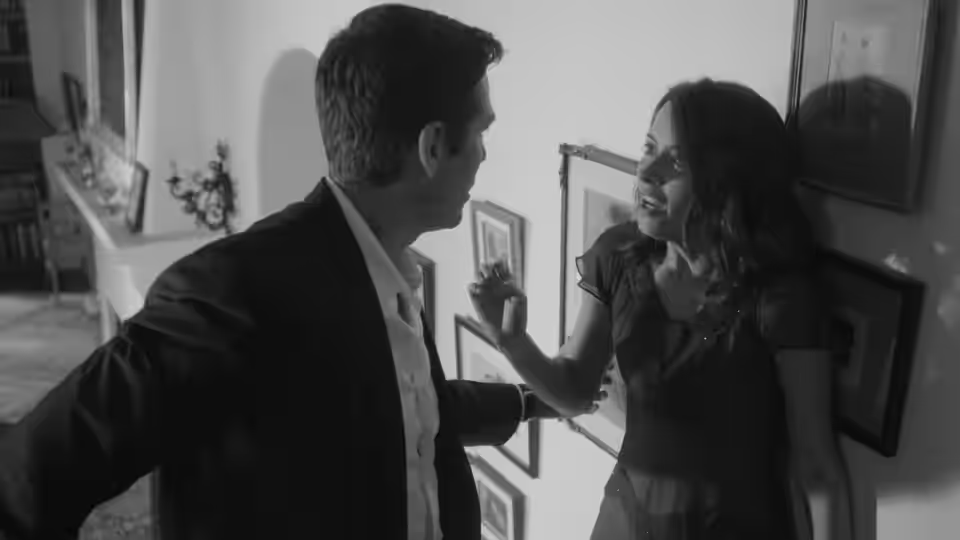
The facts are the kind that sound like a stunt and turn out to be a method. Whedon shot it in twelve days in October 2011, in his own house in Santa Monica, in a contractual break between finishing The Avengers and starting its post-production. It was the first film from Bellwether Pictures, the company he and Kai Cole set up to make small things fast. The cast were people he had worked with for a decade on television, and most of them had been coming to his house for years for informal Shakespeare readings over dinner: the film is, in a literal sense, the readings with a camera present. The text is Shakespeare's, trimmed. The dress is modern. The war Don Pedro has come back from is never explained, because it does not need to be. The house is the set, and the film's whole aesthetic follows from taking that seriously.
What that produces is a scale of Shakespeare that the cinema had mostly forgotten: the chamber scale. The plots are hatched in a kitchen, an eavesdropping is staged in a garden with a hedge that is plainly a hedge, a conspiracy is whispered in a child's bedroom because that is the room that was there. Our own review gives it a 76 and says, fairly, that the plot about Hero does not survive the move into the present, and that the handheld passages sometimes look like an expensive wedding video. Both true. Neither touches the argument, which is about form.
What the stage keeps and the camera adds
Theatre's great advantage over film, with Shakespeare especially, is the ensemble that has lived with the text: actors who know each other's timing, who can let a joke land on a look because they trust the person opposite to give it to them. Film usually has three weeks and strangers. Whedon had years and friends, and you can hear it. Amy Acker and Alexis Denisof do not so much deliver Beatrice and Benedick's insults as pass them back and forth across a worktop like people who have had this argument before; the verse goes at the speed of talk, and when a line is thrown away it is thrown away on purpose. That is a theatrical virtue, and the film has it because it was made like theatre: one company, one place, no time.
Then it does the two things only a camera can do. It gets close. Nathan Fillion's Dogberry, the play's clown, is a head of security with an earpiece who believes every word he says, and Fillion plays him at a volume that would not reach the third row; the film puts us at the distance of a colleague at the next desk, and the part is funnier for it than it has been in any stage production we can think of. And it adds a scene the play does not have: the wordless opening in which Benedick dresses and leaves Beatrice's bed while she pretends to sleep. Shakespeare gives Beatrice and Benedick a history and never says what it was. Whedon shows it in forty seconds without a word, and every barbed exchange afterwards has that morning behind it. No stage production could do that; it would need a set change and a speech. Film does it with a look at a ceiling.
The black and white belongs in the same category. It is often read as a nod to the screwball comedies whose rhythm the film borrows, and it is that, but it is also doing what a bare stage does: it removes the question of period. In colour, a Shakespeare comedy in a modern house with modern cars is a film about a modern house. In monochrome it is a film about the people in it. Jay Hunter's photography makes the pool and the marble and the big windows into a space that could be any time, which is exactly the licence a good theatre director takes with a play and a good film director usually cannot.
Why it is an evolution and not a novelty
Because it is repeatable, and because it answers the question the streaming era has been asking about Shakespeare on screen: what does a film of a play look like when there is no money and no need for a period? Branagh's Much Ado cost eight million dollars in 1993 and looks it, and that route is closed to almost everyone now. Baz Luhrmann proved the plays could take a modern setting and a pop soundtrack; Michael Almereyda's Hamlet put the prince in a corporate Manhattan with a camcorder; Ralph Fiennes's Coriolanus filmed the Roman play as Balkan news footage. Each is a thesis about one play. Whedon's is a thesis about method: a company that knows the text, a real place, the words unchanged, a fortnight, and the camera used for the two things theatre cannot do. It is a way of making Shakespeare that a good company anywhere could copy with a house and a favour, and that is new.
It also, quietly, reverses the usual traffic. Whedon's television, from Buffy onward, was built on ensembles talking over one another in rooms, and people have long said it owed something to the stage. Here the debt is paid the other way: a television director bringing to Shakespeare the one thing television is better at than either theatre or cinema, which is the sustained company of actors who know each other, and letting the play have it.
Where to start, if this is the way in
Watch this, then Branagh's, and notice how much of the same text lands differently at three feet than at thirty. Then Whedon's own Serenity is not Shakespeare but is the same company doing the same thing with a spaceship, and the Coens' Tragedy of Macbeth (2021) is the other recent proof that taking the stage seriously on film, sets and all, can produce something no theatre could hold.
Theatre on film
This is the first in a series about films that carry the stage's virtues to the screen honestly: the company, the text, the confinement, the audience's imagination doing some of the work. Some will be Shakespeare; most will not. The test is that the film knows what it took from the theatre and what only a camera could add. Nominations to the contact page.
Features are written by AI in Fi1m’s voice, checked against our reviews before publication, and corrected in the open. How we use AI