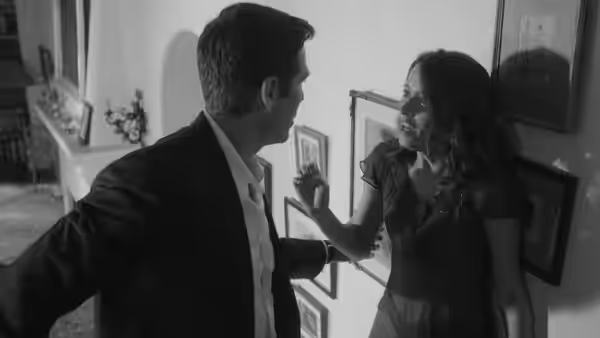
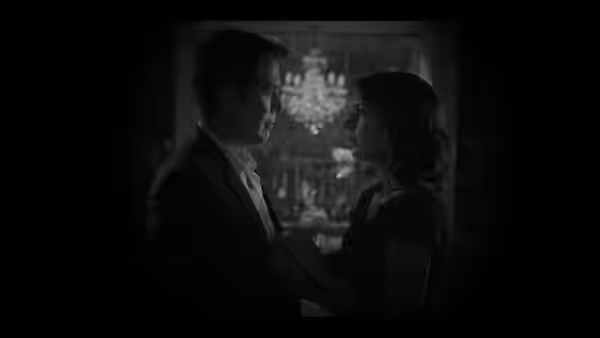
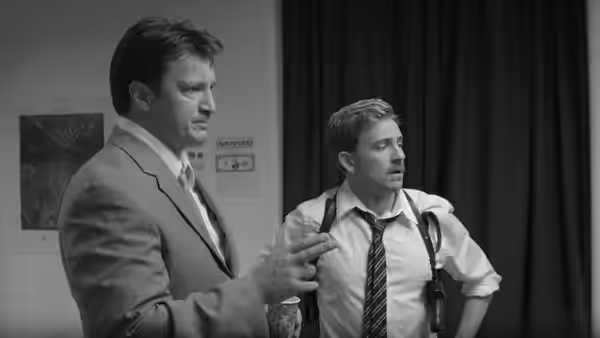
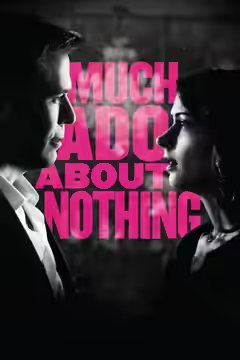
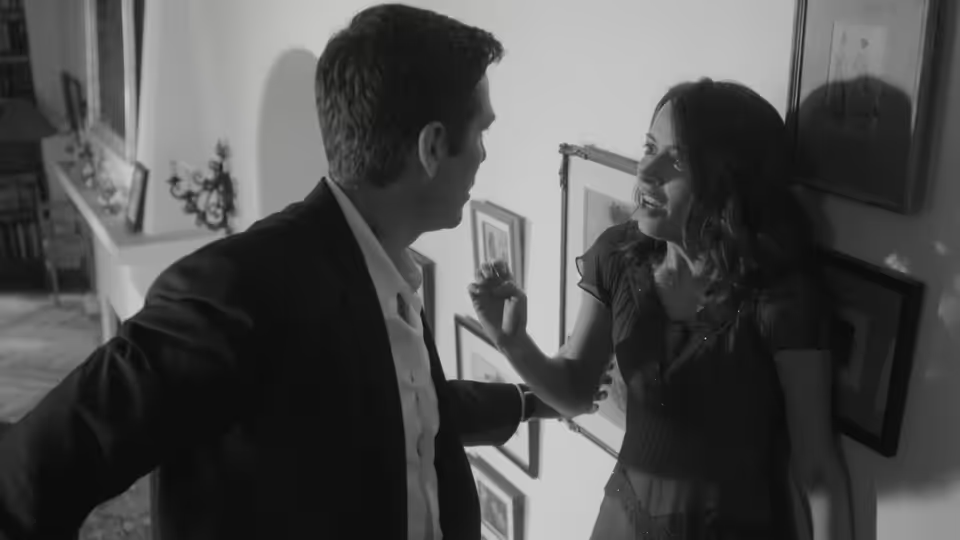
Benedick (Alexis Denisof) and Beatrice (Amy Acker) facing each other in a hallway
Film review

Much Ado About Nothing

2013 · Directed by Joss Whedon · 1h 49m · MPA PG-13

In a sentenceA Shakespeare comedy staged in a nice kitchen by actors who can hold a wine glass and a pentameter at the same time

Don Pedro (Reed Diamond) and his men arrive at the house of Leonato (Clark Gregg), a host who has offered them a month’s hospitality after business the film never explains. Among them are Claudio (Fran Kranz), who falls for Leonato’s daughter Hero (Jillian Morgese), and Benedick (Alexis Denisof), a sworn bachelor with history with Leonato’s niece Beatrice (Amy Acker): the film opens on him leaving her bed. Beatrice and Benedick trade insults across the kitchen. Don Pedro agrees to woo Hero for Claudio at a masked party. His brother Don John (Sean Maher), lately reconciled and still resentful, schemes with Borachio (Spencer Treat Clark) and Conrade (Riki Lindhome). Dogberry (Nathan Fillion) runs security. After the party, the household plots to trick Beatrice and Benedick into loving each other.

Plays from YouTube when you press play; nothing loads from them until then.

Fi1m review

Joss Whedon shoots Shakespeare in his own house, in black and white, with actors he trusts, and the result is the loosest screen Much Ado in years. Amy Acker is the reason to see it; the plot around Hero is why it does not quite fly.

Joss Whedon made this in the gap after The Avengers, in his own house, with actors he had worked with for years, and he shot it quickly and in black and white. It is modern dress: the men arrive in dark cars and darker suits, the women are in cocktail dresses, and the war Don Pedro has come home from is never explained. The idea is that the play is a house party with a plot, and for most of its 109 minutes the idea holds. It is the most likeable screen Much Ado since Kenneth Branagh’s, and it has the same soft spot Branagh’s had, in the story about Hero.

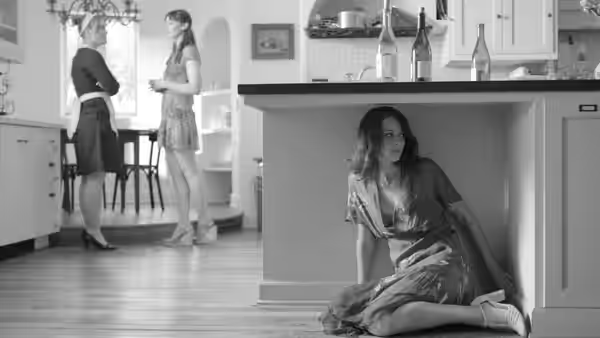
Jay Hunter shoots the house as though nobody had seen one before. The light comes through big windows and lands on marble and glass, the pool sits flat and grey under a white sky, and the kitchen, where much of the plotting happens, has more worktop than most flats. Michele Yu and Cindy Chao had a furnished house to start from, and one conspiracy is hatched in what is plainly a child’s bedroom; the film does not comment. Shawna Trpcic puts the men in thin ties and the women in dresses that would do for a funeral or, with a change of shoes, a wedding. Now and then, in the handheld passages, it looks like an expensive wedding video, and we mean that as a mild complaint.

Amy Acker is the reason to see it. Whedon opens with a scene the play does not have, wordless, of Benedick dressing and leaving Beatrice’s bed while she pretends to sleep, and Acker plays every line after that with that morning behind it. Her Beatrice is quick, tired and sore, and she is funny because she is the sharpest person in the house and knows it does her no good. There is a pratfall in the kitchen, during the plot to convince her Benedick loves her, that made us laugh out loud; then she picked herself up and spoke about taming her wild heart to his loving hand, and we found we had stopped laughing and could not say when.

Alexis Denisof has the harder job, and for the first half hour he pushes at it. His eavesdropping is staged as garden farce, with press-ups, and what would read as timing from the back of a theatre reads as mugging from three feet away. We forgave it about the time he stopped trying to be funny and started listening to Acker, after which the pair are as good a Beatrice and Benedick as we have seen on screen in years. Nathan Fillion’s Dogberry is a head of security with an earpiece and complete faith in himself, and Fillion plays it dead straight, which is the only way it works. Clark Gregg’s Leonato hosts with the patience of a man whose house has been taken over, which, in a sense, it had.

The trouble is the plot the comedy hangs from. Fran Kranz gives Claudio’s jealousy more conviction than the part usually gets, and Jillian Morgese’s Hero is sweet and given almost nothing to do, which is the play’s fault before it is hers. But a film set now asks us to accept that a woman’s future turns on what a man thinks he saw from a window one night. Whedon shoots that stretch straight, and it does not hurt the way it should; through the second half’s turn, which we will not describe, we felt the modern setting had stopped helping. Sean Maher’s Don John sulks handsomely by the pool and is never given a reason. Whedon wrote the score himself, mostly cocktail jazz, and Sigh No More, sung at the party, is lovely; the rest is pleasant and gone by the credits.

Whedon and Daniel S. Kaminsky cut it quick, and 109 minutes is right: the verse goes at conversational speed, and if you miss one joke there is another coming. Beside Branagh’s version this is cooler, smaller and funnier in its quiet moments, and less sure of itself when the mood darkens. Beside Whedon’s own television it is the film where his fondness for people talking over one another finally meets the writer who did it first.

Watch it on a sofa, with a drink, beside someone who will argue afterwards about whether Denisof is any good. He is. It takes him a while.

Critical consensus AI synthesised

78
Positive
15
Mixed
4
Negative
0

Most critics enjoy it. The reviews lean warmly towards Joss Whedon’s modern-dress, black-and-white version, shot quickly at his own house, and the praise clusters in two places: the cast’s relaxed, natural way with the verse, and Amy Acker’s Beatrice, which is singled out again and again as the best thing in it. Nathan Fillion’s Dogberry draws repeated mentions, and several critics note that the play’s darker corners come through more clearly than usual.

The reservations are about the setting and the look. A few critics find the modern trappings sit awkwardly against the language, and the home-shot black-and-white photography is called cramped by The Guardian and amateurish by Slant Magazine. The Wrap thinks Alexis Denisof miscast as Benedick, which unbalances the central romance. Comparisons with Kenneth Branagh’s version recur, not always in Whedon’s favour. The spread is fairly wide, from outright raves to middling shrugs, but nobody dismisses it.

The New York Times
7 June 2013 · Critic’s Pick · A.O. Scott
91*

The critic calls it one of the liveliest and most delightful films of the year, highlighting its screwball energy and modern, pop-cultural take on the play.

Read the full review →
Vulture
5 June 2013 · David Edelstein
90*

Edelstein calls Whedon's version the smoothest and most enjoyable Shakespeare comedy on film, crediting the director's intuitive grasp of the text and the cast's natural delivery of the language. He singles out Nathan Fillion's understated Dogberry for particular praise and notes the film's balance of comedy and darker undertones.

Read the full review →
Sight and Sound
13 June 2013 · Sophie Mayer
89*

Whedon's joyful, contemporary adaptation brings swiftness and fluency to the play's barbed banter and trials of love, with the pen proving mightier than the sword. The strong female characters, utopian domestic space, and especially Amy Acker's show-stopping Beatrice are singled out for praise.

Read the full review →
Empire
6 August 2012 · Helen O'Hara
87*

The critic praises Whedon's whipcrack wit as a perfect fit for the material and calls the intimate black-and-white home-shot film a fizzily fresh take. The well-rounded cast, especially Amy Acker's Beatrice, is highlighted as making the adaptation shine.

Read the full review →
Film Comment
· Geoffrey O’Brien
80*

The critic finds Whedon's film an unlooked-for pleasure, noting it as the most American Shakespeare movie with crisp naturalistic line readings and a romance of the one percent. Singles out how the dark side of the play emerges most forcefully here, with Whedon’s precise reading making the play new again.

Read the full review →
Los Angeles Times
6 June 2013 · Kenneth Turan
80*

The film is described as a tasty, good-humored and unpretentious backyard treat and palate cleanser shot quickly in the director’s home.

Read the full review →

Straight answers AI written, from our review

Is Much Ado About Nothing worth watching?
Much Ado About Nothing (2013) is worth watching for anyone who likes Shakespeare's comedies played fast and modern, and we scored it 76. Amy Acker's Beatrice, quick and sore and funny, is the reason to see it. The plot around Hero, in which a woman's future turns on what a man thinks he saw, sits awkwardly in a present-day house.
How long is Much Ado About Nothing, and what is it rated?
Much Ado About Nothing runs 1h 49m and is rated PG-13 by the MPA in the US. It is a comedy film.
Where can I watch Much Ado About Nothing in the US?
Much Ado About Nothing is streaming on Tubi and Amazon Prime Video in the US, and it is also available to rent from Apple TV and Amazon Prime Video from $3.99. It leaves Tubi on 1 October. Availability is checked daily; the links above go straight to each service.
How does Much Ado About Nothing compare to Much Ado About Nothing?
Much Ado About Nothing (2013) is cooler, smaller and funnier in its quiet moments than Branagh's 1993 version, and less sure of itself when the story darkens. Whedon's black-and-white house party suits viewers who want the sparring at conversational speed. Branagh's sunlit Tuscan film is warmer, louder and handles the Hero plot with more conviction.
What should I watch after Much Ado About Nothing?
After Much Ado About Nothing, try Much Ado About Nothing (1993, Fi1m 78): Branagh’s sunlit Tuscan version, warmer, louder and surer of the dark turn. Then The Philadelphia Story (1940, Fi1m 84): Hepburn and Grant sparring across a rich man’s house; the same game, older rules.

Cast

If you liked this, try…

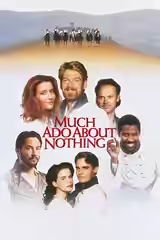
  1. Much Ado About Nothing (1993, Fi1m 78)Branagh’s sunlit Tuscan version, warmer, louder and surer of the dark turn.

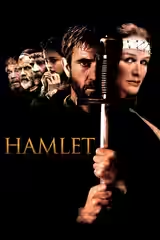
  2. Hamlet (2000) · not on Fi1m yetMichael Almereyda puts the prince in a New York hotel; Ethan Hawke broods over a camcorder.

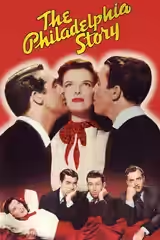
  3. The Philadelphia Story (1940, Fi1m 84)Hepburn and Grant sparring across a rich man’s house; the same game, older rules.

  4. Coriolanus (2011) · not on Fi1m yetRalph Fiennes drags the Roman play into a war of rolling news and rubble.

  5. Haider (2014) · not on Fi1m yetVishal Bhardwaj’s Hamlet in Kashmir, angrier and stranger than any English version.