Film review

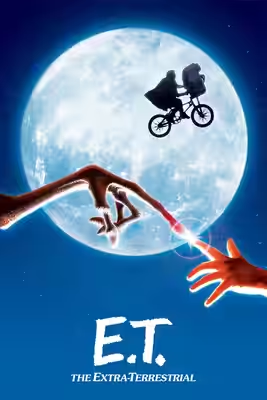
E.T. the Extra-Terrestrial

1982 · Directed by Steven Spielberg · 1h 55m · U

In a sentenceThe alien wants to go home, which is reasonable, though we would happily have him round again

AdventureScience FictionFamily

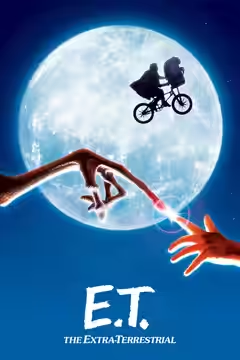
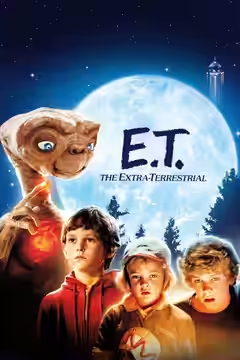
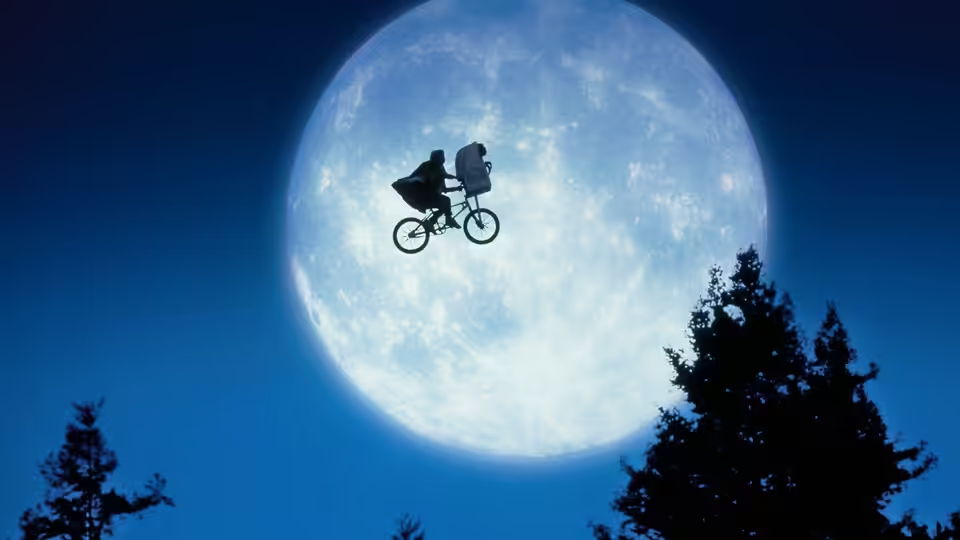
Elliott, played by Henry Thomas, befriends an alien who is afraid, alone and far from home. The visitor wants to return, while Elliott begins to make sense of a friendship with someone whose experience is far removed from his own. Their encounter places an unfamiliar creature amid suburban childhood, where family unhappiness and the need for company already shape the human lives around him. Steven Spielberg directs this family science-fiction adventure, written by Melissa Mathison, with Drew Barrymore as Gertie, Robert MacNaughton as Michael and Dee Wallace as Mary.

Plays from YouTube when you press play; nothing loads from them until then.

Fi1m review

Spielberg makes a boy’s friendship with a homesick alien funny, tender and worth taking seriously. The music sometimes tells us more than we need, but the children and the creature make its sentiment feel deserved.

Steven Spielberg’s E.T. the Extra-Terrestrial is a funny, deeply affecting family film whose kindness never feels like a duty. We would recommend it even to those usually suspicious of children befriending unusual creatures. Melissa Mathison’s screenplay takes the friendship seriously without requiring Elliott or his alien companion to become solemn representatives of human goodness. The visitor wants to go home, a wish simple enough for a child to understand, and the film gives that wish the attention it deserves.

Henry Thomas is the crucial choice as Elliott: he makes concern for the alien seem immediate and practical, without presenting it as precocious wisdom. We were moved more than we expected by the boy’s affection for this frightened visitor. Thomas gives the friendship such conviction that the creature’s unfamiliarity soon ceases to be the most interesting thing about him. Drew Barrymore’s Gertie and Robert MacNaughton’s Michael help keep the children funny and distinct, each worth watching in their own right.

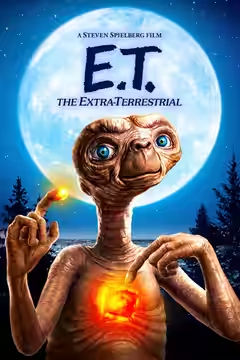
The creature itself is a considerable achievement because we can take an interest in him beyond wondering how he was made. The effects make his gentleness convincing, giving Thomas a companion we can believe he would care about. The film’s humour also allows him to be odd without making him merely a joke. Spielberg leaves room for affection to develop, which is essential in a family fantasy that asks us to care about someone so unfamiliar.

Allen Daviau’s cinematography gives suburban childhood enough visual interest to hold its own beside the visitor. The human setting remains worth looking at; the film does not become a wait for another sight of the alien. James D. Bissell’s production design helps make that setting feel inhabited by children, with lives that extend beyond this extraordinary encounter. We believe in the ordinary surroundings, and that gives Spielberg somewhere credible to put a creature who could so easily have seemed like an interruption.

Carol Littleton’s editing keeps the children central even when the effects might reasonably claim our attention. That balance is one reason the film’s treatment of divorce and dislocation feels personal: the fantasy does not require childhood’s unhappiness to disappear. Mathison also understands the usefulness of a joke when a scene threatens to become too reverent about innocence. Against the family-adventure habit of hurrying towards the next attraction, this attention to how children feel is a substantial virtue.

John Williams’s score occasionally pushes too hard. Its familiarity can be comforting, but there are passages when the music tells us how to feel with an insistence the performances do not need. Spielberg sometimes seems anxious that we might miss just how much we ought to care, when Thomas has already made the point. These are moments of overstatement, and they briefly make us conscious of being coaxed towards a response we were having quite willingly.

The U certificate should not be mistaken for a promise of an emotionally undemanding evening. There is sadness here, and the affection makes it harder to keep at a distance. Choose it for family viewing, but leave the adults a little time afterwards before asking what they thought.

Critical consensus AI synthesised

5 of 6
Positive
4
Mixed
1
Negative
0
Empire
18 October 2012 · James White
90*

The critic calls E.T. a classic that retains its magic and emotional complexity, dealing with themes of divorce and dislocation in a personal way. They single out the film's affecting power and the performances of the child actors for praise.

Read the full review →
The Guardian
12 December 1982 · Philip French
90*

The critic praises Spielberg and screenwriter Melissa Mathison for blending old-fashioned sentiment with new technology in a disarming way, creating a funny, inventive, and affectionate portrait of middle-American childhood that avoids mawkishness through sharp detail and humour.

Read the full review →
The New York Times
11 June 1982 · Vincent Canby
85*

The critic calls the film an enchanted fantasy about a boy befriending a gentle alien who wants to go home, predicting it may become a space-age children's classic that recycles timeless themes from earlier works like Peter Pan and The Wizard of Oz. He praises the beautifully realized special effects and the standout creation of E.T. itself while noting minor reservations about the familiar-sounding John Williams score.

Read the full review →
Total Film
29 March 2002
80*

The critic views the film as a small, personal work that surprised everyone by becoming a massive hit, noting its autobiographical elements and enduring spell. They discuss the anniversary edition tweaks but affirm the original's appeal.

Read the full review →
Sight and Sound
· Gilbert Adair
65*

The critic finds E.T. a child-like, idealistic suburban pastoral that defies easy criticism while inviting multiple analytical approaches. He singles out its benign, sexless alien visitor and its evocation of wonder akin to Peter Pan or religious iconography for particular note.

Read the full review →
The Hollywood Reporter
25 May 1982 · Martin Kent

Spielberg has created another instant American classic with warmth and humor that works superbly on many levels and will attract all demographics. The film is a simple fantasy elevated by brilliant cinematography, production design, editing and ILM special effects, and was brought in for a remarkably low budget.

Read the full review →

Cast

Stills

Awards

Saturn Awards, 2003

Won
Best Classic Film DVD Release

Academy Awards, 1983

Nominated
Best Cinematography
Nominated
Best Director
Nominated
Best Film Editing
Nominated
Best Picture
Nominated
Best Writing, Original Screenplay
Won
Best Original Score
Won
Best Sound
Won
Best Sound Editing
Won
Best Visual Effects

BAFTA Film Awards, 1983

Nominated
Best Direction
Nominated
Best Editing
Nominated
Best Film
Nominated
Best Makeup and Hair
Nominated
Best Sound
Nominated
Best Special Visual Effects
Nominated
Most Promising Newcomer to Leading Film Roles
Won
Best Original Music

Boston Society of Film Critics Award for Best Director, 1983

Won
Boston Society of Film Critics Award for Best Director

César Award for Best Foreign Film, 1983

Nominated
César Award for Best Foreign Film

David di Donatello for Best Foreign Director, 1983

Won
David di Donatello for Best Foreign Director

Directors Guild of America Award for Outstanding Directing – Feature Film, 1983

Nominated
Directors Guild of America Award for Outstanding Directing – Feature Film

Golden Globes, 1983

Nominated
Best Director
Nominated
Best Screenplay
Won
Best Motion Picture – Drama
Won
Best Original Score

Grammy Award for Best Score Soundtrack for Visual Media, 1983

Won
Grammy Award for Best Score Soundtrack for Visual Media

Hugo Awards, 1983

Nominated
Best Dramatic Presentation

Japan Academy Prize for Outstanding Foreign Language Film, 1983

Won
Japan Academy Prize for Outstanding Foreign Language Film

National Society of Film Critics Award for Best Director, 1983

Won
National Society of Film Critics Award for Best Director

National Society of Film Critics Award for Best Film, 1983

Nominated
National Society of Film Critics Award for Best Film

Saturn Awards, 1983

Won
Best Music
Won
Best Science Fiction Film
Won
Best Special Effects
Won
Best Writing

Los Angeles Film Critics Association Award for Best Director, 1982

Won
Los Angeles Film Critics Association Award for Best Director

Los Angeles Film Critics Association Award for Best Film, 1982

Won
Los Angeles Film Critics Association Award for Best Film

If you liked this, try…

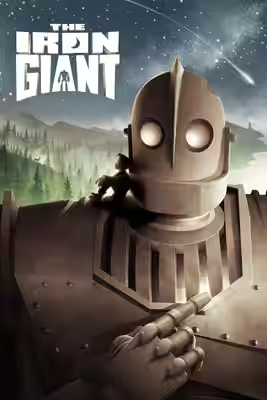
The Iron Giant poster

The Iron Giant

1999 · Another unlikely friendship whose humour makes its fear of outsiders matter.

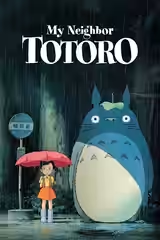
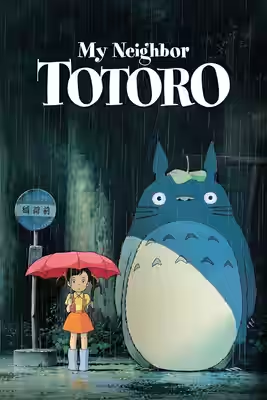
My Neighbour Totoro poster

My Neighbour Totoro

1988 · Children meet unfamiliar creatures, and the film takes their feelings seriously.

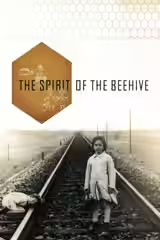
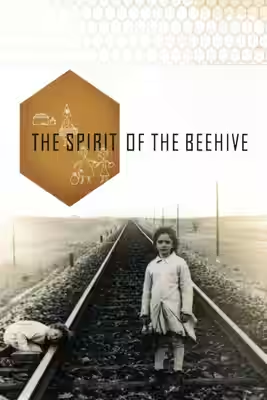
The Spirit of the Beehive poster

The Spirit of the Beehive

1973 · A quieter, more unsettling child’s encounter with the idea of a monster.

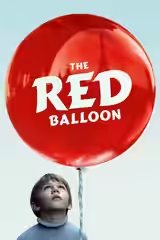
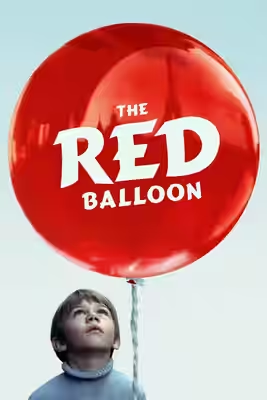
The Red Balloon poster

The Red Balloon

1956 · A child’s attachment to something extraordinary, told with little need for words.

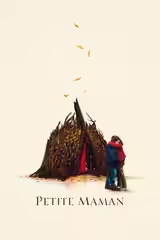
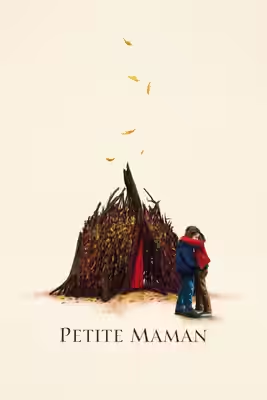
Petite Maman poster

Petite Maman

2021 · Childhood fantasy makes difficult family feelings easier to approach without explaining them away.