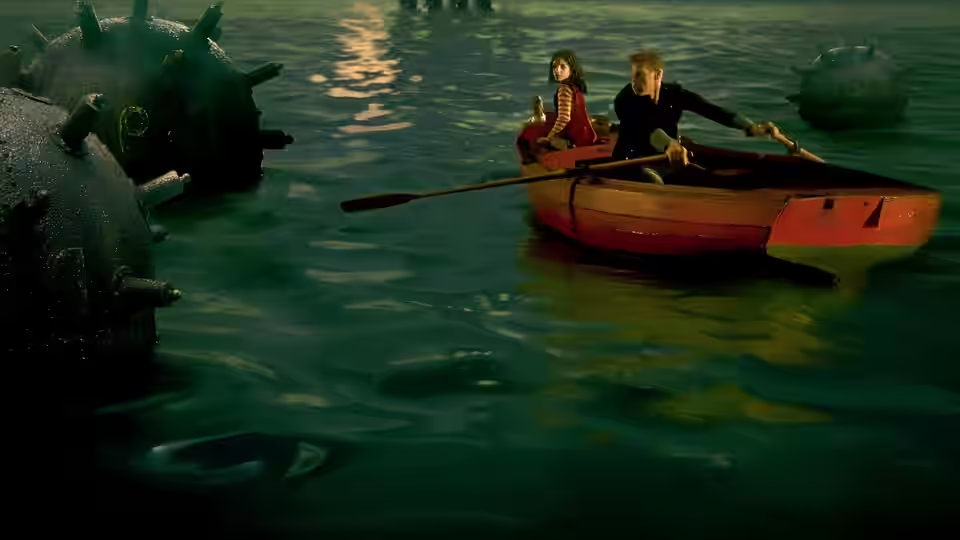
There is a moment about halfway through The City of Lost Children (1995) when a small girl cries, and a single tear falls, and the tear sets off a spider, and the spider sets off a bird, and within a minute the consequences have run several streets away and a ship is piling into the harbour wall. It is a joke, a Rube Goldberg machine built out of a whole city, and it is also the film explaining itself. Everything here is connected to everything else. Pull one thread and the whole town moves.
Jean-Pierre Jeunet and Marc Caro had made Delicatessen (1991) four years earlier, a black comedy about a butcher in a building where the tenants are the meat, and it had done well enough that someone gave them ninety million francs. This was, at the time, one of the most expensive films ever made in France. They spent it on a city. Not a location dressed to look like one: a city built from scratch on soundstages outside Paris, with a harbour and an oil rig and streets that lean in over the people walking down them, lit by Darius Khondji in greens and rust and the colour of old brass. Nothing in it is quite the right size. That is deliberate, and it is the first thing you should know about how the film tells its story: the world does the work before anyone says a word.
What happens
Out on a rig in the fog lives Krank, played by Daniel Emilfork, a man who was made rather than born and who came out wrong. He cannot dream, and without dreams he is ageing fast, so he has children kidnapped from the port and wired to a machine that lets him borrow theirs. It never works, because the children are terrified of him and all he ever gets is their nightmares. He lives with the rest of the failed experiment: six identical clones who cannot agree which of them is the original, all played by Dominique Pinon; Mireille Mossé's Miss Bismuth, who keeps house; and Irvin, a brain in a fish tank who talks through a gramophone horn and is the only one of them with any sense.
In the town, a circus strongman called One, played by Ron Perlman, loses his little brother to the kidnappers. One is enormous, gentle and not clever, and he goes looking with the single-mindedness of a man who has only ever had one idea at a time. He falls in with Miette, a nine-year-old thief played by Judith Vittet, who works for a pair of conjoined twins called the Octopus and who is far more grown up than he is. She takes him on. The rest of the film is the two of them working their way from the streets to the rig, through a flea trainer whose fleas carry a poison that turns the bitten on whoever is nearest, a cult of men who have swapped their eyes for machines, and the sea.
That is a lot of plot, and the film has been marked down for it since the day it opened Cannes. Our own review gives it a 78 and says the branching gets in the way of the pair at the centre. That is a fair reading. It is also, we think, slightly beside the point, because the film is not really telling you a story. It is telling you a world, and the story is how you get shown round.
Why it is extraordinary
Start with how much of it is done without dialogue. Perlman did not speak French, and learned his lines phonetically, so the directors gave him as few as they could and let his body act instead. One communicates by lifting things, by standing between Miette and whatever is coming, by the way his face works when he is trying to follow a conversation. It is a silent-film performance in a talking picture, and it means that when he does speak, the words land. Vittet, who was nine, is asked to be the adult in every scene, and is. The relationship between them is the reason the film is loved rather than merely admired, and Jeunet and Caro build it almost entirely from looks and gestures, in a film that could have drowned it in noise.
Then the design. Caro shared the production design with Jean Rabasse, and Jean-Paul Gaultier did the costumes, and between them they made a world where you can tell what everyone does and how much they are worth from across a room. The Cyclops in their leather and brass, with one mechanical eye and a listening device bolted where the ear should be. The clones in matching striped jerseys, bickering. Krank in a dressing gown, ancient before his time. The rule in fantasy is that a strange person needs somewhere to live, and here everyone has a home, a job and a way of moving that fits it. Terry Gilliam had been doing this since Brazil (1985); Jeunet and Caro took it further, and did it in French, and made it about children.
And then the mechanics of the storytelling itself, which is where the tear comes in. The film is full of chain reactions, sequences in which one small thing causes a bigger thing causes a bigger thing, and they are not decoration. They are how the plot moves. A child's Christmas dream that fills with Father Christmases until it is a nightmare, because the dreamer has noticed who is watching. A flea that bites the wrong man. A pickpocket's tear that sinks a ship. The film keeps demonstrating that in this city cause and effect run in straight, absurd lines, and it uses that to make a story with a dozen moving parts feel like one machine. You do not always know where you are. You always know that it connects.
Angelo Badalamenti's score, from the composer David Lynch had made famous, is the glue. It is tender when the pair are together and it goes sour, slowly, when the rig comes into view, and it carries the film across its odder digressions the way a fairground organ carries a fair. Hearing it now, it is startling how much of the film's feeling is in the music, and how little of that feeling is safe.
Why you should watch it
Because nobody makes them like this any more, and nobody made them like this before. The digital fantasy that arrived a few years later can build any world it likes and it usually builds the same one. This is a physical place, with weather, and the pleasure of it is the pleasure of a model railway built by someone with a genuinely disturbed imagination: you can see the joins and you do not want to.
Because it is a children's film for adults and an adult film for brave children, and that middle ground is almost empty. The nearest company is Spirited Away (2001), which is warmer, and Pan's Labyrinth (2006), which is crueller, and it holds its own with both. If you have a child of eleven or twelve who has grown out of being told everything will be fine, this is the film to show them. Some of it will frighten them. All of it will stay.
Because of what it led to. Jeunet went to Hollywood to make Alien: Resurrection (1997) and came back to make Amélie (2001), which is this film's design sense pointed at a nicer neighbourhood, and which the world took to its heart. Caro walked away from features almost entirely. The partnership made two films, and this is the bigger, stranger and less compromised of them, the one they made when they were allowed to do anything.
And because of the ending, which we will not describe, except to say that it pays off the dreams, and the rig, and the question of who the original is, in about four minutes and with almost no dialogue, and that it is one of the most satisfying pieces of storytelling we know. Get a little lost. It is the point.
Incredible storytelling
This is the first in a series about films that tell their stories in ways only film can: with pictures, design, sound and structure rather than with people explaining things to each other. Some will be famous and some will not. The test is that the story could not be told the same way in any other form. Nominations to the contact page.
Features are written by AI in Fi1m’s voice, checked against our reviews before publication, and corrected in the open. How we use AI