Film review

Contagion

2011 · Directed by Steven Soderbergh · 1h 46m · 12A

In a sentenceAn hour and three quarters of door handles, and we washed our hands twice on the way home

DramaThrillerScience Fiction

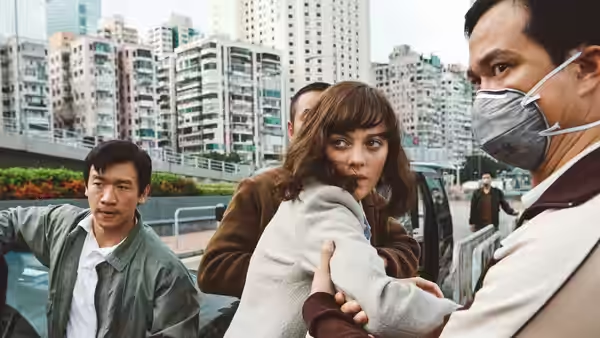
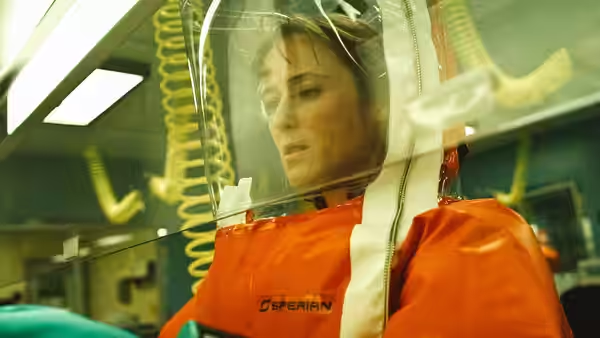
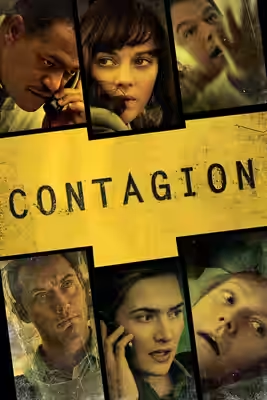
Beth Emhoff (Gwyneth Paltrow) flies home to Minneapolis from Hong Kong with a cough. Her husband Mitch (Matt Damon) tries to keep their daughter Jory (Anna Jacoby-Heron) indoors as the same illness turns up in cities across the world. In Atlanta, Ellis Cheever (Laurence Fishburne) sends field officer Erin Mears (Kate Winslet) to trace the outbreak, while Ally Hextall (Jennifer Ehle) tries to grow the virus in a laboratory. Leonora Orantes (Marion Cotillard) goes to Hong Kong to find the first case. And Alan Krumwiede (Jude Law), a blogger, tells his readers that the government is lying and that he knows a cure.

Fi1m review

Steven Soderbergh’s pandemic thriller is cold, quick and frightening in the way a good textbook is frightening. It cares more about how a virus travels than about anyone it kills, and for 106 minutes that is the right choice.

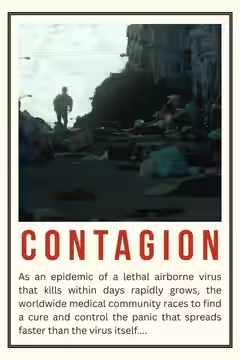
Steven Soderbergh’s pandemic film has the shape of a 1970s disaster picture, a dozen stars and a catastrophe that circles the globe, and then removes almost everything the genre usually spends its money on. Nothing burns and nobody outruns anything. What Scott Z. Burns’s script offers instead is a procedure: how a virus gets from a bowl of nuts in an airport bar to a hundred cities, and what doctors, officials and frightened people do in the weeks after. It is cold, quick and frightening in a way we did not shake off for days, and we like it a good deal more than most critics did.

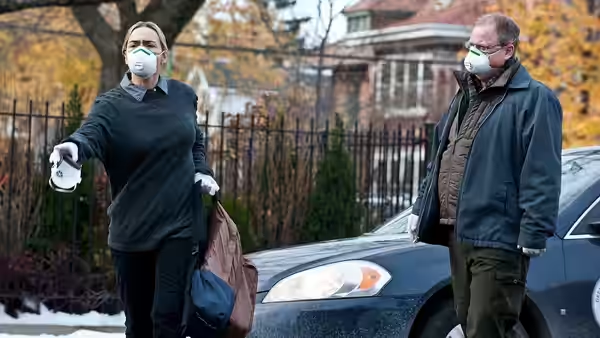
Soderbergh shot it himself, and the camera does the virus’s work. It settles a beat too long on a bus pole, a glass on a bar, a hand on a doorframe, and by the twenty-minute mark we were reading every hand on every surface as a threat. Minneapolis is lit grey-blue and Hong Kong a sickly yellow, so we know which city we are in before the caption arrives. Stephen Mirrione cuts between continents with those captions, city and population, and lets the numbers carry the dread. Cliff Martinez’s score is a low electronic pulse that quickens as the case count does, mixed low enough that we heard every cough.

The cast is large and Burns gives most of them one job and one scene to be human in. Jennifer Ehle is the best thing in the film as Ally Hextall, the laboratory scientist who works out what the thing is, and she plays her with patience and a faint irritation at everyone slower than she is. Kate Winslet’s Erin Mears is sent to Minneapolis to trace contacts and spends most of her time on a hotel phone explaining the arithmetic of infection to men who would rather not hear it. Laurence Fishburne gives Ellis Cheever the heavy stillness of a man who knows the public will not believe him. Matt Damon has the domestic strand as Mitch Emhoff, a husband who turns out to be immune and cannot see why that is meant to be a comfort.

Two moments got at us. The first is an autopsy a few minutes in, when a pathologist folds back the top of a scalp, stops, and tells his colleague to call everyone; the film cuts away before we see what he saw, and we flinched anyway. The second is Damon being told that his wife has died and asking when he can go and talk to her. He asks twice. It moved us more than we expected from a film this cool, because Soderbergh does not underline it. The doctor says her piece and leaves, and Damon is left in the corridor.

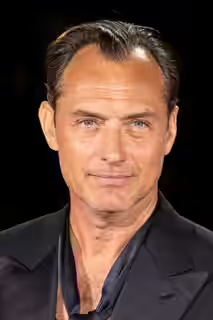
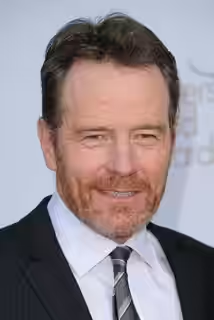
Not every strand holds. Jude Law’s Alan Krumwiede, a blogger, is written as the villain from his first line, and every scene with him is an argument the script has already decided he loses. Marion Cotillard’s Leonora Orantes flies to Hong Kong to find the first case, and her story then takes a turn we will not describe; the film has no time to make it land. Bryan Cranston, Elliott Gould and John Hawkes get a scene or two each and are set aside. Howard Cummings’s empty places, a school gymnasium turned into a ward, a pharmacy stripped to the shelves, say more than most of the supporting cast are allowed to.

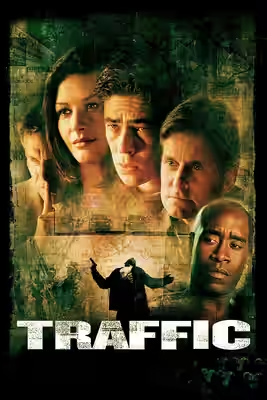
Soderbergh made Traffic (2000) as a film about the drug trade with many hands and no centre, and this is built the same way, with a virus in place of cocaine. Next to Outbreak (1995), with its monkey and its helicopters, it looks like the work of an adult. Most critics held its coolness against it. We think the coolness is the point: the film never once makes an epidemic exciting, which is the one dishonest thing it could have done.

It runs 106 minutes and carries a 12A, and the certificate is right; there is almost no blood, and everything it does to you is done with hands and surfaces. Watch it at home if you like. You will look at the remote afterwards, and then at your fingers.


Critical consensus AI synthesised

66
Positive
10
Mixed
5
Negative
2

Most critics find Contagion plausible and frightening, and the praise clusters on Soderbergh’s control: the pace, the documentary-style attention to how a virus actually spreads, and the decision to make the scientists the heroes rather than the stars. The ensemble is widely admired, with Jennifer Ehle’s turn as a researcher singled out more than once. The reservations cluster just as clearly. Many reviews, including several favourable ones, call the film cold or clinical, and say the large cast leaves few characters with room to make you care who lives or dies. The spread is wide. The New Yorker calls it brilliant and emotionally enveloping; Slant Magazine finds it a schematic, scare-mongering spectacle without human feeling, and Den of Geek thinks it turgid and dull. Several British reviews compare it unfavourably with Traffic. The consensus is respect for the craft, with doubts about the heart.

The New Yorker
19 September 2011 · David Denby
90*

The critic calls Soderbergh’s film brilliant, serious, precise, frightening, and emotionally enveloping—a highly controlled work about an out-of-control pandemic that confronts reality head-on without melodrama. It recovers the director’s mastery seen in Traffic.

Read the full review →
Empire
29 September 2011 · Dan Jolin
80*

The critic praises the film's plausible and frightening depiction of a pandemic spreading globally, highlighting its documentary-like approach and emphasis on science as the hero amid panic and societal breakdown.

Read the full review →
Time Out
18 October 2011 · ★★★★ · Dave Calhoun
80

It is a sober, engrossing thriller about the hysteria surrounding a worldwide epidemic. Soderbergh extracts a strong ensemble effort while holding a steady eye on panic and chaos.

Read the full review →
Los Angeles Times
9 September 2011 · Kenneth Turan
75*

The critic praises the thriller for moving stories along at an epidemic clip with expert choreography of its cast, making a film you can’t stop staring at despite its grim subject. It is effective but not perfect, with some plot strands less convincing than others.

Read the full review →
The Guardian
20 October 2011 · Peter Bradshaw
75*

The 1970s-style all-star disaster flick gets a slick modern update in Steven Soderbergh's global disease thriller. Soderbergh shapes the story with muscular confidence and captures some great images, though the film sometimes looks like a mosaic of mini-dramas and is less strong on the fear and horror of ordinary people.

Read the full review →
Screen Daily
3 September 2011 · festival review
70*

Chilly but sometimes truly scary, Steven Soderbergh’s Contagion tries to do for infectious disease what the director’s Traffic did for illegal drugs, though not as sure-footed. It features an impressive ensemble cast and ripped-from-the-headlines topicality.

Read the full review →

Cast

Stills

If you liked this, try…

Panic in the Streets poster

Panic in the Streets

1950 · Kazan chases plague through New Orleans docks with the same clock ticking.

The Andromeda Strain poster

The Andromeda Strain

1971 · Scientists in a bunker, a lethal organism, and almost no shouting.

Traffic poster82

Traffic

2000 · Soderbergh’s earlier many-handed film, with cocaine where the virus would be.

28 Days Later poster

28 Days Later

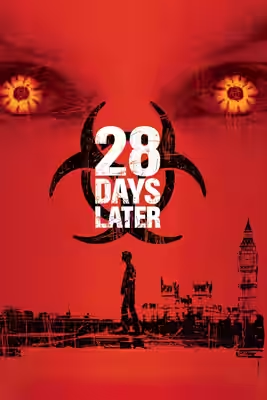
2002 · The same empty streets, filmed as horror rather than procedure.

Chernobyl poster

Chernobyl

2019 · Institutions fail, scientists argue, and the numbers do the frightening.