Ridley Scott’s survival adventure makes science and co-operation entertaining, with Matt Damon’s humour keeping the explanations lively. Watney’s loneliness is underplayed, but the practical problems hold our attention and the optimism earns our affection.
The Martian is an unusually cheerful survival film, and we recommend it for the pleasure of watching people think their way through trouble. Ridley Scott makes an astronaut stranded on Mars the centre of a story about useful knowledge and the willingness to share it. There is danger, but the film spends much of its time on the work required to stay alive. It gives us plenty to follow without requiring us to arrive with a scientific education.
Matt Damon is crucial to that choice: his Watney is resourceful, funny and sufficiently good company to keep the practical explanations from becoming homework. Drew Goddard’s screenplay, adapted from Andy Weir’s novel, gives him humour that belongs to the job of carrying on when giving up would be understandable. Damon makes the thinking interesting without asking us to applaud every solution. Watney’s jokes let us enjoy his company through explanations that could easily have become a string of instructions.
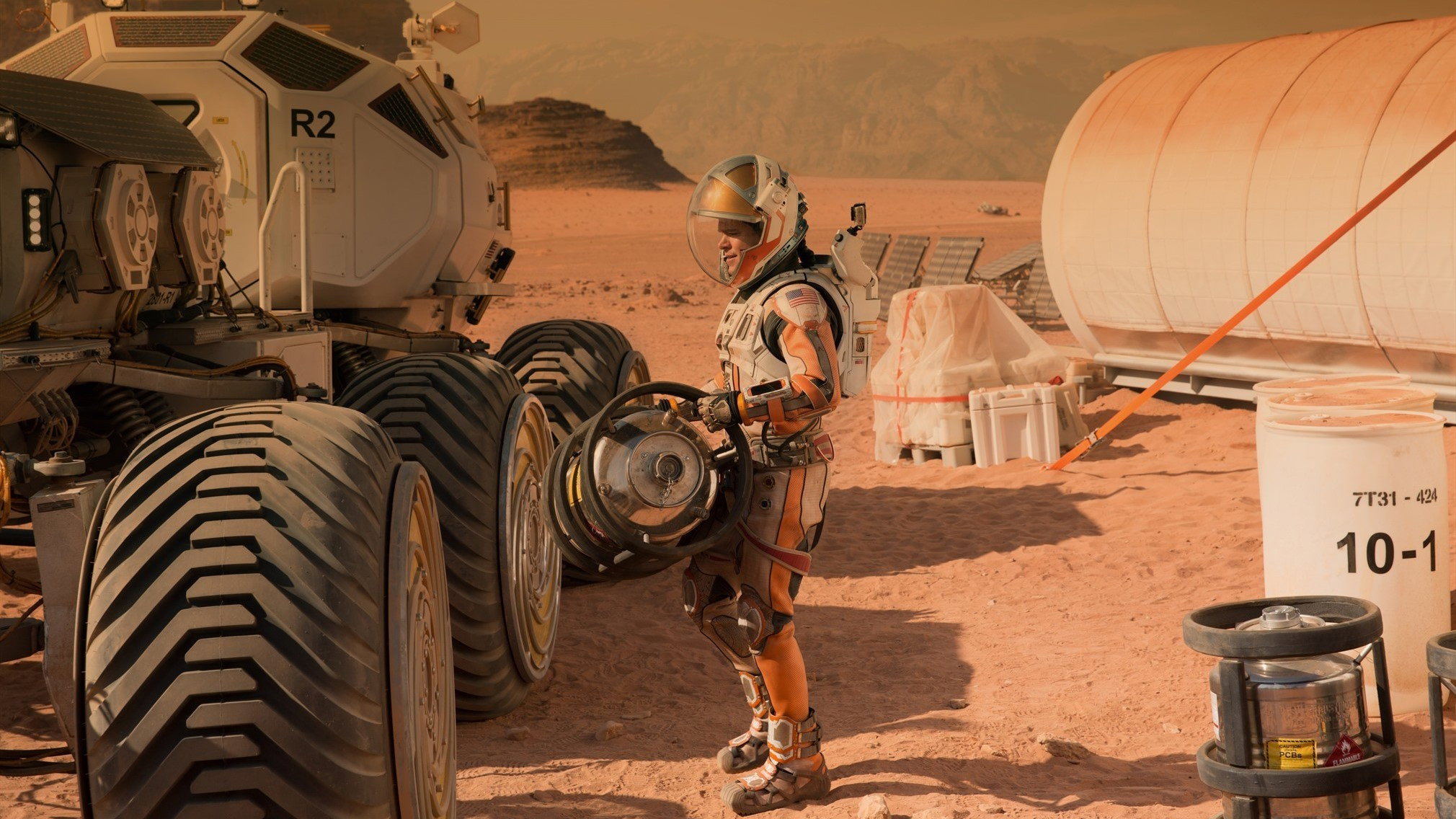
The business of growing potatoes in Martian soil is where the film’s priorities become clearest. Production designer Arthur Max makes the improvised farming feel like practical work, with an outcome worth worrying about, rather than a joke left over from a science lesson. We were more anxious about the potatoes than we expected to be. Once the film has made us understand that Watney’s survival depends on his own ingenuity, the prospect of getting something wrong is enough to hold our attention.
Dariusz Wolski’s cinematography gives Mars the scale the predicament needs, making the effort to keep one person alive seem daunting. Scott lets us enjoy the landscape, but the size of it suggests a degree of fear that Watney rarely seems to feel. His good humour can become a way of avoiding the harder questions about being alone. The film allows us to appreciate how far from help he is without spending much time on what that might do to him.
Pietro Scalia’s editing keeps the problem-solving legible as the story divides its attention between Watney and the people at NASA. We are given room to understand why a task is difficult before being asked to care about its solution. The collective effort is satisfying in its own right, though the supporting characters can feel defined chiefly by what they contribute to it. These passages broaden the story without displacing Damon, whose humour remains its most reliable pleasure.
Harry Gregson-Williams’s score supports the optimism, although the retro-pop soundtrack is more distinctive and better suited to Watney’s irreverence. The music helps keep the film light without making its scientific interests seem apologetic. Within science fiction, this confidence in patient work is welcome: understanding the difficulty is a large part of the entertainment. Scott trusts the audience to enjoy the process, and Goddard gives the technical material enough humour to keep it conversational.
At 141 minutes, the film has room to test our patience, yet the succession of tasks gives it a steady forward movement. We would have welcomed more uncertainty about Watney himself, but Scott’s confidence in the work remains persuasive. There is enough tension in the practical difficulties to make the lightness feel earned. Choose it when watching competent people do their jobs sounds like a welcome change.