James Mangold’s Dylan film is well made, well sung and well cast, and it has decided, honourably, that it cannot get inside its subject. The songs carry it; the drama between them mostly waits for the next one.
James Mangold has chosen four years and one question, and then declined to answer the question. His Bob Dylan turns up in New York in the winter of 1961 with a guitar and no past he will admit to, sings to Woody Guthrie in a hospital ward and is overheard by Pete Seeger. From there A Complete Unknown follows him through the Village clubs, the folk revival that adopts him and the point at which he stops wanting to be adopted. It is a handsome, careful, mostly patient film, and it is content to watch. The watching is the pleasure and the limit.
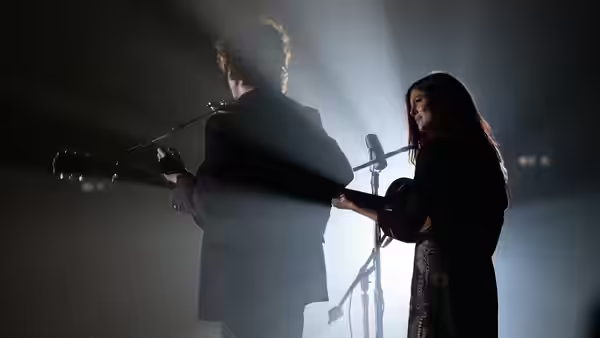
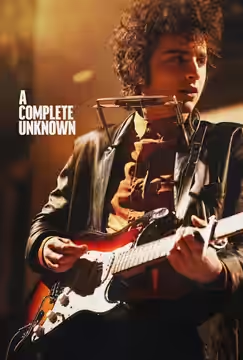
Chalamet plays Dylan as a boy who has settled what he is going to be before anyone thought to ask. The voice is there, pinched and nasal and swallowing the ends of lines, and so are the hunch over the guitar and the half-smile that arrives a beat after the joke. He sings the songs himself, and Mangold, with his editors Scott Morris and Andrew Buckland, lets them run. A verse plays out before we cut to the faces listening; a song is allowed to finish. In a genre that usually chops its music into montage, that restraint is the best decision in the film.
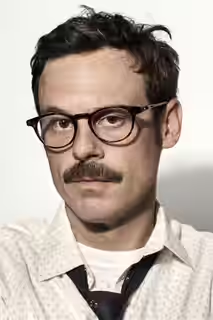
It pays off early. In the hospital scene Guthrie, played by Scoot McNairy without a usable word, lies in the bed while Chalamet sings to him, and Norton’s Seeger sits in the corner with his hat in his hands. Chalamet sings to the bed and not to the camera. McNairy answers with a flat hand on the blanket. We were moved, more than we had expected to be by a scene we knew was coming, and we were still turning it over an hour later.
Norton is the film’s other anchor. His Seeger is a decent man who believes a banjo is a tool for fixing the world, and Norton plays the decency without softening the stubbornness that goes with it; when Dylan starts to drift, the hurt on Norton’s face is the closest the film comes to an argument. Barbaro’s Baez is sharper than the lines she is given, sings beautifully and is the one person who tells Dylan off and means it. Fanning is handed a part built out of waiting by the phone and does what can be done with it, which is a good deal. Boyd Holbrook’s Johnny Cash strolls in a couple of times to be the devil on the shoulder and is plainly enjoying himself.
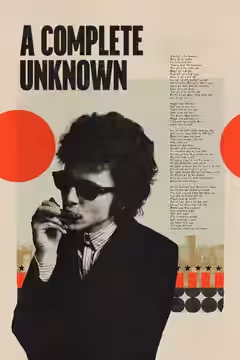
Phedon Papamichael shoots the Village in tobacco browns and low winter light, the clubs lit from the small stage so the faces in the audience are half in dark. François Audouy builds the rooms narrow and cluttered, with records on the floor and a radiator that seems to have been there since the war, and Arianne Phillips tracks the man through his clothes: the workshirt and cap of the first year, then the sunglasses, then the leather. It is very well done and none of it is showing off.
The trouble is the script, by Mangold and Jay Cocks. Every ten minutes somebody asks Bob what he means or who he is, and Bob does not say. That is true to the man and it is also a wall, and the film walks into it over and over without changing its approach. Around the middle, when the story moves from clubs to bedrooms, we noticed we were waiting for the next song, and the film seemed to be waiting too. The women in particular exist to be disappointed by him, and the film does not seem to have asked itself whether that was interesting.
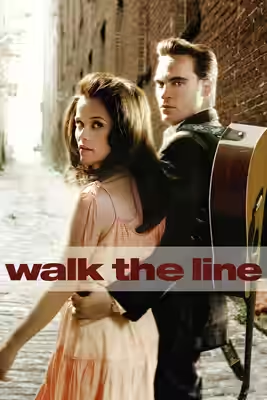
Mangold’s Walk the Line (2005) had a marriage to arrive at; this has an amplifier. Everyone knows where it is going, and the last stretch gets there at a run, with a lot of shouting about authenticity that the film has not quite earned the right to. Most of the reviews have been warmer than this, and we understand why: the singing is real and the period is right and the cast is strong from top to bottom. We simply came out knowing exactly as much about Bob Dylan as we went in with, which may be the point, but is not a great deal to carry home from 141 minutes.
See it for the songs, for Norton, and for that hospital room. Go with someone who owns the records; they will be happy the whole way through, and you can ask them on the way home what he meant.