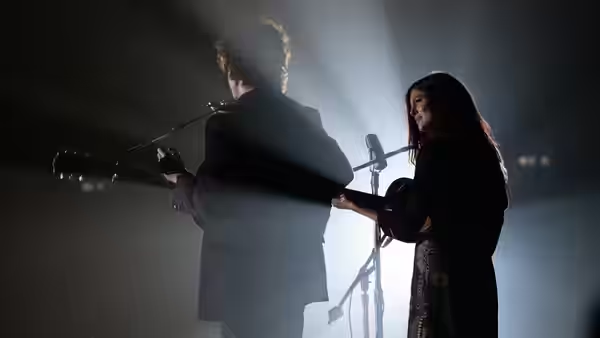
A guitarist performs on stage silhouetted against bright spotlight beams
Film review

A Complete Unknown

2024 · Directed by James Mangold · 2h 21m · CCC TE+7

In a sentenceTwo hours of people asking Bob Dylan who he is, and Bob Dylan lighting a cigarette

New York, the winter of 1961. A nineteen-year-old with a guitar and a borrowed accent arrives from Minnesota calling himself Bob Dylan (Timothée Chalamet), tracks down his hero Woody Guthrie (Scoot McNairy) in a hospital ward and sings him a song. Pete Seeger (Edward Norton), sitting at the bedside, hears something and takes the boy home. Over the next four years Dylan works the Greenwich Village clubs, falls in with an artist called Sylvie Russo (Elle Fanning), meets Joan Baez (Monica Barbaro) and acquires a manager in Albert Grossman (Dan Fogler). The folk movement claims him. James Mangold’s film follows him to the point where he decides he would rather not be claimed.

Plays from YouTube when you press play; nothing loads from them until then.

Fi1m review

James Mangold’s Dylan film is well made, well sung and well cast, and it has decided, honourably, that it cannot get inside its subject. The songs carry it; the drama between them mostly waits for the next one.

James Mangold has chosen four years and one question, and then declined to answer the question. His Bob Dylan turns up in New York in the winter of 1961 with a guitar and no past he will admit to, sings to Woody Guthrie in a hospital ward and is overheard by Pete Seeger. From there A Complete Unknown follows him through the Village clubs, the folk revival that adopts him and the point at which he stops wanting to be adopted. It is a handsome, careful, mostly patient film, and it is content to watch. The watching is the pleasure and the limit.

Chalamet plays Dylan as a boy who has settled what he is going to be before anyone thought to ask. The voice is there, pinched and nasal and swallowing the ends of lines, and so are the hunch over the guitar and the half-smile that arrives a beat after the joke. He sings the songs himself, and Mangold, with his editors Scott Morris and Andrew Buckland, lets them run. A verse plays out before we cut to the faces listening; a song is allowed to finish. In a genre that usually chops its music into montage, that restraint is the best decision in the film.

It pays off early. In the hospital scene Guthrie, played by Scoot McNairy without a usable word, lies in the bed while Chalamet sings to him, and Norton’s Seeger sits in the corner with his hat in his hands. Chalamet sings to the bed and not to the camera. McNairy answers with a flat hand on the blanket. We were moved, more than we had expected to be by a scene we knew was coming, and we were still turning it over an hour later.

Norton is the film’s other anchor. His Seeger is a decent man who believes a banjo is a tool for fixing the world, and Norton plays the decency without softening the stubbornness that goes with it; when Dylan starts to drift, the hurt on Norton’s face is the closest the film comes to an argument. Barbaro’s Baez is sharper than the lines she is given, sings beautifully and is the one person who tells Dylan off and means it. Fanning is handed a part built out of waiting by the phone and does what can be done with it, which is a good deal. Boyd Holbrook’s Johnny Cash strolls in a couple of times to be the devil on the shoulder and is plainly enjoying himself.

Phedon Papamichael shoots the Village in tobacco browns and low winter light, the clubs lit from the small stage so the faces in the audience are half in dark. François Audouy builds the rooms narrow and cluttered, with records on the floor and a radiator that seems to have been there since the war, and Arianne Phillips tracks the man through his clothes: the workshirt and cap of the first year, then the sunglasses, then the leather. It is very well done and none of it is showing off.

The trouble is the script, by Mangold and Jay Cocks. Every ten minutes somebody asks Bob what he means or who he is, and Bob does not say. That is true to the man and it is also a wall, and the film walks into it over and over without changing its approach. Around the middle, when the story moves from clubs to bedrooms, we noticed we were waiting for the next song, and the film seemed to be waiting too. The women in particular exist to be disappointed by him, and the film does not seem to have asked itself whether that was interesting.

Mangold’s Walk the Line (2005) had a marriage to arrive at; this has an amplifier. Everyone knows where it is going, and the last stretch gets there at a run, with a lot of shouting about authenticity that the film has not quite earned the right to. Most of the reviews have been warmer than this, and we understand why: the singing is real and the period is right and the cast is strong from top to bottom. We simply came out knowing exactly as much about Bob Dylan as we went in with, which may be the point, but is not a great deal to carry home from 141 minutes.

See it for the songs, for Norton, and for that hospital room. Go with someone who owns the records; they will be happy the whole way through, and you can ask them on the way home what he meant.


Critical consensus AI synthesised

73
Positive
19
Mixed
2
Negative
3

Most critics like it, and almost all of them like Chalamet. The praise clusters around his performance, which the reviews describe as far more than an impersonation, and around the fact that he sings and plays himself, so the music sequences carry real weight. Several also single out the supporting cast, with Norton as Seeger and Barbaro as Baez named most often, and the recreation of the Greenwich Village folk scene.

The reservations are about the film around him. A good number of otherwise warm reviews say it plays safe, leans on familiar biopic habits and offers little new insight into Dylan, who stays a distant figure. The spread is wide: The Times calls it lifeless and incurious, with the hero left a blank slate, while Den of Geek and The Wrap find it superficial and formulaic even as both praise the lead. At the other end, HeyUGuys and The Playlist regard it as close to faultless.

The AV Club
10 December 2024 · A- · Tomris Laffly
90

Mangold delivers an accessible, rousing biopic that gets close to Dylan’s enigma through strong performances, especially Chalamet’s, without propping up the hero’s likable traits alone.

Read the full review →
Evening Standard
10 December 2024
85*

The critic finds it a richly detailed biopic that engrosses even non-fans, highlighting Chalamet's extraordinary performance as far deeper than an impersonation and the film's capture of the era's music scene and cultural shifts.

Read the full review →
Radio Times
13 January 2025 · ★★★★ · Terry Staunton
80

Praises Chalamet’s convincing and complex interpretation of Dylan, highlighting his musical performances and the supporting cast, especially Norton as Seeger; notes some dramatic licence but overall a strong biopic.

Read the full review →
The New York Times
25 December 2024 · Manohla Dargis
80*

The critic finds the film an enjoyable fiction about Dylan's early years, anchored by Chalamet's ideal portrayal of the enigmatic, sometimes cruel singer. Chalamet's performance and the power of the music stand out as highlights.

Read the full review →
The Telegraph
16 January 2025
80*

Mangold delivers an accessible and rewarding biopic with a riveting central performance from Chalamet that captures Dylan's coolness, genius and truculence.

Read the full review →
Vulture
18 December 2024
80*

The film succeeds by focusing on the supporting characters’ experiences in Dylan’s orbit rather than trying to explain the man himself, with standout turns from Norton, Barbaro and Fanning.

Read the full review →

Straight answers AI written, from our review

Is A Complete Unknown worth watching?
A Complete Unknown is worth watching if you care about the songs, which Timothée Chalamet sings himself and which the film lets run to the end; we scored it 68. Between the music it mostly waits for the next number, and you will leave knowing no more about Bob Dylan than you arrived with. Take someone who owns the records.
How long is A Complete Unknown, and what is it rated?
A Complete Unknown runs 2h 21m and is rated TE+7 by the CCC in Chile. It is a drama and music film.
Where can I watch A Complete Unknown in Chile?
A Complete Unknown is streaming on Disney+ in Chile. Availability is checked daily; the links above go straight to each service.
How violent or frightening is A Complete Unknown, and is it suitable for children?
A Complete Unknown is not a violent or frightening film; its UK 15 certificate reflects language and adult relationships rather than anything alarming on screen. The review mentions smoking, drinking and a good deal of shouting, but no violence. Younger children will be bored by 141 minutes of folk clubs; teenagers who like the music will manage it comfortably.
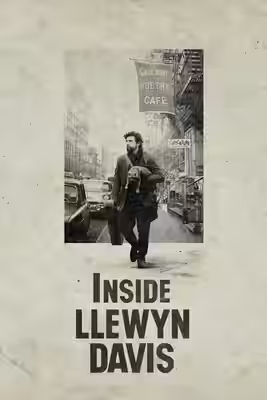
How does A Complete Unknown compare to Inside Llewyn Davis?
A Complete Unknown and Inside Llewyn Davis share the same Greenwich Village winter, but the Coens' film is the better one: funnier, sadder and more willing to say what it thinks of its singer. Mangold's film has the real songs and a strong cast, and declines to get inside its subject. Choose Dylan for the music, Llewyn Davis for the drama.
What should I watch after A Complete Unknown?
After A Complete Unknown, try I'm Not There (2007, Fi1m 74): Six actors play Dylan and none of them explains him either; a braver mess. Then Inside Llewyn Davis (2013, Fi1m 87): The same Village, the same winter, and the folk singer who did not make it; and Walk the Line (2005, Fi1m 78): Mangold’s Johnny Cash film, with a love story that actually goes somewhere.

Cast

If you liked this, try…

  1. I'm Not There (2007, Fi1m 74)Six actors play Dylan and none of them explains him either; a braver mess.

  2. Inside Llewyn Davis (2013, Fi1m 87)The same Village, the same winter, and the folk singer who did not make it.

  3. Dont Look Back (1967) · not reviewed yetThe real man, filmed on tour, being every bit as impossible as Chalamet suggests.

  4. Walk the Line (2005, Fi1m 78)Mangold’s Johnny Cash film, with a love story that actually goes somewhere.

  5. Control (2007, Fi1m 80)Anton Corbijn’s Ian Curtis film: black and white, Macclesfield, and a singer nobody could reach.

Free account

Know what to watch tonight

Two lists that know where things are streaming, collections you can share, your own score beside ours, and Discover that remembers what you have seen.

  • Want to see, sorted by what is streaming now
  • Seen, with your score out of ten
  • No adverts, ever