David Thacker films Ibsen plainly, closely and at length, and trusts Juliet Stevenson to carry it. She does: her Nora keeps a smile going long after the rest of her has stopped. Trevor Eve’s Torvald is less interesting, which is partly the point and partly a flaw.
Henrik Ibsen’s play has been shocking audiences since 1879, and David Thacker’s version does nothing to soften it and nothing much to open it out. At 136 minutes it keeps nearly the whole text, stays almost entirely inside the Helmers’ flat, and lets the actors get on with it. It is good; worth your evening if a filmed play does not put you off, and worth it chiefly for one performance.
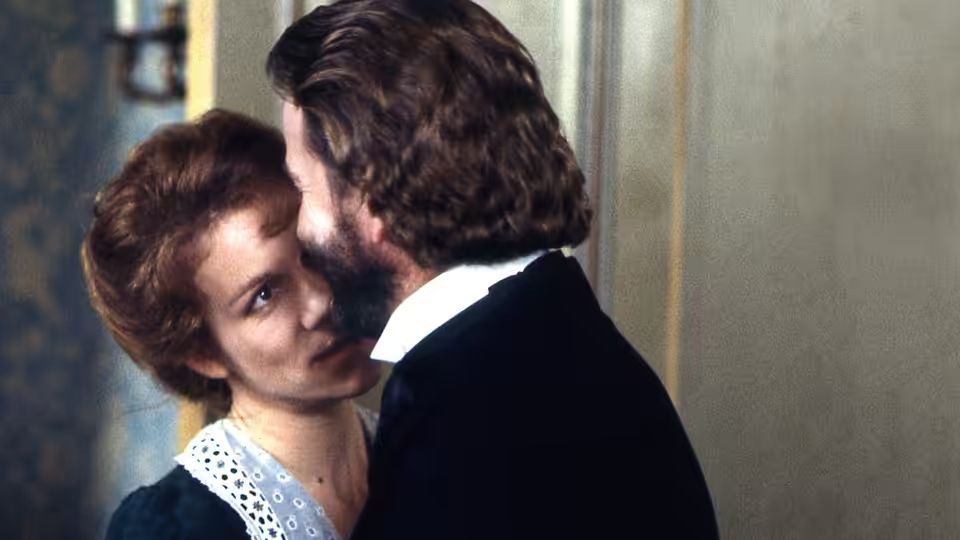
Juliet Stevenson plays Nora as a woman who has been performing happiness for eight years and has got so good at it she has half convinced herself. In the opening scenes she is all movement, tearing wrapping paper, crawling under the table with the children, popping a macaroon in her mouth and wiping the crumbs before Torvald comes in. It is a lot, and it is meant to be. The scene that told us the film would be all right is Krogstad’s first visit. Calder explains, patiently, what a forged signature means in law, and Stevenson’s Nora goes on smiling, and nodding, and offering him reasons, and the smile stays while everything behind it empties out. We found we were holding our breath and could not have said when we had started.
Trevor Eve has the harder and less rewarding job. His Torvald is a man who believes he is kind, and most of the time the film agrees he is not cruel so much as fond of the arrangement. The pet names, the little lectures about debt, the hand on the back of the neck: Eve plays them as habits rather than threats, which is right. The flaw is that he plays the prig from the first scene. We can see where this marriage is going before Nora can, and the final confrontation has less distance to travel than it should. We will not describe that ending, though it has been famous for well over a century. We will say Stevenson earns it and Eve is slightly left behind by it.
Around them the casting is strong and unshowy. Patrick Malahide’s Dr. Rank is dry, amused and dying, and his scene alone with Nora, in which he tells her something he had meant never to tell her, is the quietest thing in the film and one of the best. Geraldine James gives Kristine Linde a hardness the part often lacks; this is a woman who has buried a husband she did not love and is not going to pretend otherwise. David Calder’s Krogstad is the surprise. He plays the blackmailer as exhausted rather than villainous, a man who has done one bad thing and been paying for it ever since, and the film is more frightening for it.
Marjorie Pratt’s flat is comfortable, warm and slightly too full: a stove, a piano, a Christmas tree that gets bigger as the three days pass, lamps everywhere. It looks like a place a woman has spent years making nice because she was not allowed to do anything else, and the camera sits inside it close enough that we start to feel the walls. Guy Woolfenden’s music is used sparingly and is at its best when it is not there; the long stretches of two people talking in a room play against silence, and St. John O’Rorke holds his shots on faces for longer than most editors of the period would have dared. When Nora rehearses her tarantella and Torvald corrects her steps, the cutting stays on her and lets us watch her dance herself towards something.
The length tells. The middle act, which is where Ibsen tightens the screws, is also where the film stops moving; two long visits, a letter in a box, a great deal of waiting. We looked at the clock once and were not proud of it. A braver adaptation might have trimmed. This one would rather be complete than quick, and we understand the choice without entirely sharing it.
The only review we have read calls Stevenson’s Nora a transformation from dutiful wife to liberated woman. We would put it differently. What Stevenson shows is a woman who was always capable of this and had nowhere to put it. That is a harder thing to act and she does it with her hands as much as her voice; watch where they go, and when they finally stop.
Watch it at home with the lights down and the phone in another room. It was always a chamber piece, and this is a chamber.