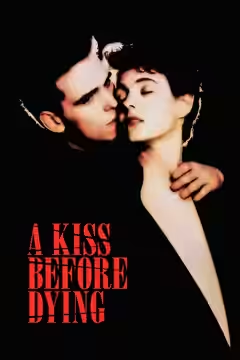
Matt Dillon supplies credible charm and menace, but James Dearden’s thriller gives him unconvincing relationships and too little suspense. The handsome finish cannot disguise a screenplay that keeps its heroine several steps behind the audience.
James Dearden’s A Kiss Before Dying has a promising centre in Matt Dillon and too little suspense around him. It is a poor thriller, with enough polish to suggest that something more involving ought to be happening. Adapting Ira Levin’s novel for the screen, the director depends on the difference between Jonathan Corliss’s agreeable manner and his psychopathy. That gives his leading actor something to play, although the screenplay too often expects everyone else’s slow understanding to keep the story moving.
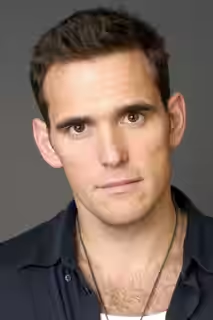
Matt Dillon is worth watching because he does not advertise each change in Jonathan Corliss’s manner. His charm is credible, and he lets the unpleasantness show without discarding it, so the performance makes sense as a way of getting close to people. We were briefly unsettled by how little his friendly manner had to change to become threatening. The trouble is that his control is doing work the surrounding scenes ought to share.
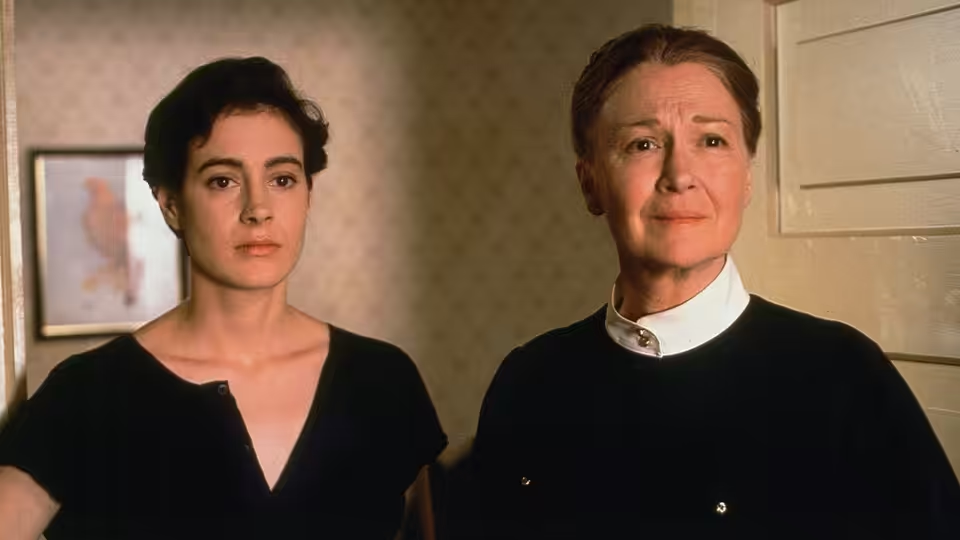
Sean Young, playing Ellen and Dorothy Carlsson, has the more exposed assignment. The screenplay asks the heroine to overlook clues that have already registered with us, and she cannot make that delay convincing. Her dual performance offers too little distinction or feeling to compensate, while her scenes with Matt Dillon lack the attraction that might explain such poor judgement. Once we start waiting for a character to notice the obvious, concern gives way to impatience. That is a serious problem for a thriller built around misplaced trust.
Mike Southon’s cinematography gives the film a composed, attractive surface, and Jim Clay’s production design helps make that finish coherent. Those are real virtues: there is no reason a crime thriller must look grubby to feel dangerous. Yet the handsome presentation seldom makes Jonathan Corliss’s company more uncomfortable, or gives his charm an extra edge. The film looks assured even when the scenes are struggling to hold our attention.
Michael Bradsell’s editing cannot solve the problem of a story that makes us wait for people to catch up. The delays become conspicuous because James Dearden has not made the heroine’s failure to understand sufficiently plausible. Howard Shore’s music offers some unease, but it cannot give these encounters the force missing from the relationships and writing. At 95 minutes, the film is hardly sprawling; it still contains stretches in which our attention has little to settle on beyond the leading man.
A thriller can let us recognise a dangerous man early and still frighten us, provided we believe the people who do not. It can also make their mistakes interesting enough that we keep following them despite ourselves. The director never gives the relationships that degree of conviction, and the familiar suspense situations offer little distraction from their weakness. Knowing that somebody is dangerous becomes tiresome when the film keeps postponing everyone else’s understanding of it.
There is a limited pleasure here for anyone interested in watching a capable actor find small variations inside a familiar part. Anyone coming for a persuasive relationship or a sustained sense of threat will have a less rewarding evening. The professional finish makes the weak writing more frustrating, because the film has plainly received care elsewhere. Make time for it only if Matt Dillon’s performance is the attraction.