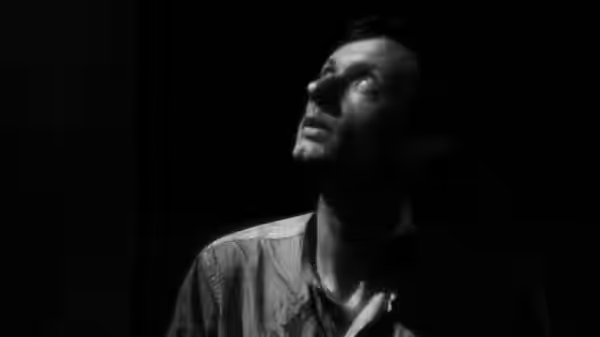
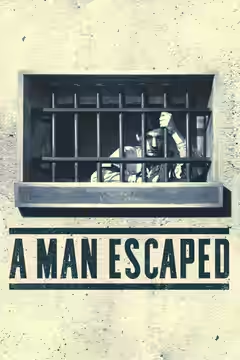
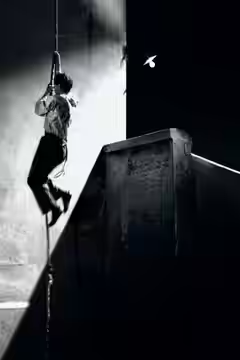
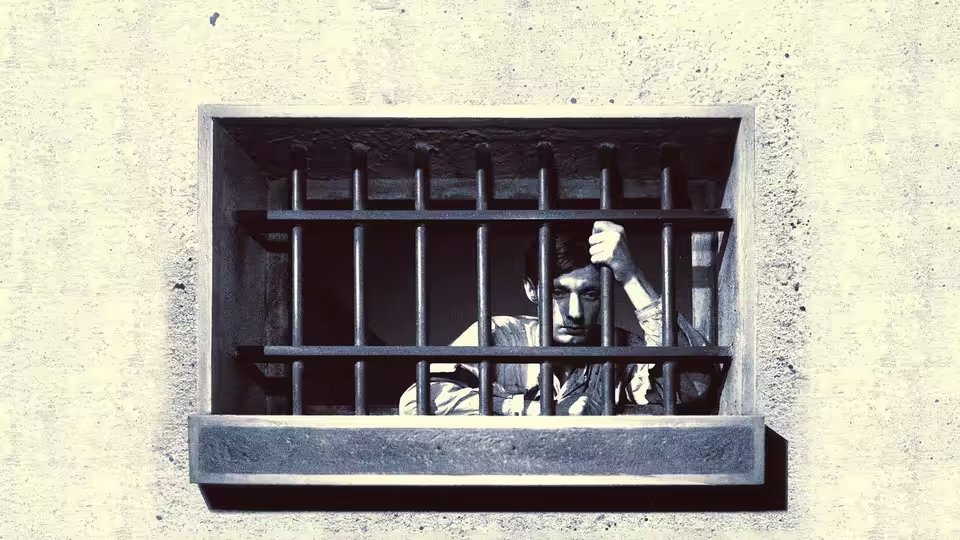
Fontaine peers through barred prison-cell window, raising a hand beside the iron bars
Film review

A Man Escaped

1956 · Directed by Robert Bresson · 1h 41m

In a sentenceA prison film that had us worrying our own breathing was too loud

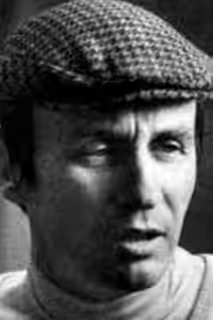
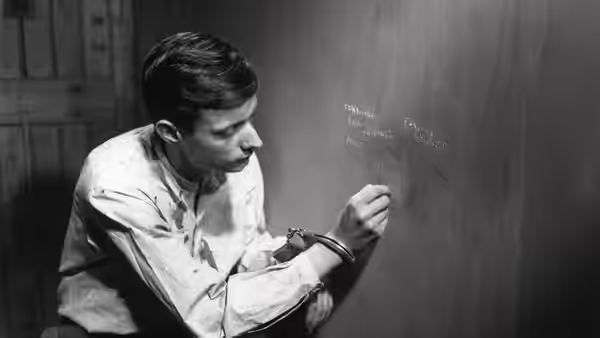
Fontaine (François Leterrier) wants to get out of prison. Steel bars stand between him and freedom, and resourcefulness must supply what force cannot. He studies the obstacles around him, attending to the sounds of confinement while working towards a possible escape. Blanchet (Maurice Beerblock) and Orsini (Jacques Ertaud) are among the other prisoners. Robert Bresson’s drama follows the practical business of preparing to leave a place built to prevent it, where patience, ingenuity and the ability to keep working under pressure matter to every decision.

Plays from YouTube when you press play; nothing loads from them until then.

Fi1m review

Robert Bresson’s prison thriller makes painstaking preparation engrossing, with sound carrying much of the danger. The restraint can keep the other prisoners at a distance, but we recommend it warmly, and with the telephone out of reach.

Robert Bresson’s A Man Escaped makes the practical work of getting out of prison absorbingly tense, and we would recommend it even to people who think they dislike prison films. At 101 minutes, it gives ingenuity and waiting the attention usually reserved for a confrontation. The interest lies in how a confined man learns to use what little is available to him, and how much concentration that requires. We come to care about the work because the film makes us understand its difficulty.

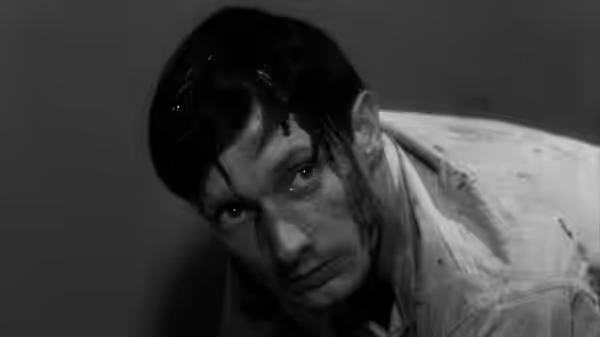
François Leterrier plays Fontaine with a restraint that suits this attention to practical matters. We do not need a display of anguish to register the strain; his concentration is enough. The performance can seem remote at first, particularly if we expect a prisoner to explain himself or make an appeal for our sympathy. Gradually, we stop asking for that and become absorbed in watching him think about what he must do next.

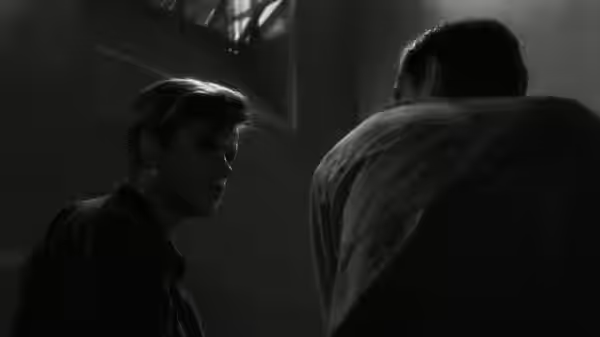
Léonce-Henri Burel’s cinematography and Pierre Charbonnier’s production design make the confinement physically convincing. The steel bars look solid and unremarkable, which is just what they need to be. The prison never becomes picturesque enough to distract us from the problem of being stuck inside it. That matters to the suspense, because the ingenuity of the preparations would count for less if the building felt like a collection of conveniently soluble problems.

We felt trapped by the sounds of incarceration. Their prominence makes it hard to relax, even when our attention wants to stay with the preparations, and that divided attention becomes exhausting. Robert Bresson makes listening feel necessary, involving us in the effort of staying alert while there is work to be done. We begin attending to what might interrupt that work, and the smallest possibility of interruption acquires an unreasonable importance.

Raymond Lamy’s editing gives the preparations enough time for their difficulty to register. Hurrying through them would lose the effort involved, and much of the anxiety comes from understanding how much patient work an interruption might undo. The use of Mozart’s music brings warmth into this restrained film without making the imprisonment feel any less severe. It allows a fuller expression of feeling than the performances generally permit, and the relief of hearing it matters.

There is a limitation to this concentration on the task. The other prisoners can feel held at a distance, and we sometimes wanted a fuller sense of them beyond their place in Fontaine’s ordeal. Anyone hoping for a broad account of prison life will find less of that here than the setting might promise. This is a real cost of the restraint, though it never weakened our concern for the preparations or our apprehension about their risks.

Within the prison-break thriller, this is an unusually patient account of the work involved. It takes ingenuity seriously enough to let us appreciate the thought and effort behind it, without needing to congratulate its central character. There is spiritual weight in that endurance too, though we need not settle its meaning before responding to the strain on screen. Give it a quiet room; this is a film we would hate to have talked over.

Critical consensus AI synthesised

87
Positive
6
Mixed
2
Negative
0

Most critics respond enthusiastically to A Man Escaped, with praise concentrated on Bresson’s restraint, the claustrophobic setting and the use of sound to build tension. The reviews repeatedly emphasise the attention to practical ingenuity and endurance, finding the escape story compelling without conventional embellishment. Several also see a spiritual dimension in its treatment of imprisonment and human reliance. Slant Magazine specifically credits the sound design with making that less tangible dimension felt.

The apparent spread needs a qualification: the six positive reviews offer clear endorsements, while the two entries classified as mixed have no verifiable verdict or detailed criticism available. There is therefore no documented cluster of reservations to set against the praise. Among the accessible responses, differences concern emphasis rather than approval: some focus on the mechanics of escape and the sounds of incarceration, others on religious meaning or the emotional force of Mozart’s music.

Radio Times
★★★★★ · Adrian Turner
100

Turner calls the film a great classic of European art cinema. He praises Bresson’s hypnotic, restrained approach and its influence on later prison films.

Read the full review →
Slant Magazine
17 January 2012 · ★★★★/4 · Jaime N. Christley
100

The critic regards the film as an exceptional, quintessential Bresson work that rises beyond its straightforward escape story. They single out its uncanny sound design for helping convey the story’s intangible spiritual dimension.

Read the full review →
Time Out
17 January 2012 · ★★★★★ · David Fear
100

Time Out gives the film its top rating, indicating a strongly positive verdict. The available description singles out its tale of steel bars and iron will.

Read the full review →
Empire
9 June 2006 · David Parkinson
90*

Parkinson regards the film as a compelling, masterful work and a pinnacle of French cinema. He especially praises Bresson’s claustrophobic setting and masterly use of the sounds of incarceration.

Read the full review →
Evening Standard
10 April 2012
90*

The critic presents the film as an extraordinary, spiritually resonant study of endurance, ingenuity and redemption. They single out its austere sound-driven tension and the final escape, where the prisoners’ mutual reliance gives the story its religious meaning.

Read the full review →
The New Yorker
15 October 2006 · David Denby
90*

Denby calls the film the greatest prison-break movie and finds its ending elating. He singles out the meticulous, resourceful escape and the way Mozart’s music intensifies its emotional force.

Read the full review →

Straight answers AI written, from our review

Is A Man Escaped worth watching?
A Man Escaped is worth watching for its engrossing prison-break preparations and suspense built around sound; we score it 90 out of 100. We recommend it even to those who usually avoid prison films, though its restrained performances and narrow focus can leave the other prisoners feeling distant.
How long is A Man Escaped, and what is it rated?
A Man Escaped runs 1h 41m. It is a drama and thriller film.
Where can I watch A Man Escaped in Ireland?
A Man Escaped is not on any streaming or rental service in Ireland at the moment. It is available in 9 other countries; change your country at the top of the page to see where. Availability is checked daily.
How violent or frightening is A Man Escaped, and is it suitable for children?
A Man Escaped is intensely tense rather than reassuring viewing for children, with no UK certificate supplied and a US NR designation that offers no age guidance. We find the sounds of confinement and the threat of interrupted preparations exhausting in their suspense. That supports caution for viewers sensitive to tension, but does not establish how graphic its violence is.
How does A Man Escaped compare to The Lives of Others?
A Man Escaped is our stronger recommendation for concentrated suspense, while The Lives of Others suits those wanting a more openly humane surveillance thriller. Both make listening tense and hold feeling back, but Bresson concentrates on patient physical preparation at some cost to the supporting prisoners; the comparison film’s faith in personal goodness can make its brutal political system seem too easily understood.
What should I watch after A Man Escaped?
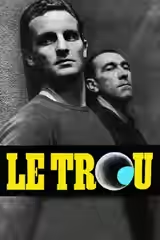
After A Man Escaped, try Le Trou (1960, Fi1m 88): Another patient prison escape, with tools and trust given equal weight. Then The Lives of Others (2006, Fi1m 84): For suspense built around listening, and feeling held back until it matters.

Cast

If you liked this, try…

  1. Le Trou (1960, Fi1m 88)Another patient prison escape, with tools and trust given equal weight.

  2. Escape from Alcatraz (1979) · not on Fi1m yetFor the same satisfaction of watching stubborn, practical work become suspense.

  3. The Ascent (1977) · not on Fi1m yetA harsher wartime ordeal, with a similarly serious interest in faith.

  4. All Is Lost (2013) · not on Fi1m yetOne isolated man solves immediate problems while danger keeps narrowing his options.

  5. The Lives of Others (2006, Fi1m 84)For suspense built around listening, and feeling held back until it matters.