Nick Broomfield’s documentary makes a compelling enquiry into the dealings around Aileen Wuornos, but gives her claims too little scrutiny. It is worth following for the search, with substantial reservations about what it establishes.
Aileen Wuornos: The Selling of a Serial Killer is an unsettling documentary whose director is too ready to accept its subject’s account. Nick Broomfield follows the publicity and dealmaking around Aileen Wuornos, finding enough competing interests to make his own enquiries part of the story. That pursuit gives the film momentum even when it brings him no closer to a satisfactory account of the killings. We would recommend it to those interested in the handling of criminal cases, rather than anyone seeking a full explanation of this one.
Steve Glazer is the lawyer, Mike Reynolds the biographer, and Tyria Moore is Aileen Wuornos’s girlfriend. Those descriptions establish different relationships to the same woman; they do not establish who deserves our confidence. The film is good at making us notice how readily proximity to a subject can pass for authority. Its attention to the business around the case also gives it a sour humour, though the possibility that somebody might profit from a story is never, by itself, a reason to disbelieve them.
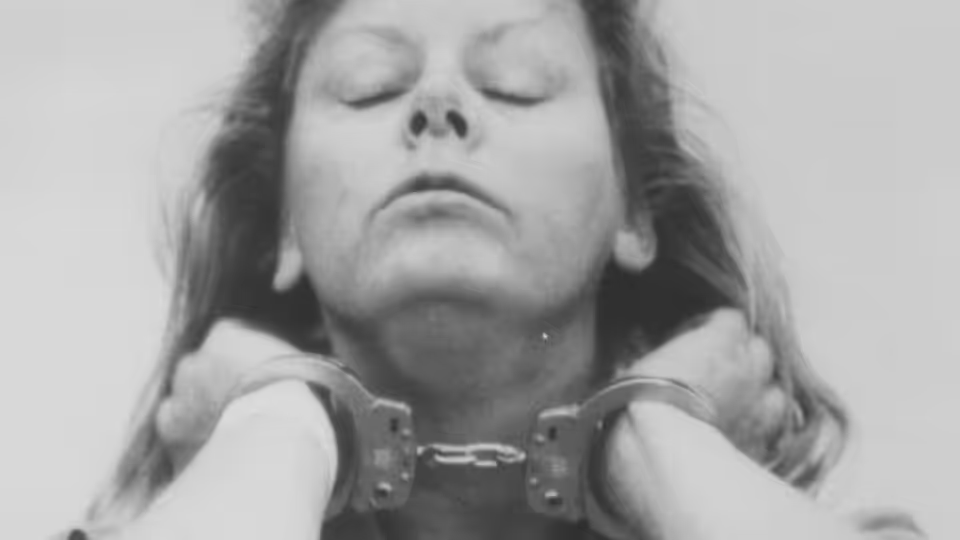
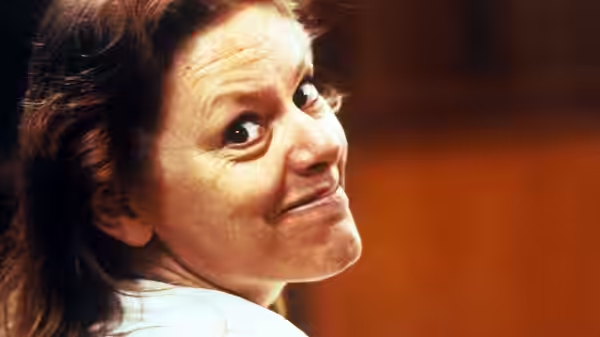
We were upset by the court videos, which bring Aileen Wuornos herself into focus amid the publicity surrounding her. For a while, the deals cease to be the most pressing thing to think about. The footage makes the film’s sympathy understandable, and it would be a poorer documentary without that sympathy. It also makes the need to examine her account more urgent, because feeling for someone can make us less willing to question them.
Barry Ackroyd’s cinematography gives the investigation a useful directness, though the presence of a camera is no guarantee that anybody is being candid. Editors Richard M. Lewis and Rick Vick keep the search moving across the 87 minutes, and that is a substantial part of the film’s appeal. There is a reason to follow the next enquiry even when we doubt it will resolve much. David Bergeaud’s music has less effect on us than the court footage. The film is most unsettling when the people connected to the case have our full attention.
The weakness is the treatment of Aileen Wuornos’s claims of self-defence. Nick Broomfield does not press them hard enough or give the evidence against them sufficient attention. This leaves us poorly equipped to judge what the film’s sympathy rests on. Showing that people have an interest in selling her story cannot establish whether her version of it is true. The film needs more patient examination here, even at the cost of some of the momentum generated by the search.
An investigative documentary does not have to solve its case to justify itself, and the frustration of a search can be worth recording. What matters is whether we come away knowing more about why the answers have proved difficult to obtain. Nick Broomfield gives us some sense of that difficulty, and enough human complication to hold our attention, without making the crucial claims easier to assess. That leaves a useful, troubling film for viewers willing to do some further questioning. We would not use it as the last word on Aileen Wuornos’s account of the killings.