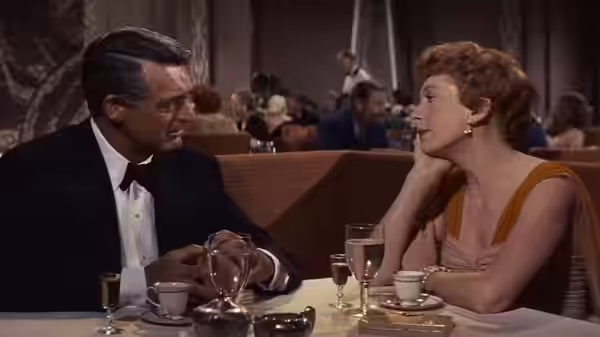
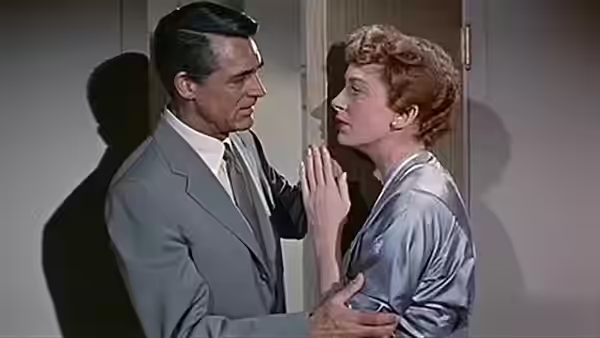
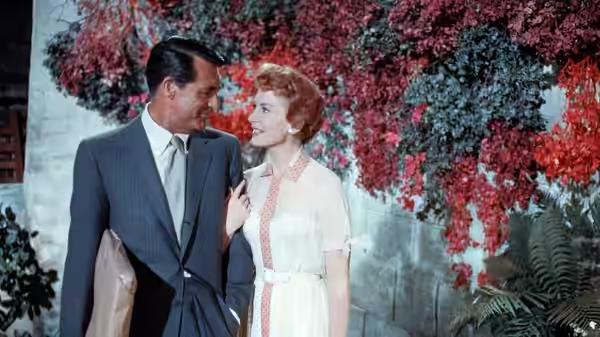
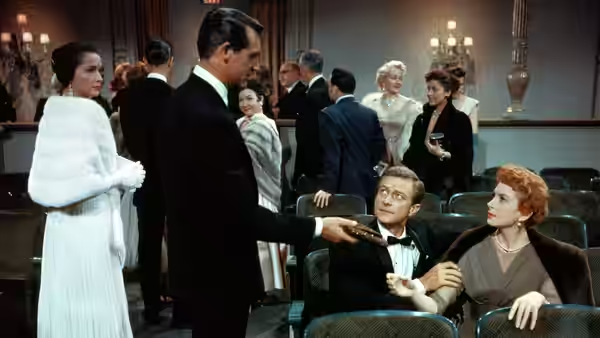
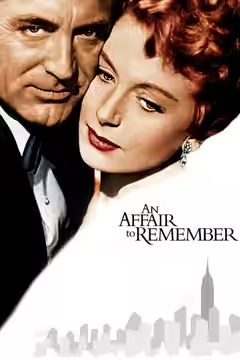
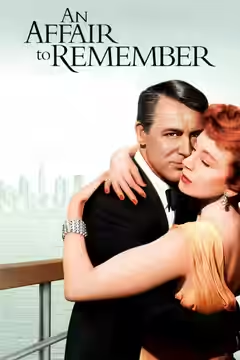
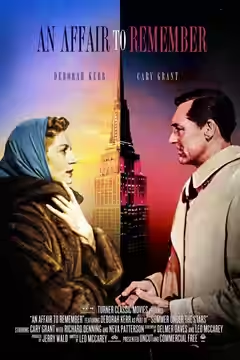
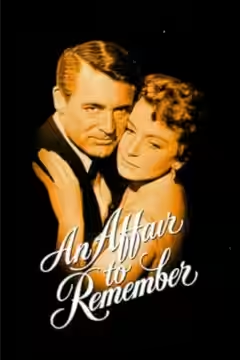
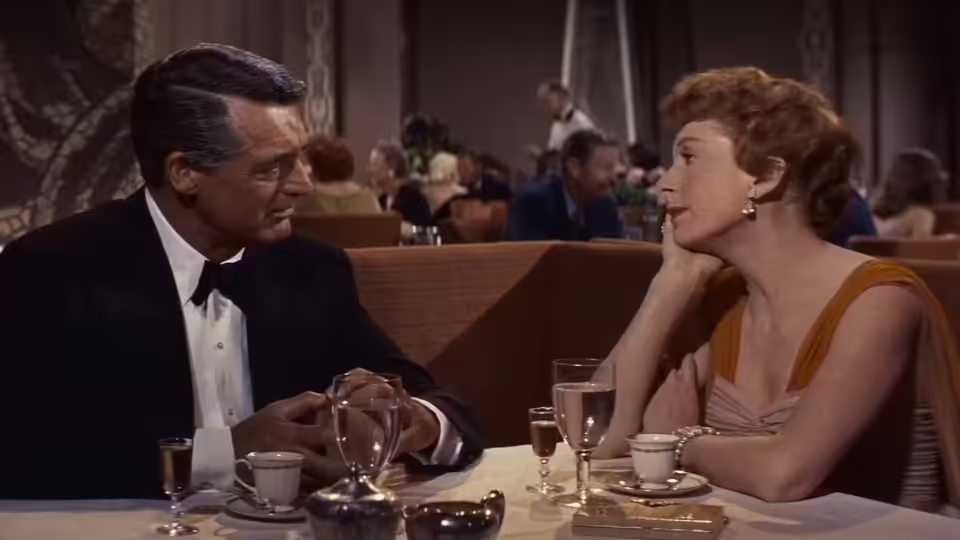
Nickie Ferrante (Cary Grant) and Terry McKay (Deborah Kerr) talk over dinner
Film review

An Affair to Remember

1957 · Directed by Leo McCarey · 1h 51m · FSK 12

In a sentenceCary Grant can manage a romance with a pause; the film insists on taking several

Nickie Ferrante (Cary Grant) and Terry McKay (Deborah Kerr) begin a romance aboard a ship. Their courtship moves through teasing exchanges towards a first kiss, with each trying to judge how seriously to take the attraction. Grandmother Janou (Cathleen Nesbitt), Kenneth Bradley (Richard Denning) and Lois Clark (Neva Patterson) also figure in their story. For now, the voyage gives Nickie and Terry time together, and their conversations turn flirtation into something neither can dismiss as a passing amusement.

Fi1m review

Cary Grant and Deborah Kerr make An Affair to Remember worth its stretches of delay. Leo McCarey’s romance is funny and affecting when it trusts them, less persuasive when it presses for sentiment.

Leo McCarey’s An Affair to Remember is a good romance with a habit of keeping its lovers waiting longer than they need to. We recommend it for Cary Grant and Deborah Kerr, whose humour makes the sentiment easier to accept. The shipboard courtship gives them time to test one another without making every exchange a declaration. The director understands the pleasure of watching two people enjoy a conversation while trying to conceal how much the other person’s opinion matters.

Cary Grant makes Nickie Ferrante’s charm seem practised but susceptible to interruption. His restraint is important: he leaves room for Deborah Kerr to answer, and the comedy depends on our attending to both of them. There is something touching about a confident performer allowing another person to unsettle his timing. We do not need Nickie to become solemn before we believe that his feelings might be serious, and the performance avoids insisting on that change.

Deborah Kerr gives Terry McKay enough composure to make her participation in the flirtation feel like a choice. She is an attentive comic partner, with a reserve that encourages us to look closely at her responses. We were moved by the first kiss. Its gentle staging preserves the restraint of the earlier exchanges, so the tenderness feels like something these particular people have arrived at together. Nothing in the performances needs to be forced to make the moment count.

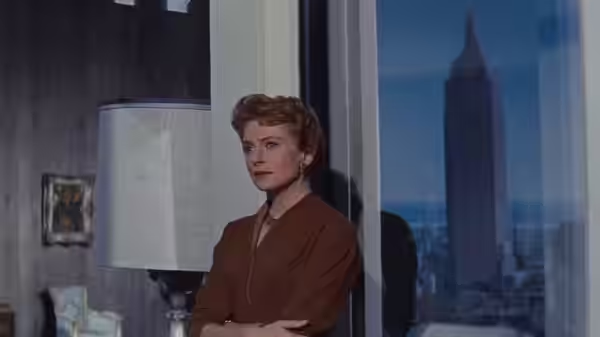
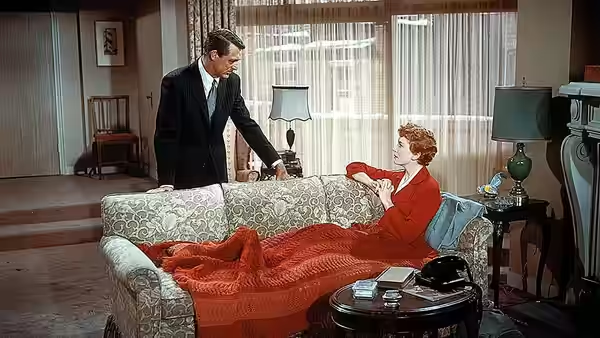
Milton Krasner’s widescreen photography serves the courtship well, giving the two performers space to remain interesting together. The width encourages us to notice their relationship within the image, rather than treating each face as a separate attraction. Charles LeMaire’s costumes contribute to the formality that makes small changes of manner noticeable. The polished appearance suits a romance conducted with this much self-possession, though the images are often more expressive than the film’s leisurely movement between them.

The screenplay by Delmer Daves and Leo McCarey has more trouble sustaining the romance once it must develop beyond those early encounters. The later complications ask for an indulgence that the dialogue cannot always earn, and the delay begins to feel imposed on the characters. James B. Clark’s editing allows the comic exchanges to settle, but that patience becomes less helpful when the story slows. A pause can give an actor something to play; repeated postponement gives the audience time to question the plot.

Hugo Friedhofer’s music supports the film’s tenderness, although its sweetness sometimes reinforces a feeling the performances have already made clear. The song sequences are a more noticeable interruption. They lengthen a film whose strongest pleasure is the concentration of two people attending to one another. There is room for music in that courtship, but these passages make it harder to recover the conversational ease that first drew us in.

Romantic melodrama needs some willingness to accept unlikely behaviour, and we are happy to grant it when the people remain convincing. Here, the performances keep that willingness alive through stretches when the writing tests it. The director’s light comic touch also matters: having enjoyed these people together, we have a reason to care when the mood grows serious. If impatience is your usual response to romantic hesitation, this is unlikely to cure it.

Critical consensus AI synthesised

71
Positive
4
Mixed
3
Negative
0

Most critics respond warmly to An Affair to Remember, with praise centred on Cary Grant and Deborah Kerr’s performances and the romance’s balance of wit and sentiment. The favourable reviews find the pair’s restrained comic chemistry persuasive, allowing the tender moments to land without losing the sophisticated humour. McCarey’s light touch also earns approval, particularly for the way comedy gives way to melodrama.

The spread is fairly wide, though none of the reviews is wholly negative: pacing, sentimentality and the later story account for most reservations. Judgements of the filmmaking differ, with Slant Magazine praising expressive widescreen imagery while The AV Club finds the direction dated and utilitarian. Empire questions both leads’ dramatic effectiveness but still responds to the finale’s romance; The New Yorker is less forgiving, admiring the tender, funny shipboard courtship before finding the later developments increasingly ridiculous and sanitised.

The AV Club
23 January 2008 · A · Donna Bowman
95

Bowman finds the romance successful despite its dated, utilitarian filmmaking and a third act that spins its wheels. She praises the leads’ performances and the gripping final scene.

Read the full review →
Variety
31 December 1956 · Variety Staff
85*

The review calls the film a winning, funny, tenderly sentimental romance. It praises Cary Grant and Deborah Kerr’s sparkling performances and restrained comic chemistry.

Read the full review →
Radio Times
★★★★ · Sue Heal
80

The review is positive about this frothy romantic comedy. It praises Cary Grant and Deborah Kerr’s performances and the film’s sophisticated comic style.

Read the full review →
Slant Magazine
21 January 2008 · ★★★½ · Fernando F. Croce
70

Croce regards the film as an emotionally powerful, dreamlike romance. He singles out McCarey’s graceful blend of comedy and melodrama, along with the film’s expressive widescreen imagery.

Read the full review →
Empire
25 August 2006 · Ian Nathan
58*

Nathan finds the film an effective, if slight and sentimental, melodrama whose romance still has a certain skill. He praises the finale’s hopeless romance, while faulting Cary Grant’s lack of tragic force and Deborah Kerr’s songs and limited emotional expression.

Read the full review →
The New Yorker
45*

The critic finds the film’s shipboard romance tender and funny, but sees the later story as increasingly ridiculous and sanitized. They single out the sweetly staged first kiss for praise and the final line as an all-time howler.

Read the full review →

Straight answers AI written, from our review

Is An Affair to Remember worth watching?
An Affair to Remember is worth watching for Cary Grant and Deborah Kerr’s funny, restrained courtship, and we score it 78. We recommend it to romance lovers willing to forgive some prolonged hesitation: the leads make the tenderness convincing, but the later complications and song sequences test our patience.
How long is An Affair to Remember, and what is it rated?
An Affair to Remember runs 1h 51m and is rated 12 by the FSK in Austria. It is a drama and romance film.
Where can I watch An Affair to Remember in Austria?
An Affair to Remember is available to rent from Amazon Prime Video and Apple TV from €3.99. Availability is checked daily; the links above go straight to each service.
How does An Affair to Remember compare to Brief Encounter?
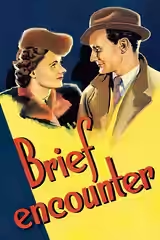
An Affair to Remember offers more pleasure in flirtation than Brief Encounter, but we recommend the latter more strongly for its painful sense of anxiety. Both romances make good manners an obstacle to speaking plainly; Grant and Kerr’s teasing exchanges suit an appetite for romantic comedy, while Brief Encounter makes falling in love feel ordinary and frightening.
What should I watch after An Affair to Remember?
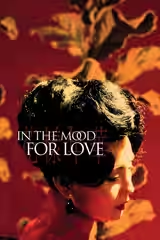
After An Affair to Remember, try Brief Encounter (1945, Fi1m 90): For another romance in which good manners make everything harder to say. Then In the Mood for Love (2000, Fi1m 91): For withheld declarations, careful clothes and the ache of being near.

Cast

Awards

Academy Awards, 1958

Nominated
Best Cinematography
Nominated
Best Costume Design
Nominated
Best Score, Adaptation or Treatment

If you liked this, try…

  1. Brief Encounter (1945, Fi1m 90)For another romance in which good manners make everything harder to say.

  2. The Shop Around the Corner (1940) · not on Fi1m yetTwo prickly people discover how much easier affection is at a distance.

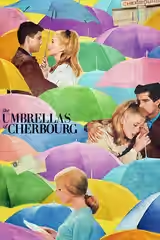
  3. The Umbrellas of Cherbourg (1964) · not on Fi1m yetMusic carries a romance whose sweetness never quite conceals the hurt.

  4. In the Mood for Love (2000, Fi1m 91)For withheld declarations, careful clothes and the ache of being near.

  5. The Lunchbox (2013) · not on Fi1m yetA quieter courtship, with shared meals doing the work of grand speeches.