Bill Nighy and Imelda Staunton give & Sons some force, but Pablo Trapero’s family drama is too thinly written and too laborious to recommend. The performances deserve a more convincing film.
& Sons is a family drama with two performances worth caring about and too little around them to justify the time it takes. Bill Nighy and Imelda Staunton give it force, but we cannot recommend the whole film on their account. Pablo Trapero directs this adaptation of David Gilbert’s novel from a screenplay written with Sarah Polley. It wants us to look closely at a difficult family, then keeps failing to give us enough to see.
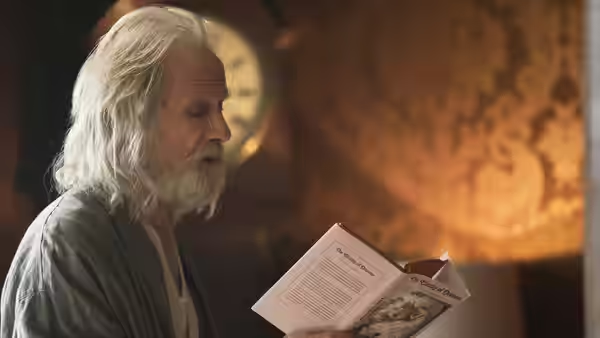
Nighy plays Andrew, a dishevelled alcoholic author, and the performance is the clearest reason to persist. He makes the man’s disorder interesting without making it attractive, which is a useful start for a drama about the people around him. An author’s drinking can easily become a shortcut to suggesting depth; Nighy gives Andrew enough weight to avoid that. The difficulty is that the film seems to expect the performance to supply much of the depth elsewhere, too.
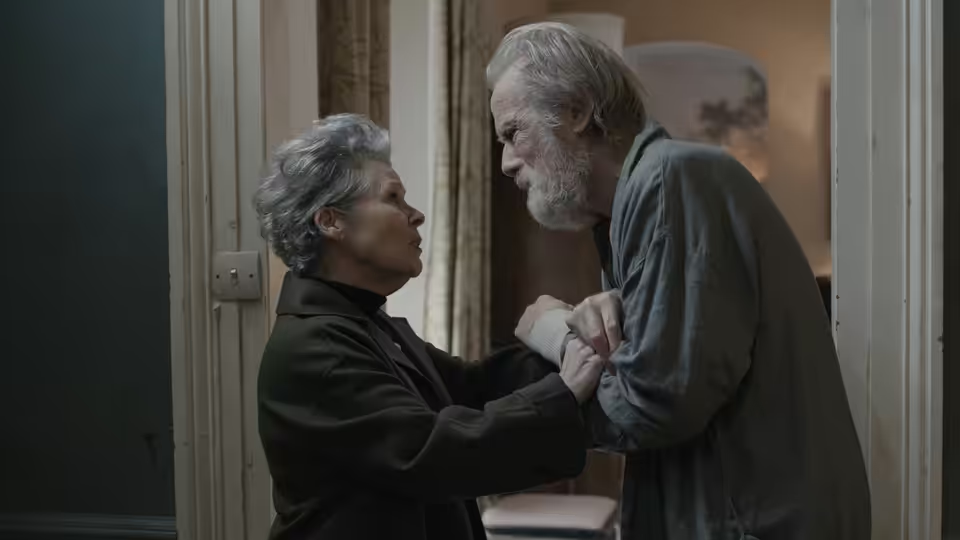
Staunton, playing Isabel, keeps the drama believable, and her confrontation with Nighy is its most persuasive stretch. We were moved by it: Staunton gives the family conflict a seriousness that the surrounding melodrama struggles to sustain. These two make a quarrel matter without requiring us to find everyone involved sympathetic. There is enough in their exchange to suggest how much stronger a plainer version of this film might have been, with more time spent on the relationships themselves.
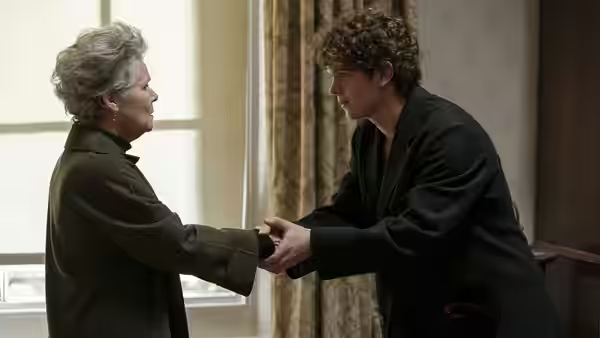
Trapero and Polley’s screenplay is much less secure when it asks us to accept the explanation on which the larger drama depends. We will not describe it, but its implausibility matters because it distracts from the family relationships that should hold our attention. A family drama can accommodate unlikely events if the people remain convincing, and this one has not made them substantial enough. Noah Jupe’s Andy, George MacKay’s Jamie and Johnny Flynn’s Richard belong to an ensemble that needs more space to become people we know.
That leaves the other departments supporting emotions the script has not earned. Diego Dussuel’s cinematography is most effective when Nighy and Staunton give it something definite to attend to in their confrontation. Sonja Klaus’s production design contributes less to our involvement than those performances do. Cristóbal Tapia de Veer’s music has the same difficulty: our attention keeps returning to the credibility of the writing, when it ought to be on the family.
The editing, credited to Gemma Cabello, Thom Smalley and Trapero, does not give the drama enough momentum across its 119 minutes. Its restraint has some value: the quieter emotional passages offer relief from the effort of accepting the writing. But restraint becomes laborious when it brings so little new understanding of the people involved. We spend too long waiting for another exchange as convincing as Nighy and Staunton’s. Even a fondness for this cast will need some patience.