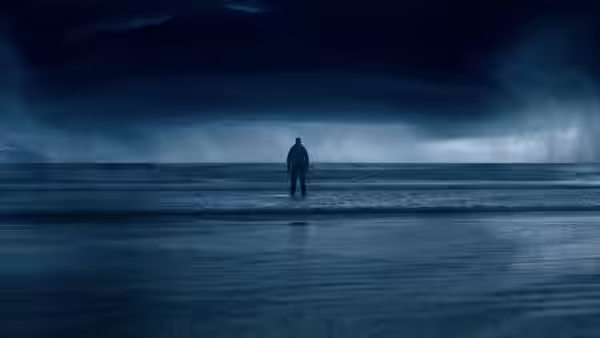
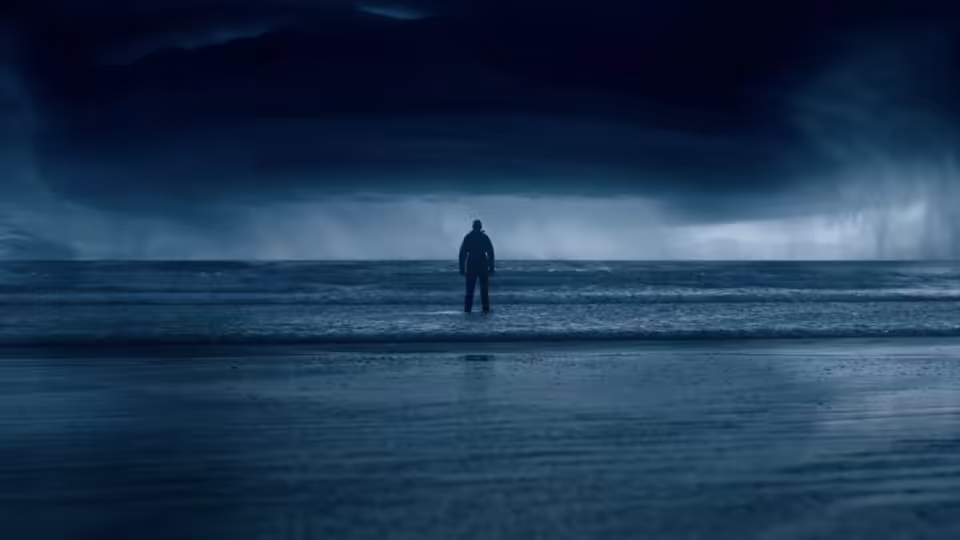
A lone figure stands on a beach beneath heavy storm clouds
Film review

Anemone

2025 · Directed by Ronan Day-Lewis · 2h 05m · MPA R

In a sentenceTwo superb speeches in a shed, and a two-hour wood grown around them to keep them dry

Jem Stoker (Sean Bean) walks into a wood in the north of England with a pack on his back and a letter in his pocket, looking for his brother. Ray Stoker (Daniel Day-Lewis) has lived out there alone for years, in a hut of tarpaulin and tins, and has no wish to be found. Jem has come because of Brian (Samuel Bottomley), the son Ray left behind, raised by Jem and Nessa (Samantha Morton) in a terraced house a long way from the trees. Brian is in trouble, and Jem thinks only his father can reach him. Ray, a former soldier, would rather talk about anything else. The first act is rain, a stove, two men circling each other over tea, poachers in the undergrowth, and a house back home where Nessa waits for news.

Plays from YouTube when you press play; nothing loads from them until then.

Fi1m review

Daniel Day-Lewis returns to a hut in a wood and gives his son Ronan two monologues worth the trip. Around them is a long, grey, hushed film that keeps telling us something terrible happened and mostly declines to make drama out of it.

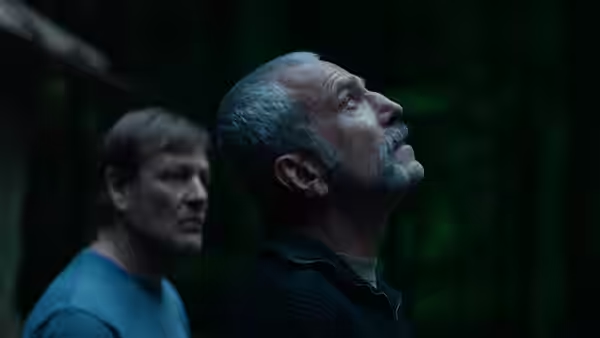
Ronan Day-Lewis directs his first feature from a script written with his father, and it runs 125 minutes, nearly all of them in the rain. Jem Stoker (Sean Bean) walks into a wood to find his brother Ray (Daniel Day-Lewis), who has lived there alone for years and wants to go on doing so. Jem has come to fetch him home for the sake of Ray’s son Brian (Samuel Bottomley), raised in Ray’s absence by Jem and Nessa (Samantha Morton). That is the whole engine of the film, and it is a sound one. The film is seriously acted, handsomely shot and, for long stretches, stuck.

Start with what works, because it works a great deal. Daniel Day-Lewis plays Ray as a man who has stopped using his voice and finds it rusty when he needs it. He eats like an animal, he laughs at nothing, and twice in the film he tells a story: one about a priest, one about his years as a soldier in Northern Ireland. We sat without moving through the first of these. The reason is that he tells it flat, the way people tell things they have told themselves a thousand times, and Ben Fordesman’s camera does not move either, so there is nothing to watch but a face deciding how much to admit. Both speeches would justify the ticket on their own. The trouble is that the film knows this too, and arranges itself around them like furniture.

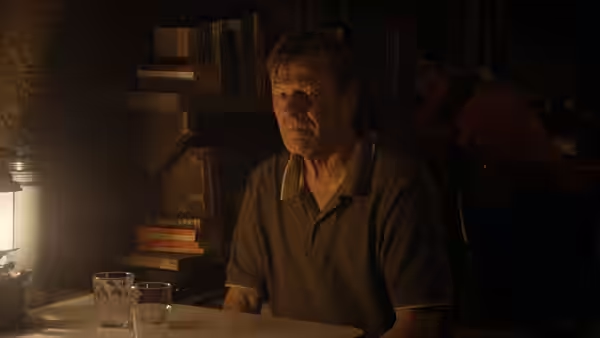
Sean Bean has the quieter job and does it properly. His Jem is the brother who stayed, who prays, who absorbs Ray’s contempt without returning it, and Bean lets you see the cost of the patience without ever asking for credit. The scenes where the two of them simply sit, one talking and one not, are the best the film has after the monologues. Jane Petrie dresses Ray in layers of old army kit and Jem in a decent anorak, which tells you most of what the script spends an hour telling you.

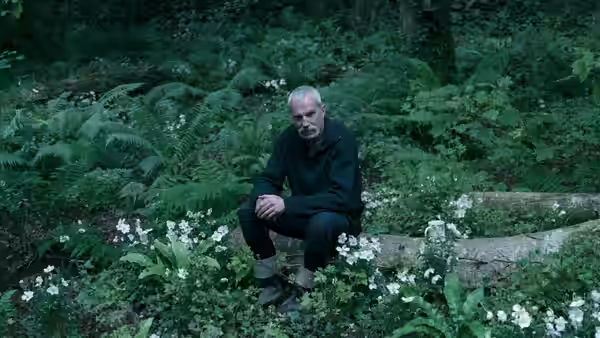
Fordesman shoots the wood in flat grey-green light, wide and still, with the men small in the frame and the trees doing most of the acting. It is good to look at. A sequence at a river is the one place the images and the story pull in the same direction at the same time. Chris Oddy’s hut is exact: tarpaulin, a stove, tins stacked like a man who counts them, nothing that was not carried in by hand. The Haxan Cloak scores all of this with low electronic drones that tell us to be frightened of a scene in which two men are eating, and after the first few times we stopped believing the warning.

Then there is everything outside the wood. Nathan Nugent cuts away, every so often, to Nessa and Brian in their kitchen, and each time the film stops dead. Morton is given a worried face and little else to do with it. Brian’s trouble is announced rather than shown. Safia Oakley-Green’s Hattie is barely a part. The script keeps stating that terrible things were done and not forgiven, and it keeps stating it in the same place, in the same weather, to the same drone. By the ninetieth minute we were waiting, and then we were irritable about waiting, because the film plainly had its two best scenes behind it and seemed to know it. The last half hour turns to weather and symbol in ways we will not describe; we laughed once where we were not meant to.

As a debut it is not lazy. Ronan Day-Lewis frames with real care and trusts his actors with long silences, which is rarer in first films than it ought to be. What he has not yet learned is when a scene is finished. Set against the small, hard British films about damaged men it most resembles, this one is better acted than almost any of them and thinner than most.

See it if you have been waiting for Daniel Day-Lewis to come back, because for perhaps twenty minutes he is as good as he has ever been. At home you will be tempted to find those twenty minutes and skip the wood, and we would understand.

Critical consensus AI synthesised

52
Positive
5
Mixed
10
Negative
7

Most critics agree that Anemone belongs to Daniel Day-Lewis. Nearly every review, including the hostile ones, picks out his performance, and several single out two long monologues as the film’s strongest passages. The imagery gets the next most consistent credit: the woodland setting, a river sequence, and a debut director with a clear eye for a frame. Sean Bean draws a few mentions for his quieter work.

Beyond that the reviews scatter widely. The reservations cluster on the script, which is called thin, underwritten and slow, with a story that stays hazy too long and a tone most find excessively solemn. A handful of critics, Empire and IndieWire among them, think the promise outweighs the faults. A larger group finds it a slog, and the lowest scores come from Variety, which calls it a static dud, and The Observer, which alone argues the film wastes Day-Lewis rather than serving him.

Empire
21 October 2025 · Ian Freer
80*

Freer finds the film a powerful, brooding story and praises Daniel Day-Lewis’s performance as a showcase for his talent. He also singles out Sean Bean’s subtle work and the film’s visual poetry, though he finds the cuts to Nessa and Brian slow the story.

Read the full review →
IndieWire
28 September 2025 · B · Ryan Lattanzio
77

Lattanzio finds the debut a miserable but richly made drama whose promise outweighs its flawed conclusion. He praises Daniel Day-Lewis’s performance and the film’s dense, spiky dialogue.

Read the full review →
The AV Club
1 October 2025 · B · Luke Hicks
77

Hicks finds the film a poignant, promising drama that lets its mysteries linger too long. He praises Daniel Day-Lewis’s magnetic performance and the painterly imagery, especially a striking river sequence.

Read the full review →
Screen Daily
28 September 2025 · Robert Daniels
64*

The page identifies this as a review, but its verdict is not visible in the accessible text. The article body is behind a paywall, so no specific praise or complaint can be established.

Read the full review →
The New York Times
2 October 2025
64*

The page could not be accessed, so the critic’s verdict cannot be determined. No praise or complaint from the review was available to identify.

Read the full review →
Little White Lies
4 November 2025 · 4/3/2 · David Jenkins
60

Jenkins finds the film a dour slog despite moments of magic. He praises Daniel Day-Lewis’s two intricate monologues, while criticizing the stylized visuals and thin supporting characters.

Read the full review →

Straight answers AI written, from our review

Is Anemone worth watching?
Anemone is worth watching mainly for Daniel Day-Lewis, who gives two monologues in a hut that are as good as anything he has done, and we scored it 50. Around them is a long, grey, hushed film about a damaged ex-soldier and his brother that keeps saying something terrible happened without making drama of it. For patient admirers of the cast; others will find it stuck.
How long is Anemone, and what is it rated?
Anemone runs 2h 05m and is rated R by the MPA in the US. It is a drama film.
Where can I watch Anemone in the US?
Anemone is streaming on Netflix in the US, and it is also available to rent from Amazon Prime Video from $3.99. Availability is checked daily; the links above go straight to each service.
How violent or frightening is Anemone, and is it suitable for children?
Anemone is a UK 15 and US R, an adult drama about an ex-soldier living alone in a wood, and it is not for children. The violence is mostly spoken rather than shown: a story about Northern Ireland, poachers in the undergrowth, a score of low drones that insists on menace. Teenagers used to slow, talk-heavy films might manage it; the squeamish have little to fear beyond the mood.
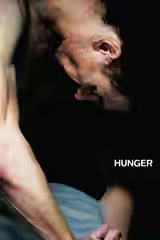
How does Anemone compare to Hunger?
Anemone and Hunger share Northern Ireland, a priest and a long still conversation, but Hunger is the better film by some distance. McQueen's prison drama earns its stillness and lands its suffering, while Anemone builds two hours of rain and drone around twenty excellent minutes. Choose Hunger for a complete film, Anemone for Daniel Day-Lewis alone.
What should I watch after Anemone?
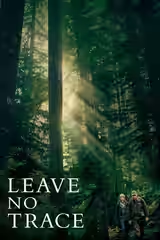
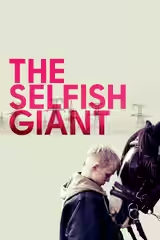
After Anemone, try Hunger (2008, Fi1m 86): Northern Ireland, a priest and one long conversation that earns every minute of its stillness. Then Leave No Trace (2018, Fi1m 88): A veteran hiding in the woods with a child, told with the patience this film lacks; and The Selfish Giant (2013, Fi1m 88): Northern England, scrap, poverty and boys in trouble; Clio Barnard makes the bleakness move.

Cast

If you liked this, try…

  1. Hunger (2008, Fi1m 86)Northern Ireland, a priest and one long conversation that earns every minute of its stillness.

  2. Leave No Trace (2018, Fi1m 88)A veteran hiding in the woods with a child, told with the patience this film lacks.

  3. The Selfish Giant (2013, Fi1m 88)Northern England, scrap, poverty and boys in trouble; Clio Barnard makes the bleakness move.

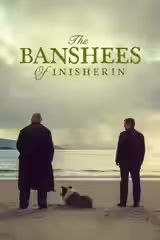
  4. The Banshees of Inisherin (2022, Fi1m 84)Two men who cannot forgive each other, with the jokes this film forgot to bring.

  5. Winter Light (1963, Fi1m 88)Bergman on faith, silence and a man who has stopped believing; eighty minutes, no fat.