Peyton Reed’s shrinking-hero heist is the smallest thing Marvel has made and the better for it, with Paul Rudd’s charm and Michael Peña’s storytelling carrying a script that explains itself too often. Pleasant, funny in patches, and gone by morning.
Marvel has made a small film, on purpose. Peyton Reed’s Ant-Man takes a burglar, a suit that shrinks him to the size of an insect and a heist, and spends most of its 117 minutes at the height of a skirting board. Joe Cornish and Edgar Wright wrote the story and share the screenplay credit with Paul Rudd and Adam McKay; Wright left before shooting, and most reviews have dwelt on the film he might have made. We are more interested in the one in front of us, which is likeable, funny in patches and explains itself more than it needs to.
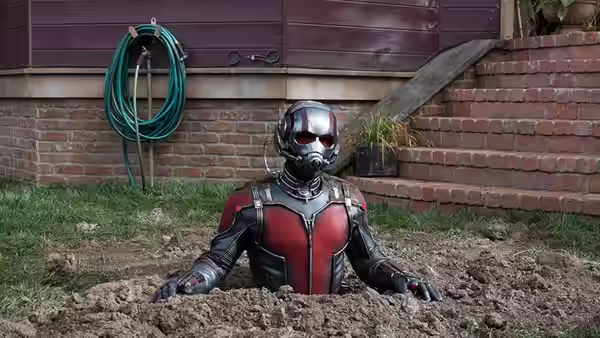
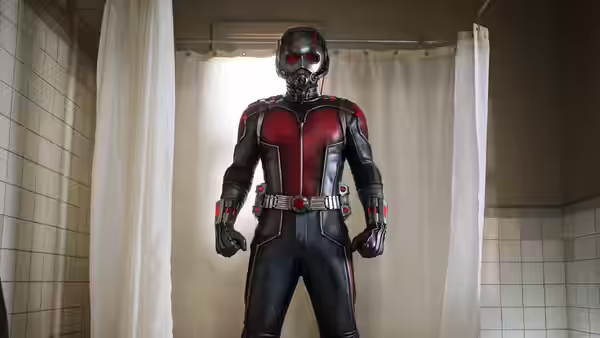
When Scott Lang first pulls on the suit and drops into his bathtub, the film finds what it is for. Russell Carpenter shoots the shrunken world in macro: the enamel is a white cliff, the running tap a flood, and everything beyond a few millimetres of focus is blur. A nightclub dance floor becomes a field of falling heels. We felt the floor go out from under us in that bathtub, which we did not expect.
Michael Peña is the best thing in it. Luis explains how he came by his tips, and the editors, Dan Lebental and Colby Parker, Jr., cut each story as a fast montage in which everyone in it, a wine-bar bore, a security guard, a gallery owner, mouths Luis’s own words in Luis’s own rhythm. We laughed harder at the second of these than at anything else, and felt a small drop every time it cut back to the basement briefings. David Dastmalchian, as the crew’s hacker Kurt, gets about three jokes and lands them.
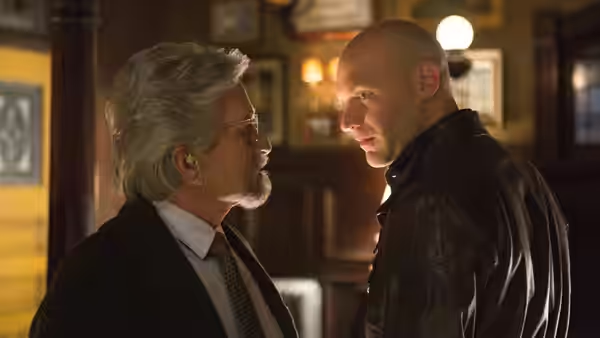
Rudd plays Scott as a man who apologises while robbing you, and it works. Michael Douglas gives Hank Pym a dry, sour authority, a man who has been right for decades and is tired of saying so. Evangeline Lilly’s Hope van Dyne is written as the person who ought to be in the suit and is not; the film knows this and does almost nothing about it, so she spends the film at Douglas’s shoulder looking annoyed. Corey Stoll’s Darren Cross is bald, sleek and aggrieved that his mentor never loved him, and that is the whole of him.
Shepherd Frankel builds two worlds: Pym’s tall old San Francisco house of dark wood and brass with a laboratory in the basement, and Pym Technologies, all glass and white light, a building without a cobweb. Sammy Sheldon’s suit has a leather-look helmet, dials on the belt and a red that has been worn in, so it looks like something built in a garage long ago. Christophe Beck’s brassy caper theme says heist rather than war, and it is the right note; his swells in the last half hour sound like everyone else’s.
The first hour is mostly people telling other people how the suit works. There is a prologue with a younger Douglas, a scene in which Pym explains the suit, a scene in which Hope explains the ants, and a scene in which Pym explains the ants again. Scott is sent to fetch a part from a warehouse and finds Sam Wilson (Anthony Mackie) guarding it, and for ten minutes the film is an advertisement for larger films. Cassie (Abby Ryder Fortson) and Maggie (Judy Greer) give Scott a reason and are then put away; Bobby Cannavale’s Paxton gets one late scene warmer than the writing around it.
The last half hour is where the ideas come back. The heist is cleanly cut and easy to follow, and the fight that follows ends up on a child’s bedroom floor, where a toy train is a roaring locomotive until the camera pulls back and it is a toy train again. It is the best joke in the film and a visual one, which is where the jokes belonged.
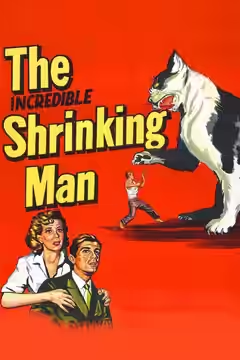
Next to Marvel’s other films it is a relief: one man, one suit, one building. Next to The Incredible Shrinking Man (1957), which found dread in a cellar with a cat, it is a pleasant afternoon. Watch it with children of about ten, who will not mind the briefings and will love the bathtub.