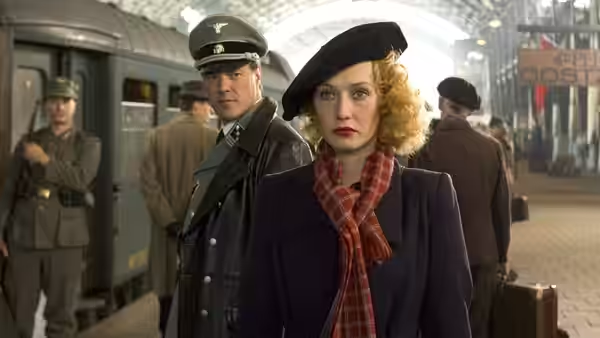
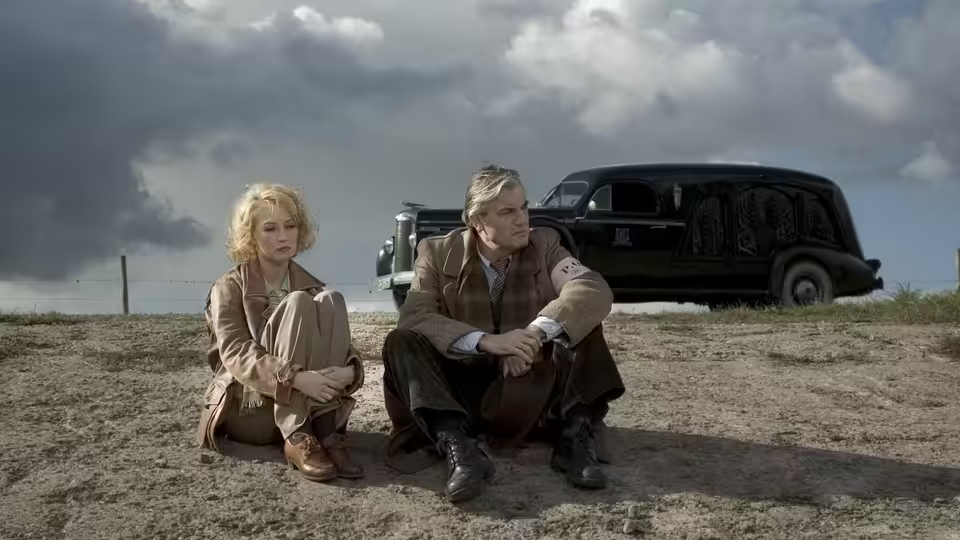
Rachel (Carice van Houten) and Müntze (Sebastian Koch) sit beside a parked car in the countryside
Film review

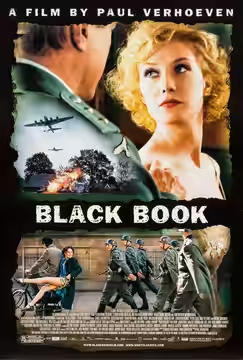
Black Book

2006 · Directed by Paul Verhoeven · 2h 25m · ClassInd 16

In a sentenceVerhoeven’s war: bright sunshine, good frocks, and a betrayal every twenty minutes

The Netherlands, September 1944. Rachel Stein (Carice van Houten), a singer, has spent the occupation hidden on a farm until an Allied bomb destroys it. Through the notary Wim Smaal (Dolf de Vries) and the policeman Van Gein (Peter Blok), she buys a place on a night boat carrying Jews south through the marshes to liberated territory, and finds her family aboard. A German patrol boat is waiting. Rachel alone comes out of the water alive. Taken in by the resistance under Gerben Kuipers (Derek de Lint) and the doctor Hans Akkermans (Thom Hoffman), she bleaches her hair, becomes Ellis de Vries, and is sent into the SD headquarters in The Hague to get close to its chief, Ludwig Müntze (Sebastian Koch), a collector of stamps. Under him, Günther Franken (Waldemar Kobus) is the one to fear.

Plays from YouTube when you press play; nothing loads from them until then.

Fi1m review

Paul Verhoeven goes home to the occupied Netherlands and makes a bright, fast, pulpy resistance thriller with Carice van Houten in nearly every frame. The last hour turns into a traitor hunt that explains more than it needs to, but it kept us gripped.

Paul Verhoeven spent two decades in Hollywood making films about robots, giant insects and women with ice picks, and then he went home. Black Book is his first Dutch film since The Fourth Man (1983), written once more with Gerard Soeteman, who wrote Soldier of Orange (1977) with him. It is a resistance thriller about a singer who spies for the underground from inside the German security police in The Hague, and it is fast, bright, lurid and unashamed. We enjoyed it more than we have any right to enjoy a film about the occupation.

Carice van Houten is in nearly every scene and carries all of them. Her Rachel decides early that she is going to live, and the film is a record of what that takes: lying to a man’s face, singing for people who would shoot her, bleaching her hair at a basin to become Ellis de Vries, and not only the hair on her head. Survival, the film says, is thorough and undignified, and Verhoeven shows that last detail without a flicker.

Sebastian Koch’s Müntze is the film’s second surprise. He is a tired, courteous man who collects stamps and would rather talk about perforations than arrests; the two of them meet on a train over his album. Koch plays him without asking for our sympathy, and the film does not pretend he is innocent. It asks whether a decent man in that uniform is any use to anyone, and it declines to give an easy answer.

Karl Walter Lindenlaub shoots the occupation in sunshine. The canals glitter, the reception rooms gleam, and the one grey thing in the film is the uniforms. Wilbert Van Dorp’s headquarters is a grand townhouse with chandeliers upstairs and cells below. Yan Tax dresses Ellis in frocks cut to be looked at, which is the cover. Anne Dudley’s score is lush and old-fashioned, strings and brass from a 1940s studio picture, and it suits a film that knows it is a melodrama. Job ter Burg and James Herbert cut at a sprint, and 145 minutes do not feel long until the last forty.

The night boat is where the film told us what it was. A searchlight comes on, a machine gun opens up, and the people who have paid everything they had to escape are dead in the water within a minute, their bodies gone through for jewellery before the smoke has cleared. We were horrified, and what horrified us was the speed and the moonlight: Verhoeven does not cut away, does not slow down and does not dirty the image to make it respectable. Then he moves on, because Rachel has to.

The supporting cast is drawn in thick strokes and all the better for it. Waldemar Kobus plays Franken, the brute of the building, as a sweating man who sings at parties and keeps a cash box. Halina Reijn’s Ronnie sleeps with Germans because the food is better, says so, and is the most honest person in the film. Thom Hoffman’s doctor Akkermans and Derek de Lint’s Kuipers run the resistance as a gentlemen’s committee; Matthias Schoenaerts’s Joop wants to shoot people and usually gets to. Christian Berkel turns up as General Käutner to remind everybody who is in charge.

The second half takes turns we will not describe. What we can say is that the plot becomes a hunt for whoever betrayed the boat, and that Verhoeven and Soeteman have so many suspects and reversals in hand that for the final forty minutes people mostly stand in rooms explaining the last reversal to each other. Nobody in it is hungry, either; the winter of 1944 in the western Netherlands was one in which people ate tulip bulbs, and some will find the film’s prettiness indecent.

Beside Soldier of Orange this is the brasher, faster sibling, closer in spirit to his Hollywood films. It carries a 15 and earns it. Watch it with someone who does not mind a war film that enjoys itself, and do not try to keep a list of who has betrayed whom. The film is keeping one for you, and it will read it out.

Critical consensus AI synthesised

67
Positive
6
Mixed
6
Negative
1

Most critics take Black Book as a lively return to form for Paul Verhoeven: a brisk, twisting resistance thriller that is more entertaining than respectable. The praise clusters around Carice van Houten, whose performance is singled out in nearly every review as the thing holding the film together, with Sebastian Koch’s work opposite her noted more than once. The reviews also tend to credit the film’s refusal of moral clarity, its view of collaborators and resisters as equally compromised, and Verhoeven’s taste for the outrageous.

The reservations are about plot and plausibility. Several critics find the twists pile up past the point of credibility, and Slant Magazine argues the plotting is mechanical and the characters thin. The spread is fairly wide, from near-raves to one sharp dissent: The New Yorker’s Anthony Lane dismisses it as shallow soap opera with a sanitised view of wartime suffering, though even he admires van Houten.

Little White Lies
8 January 2007 · 3/5/4 · David Jenkins
100

Jenkins finds the film a thrilling, morally unsettling return to form for Verhoeven. He particularly praises Carice van Houten’s committed performance and the film’s relentless plot twists.

Read the full review →
Total Film
19 January 2007 · ★★★★ · Total Film
80

The review finds Verhoeven revitalised, calling the film a brisk, gripping thriller despite occasional pacing and tension problems. It particularly praises Carice van Houten’s bold performance and the story’s twists and moral complexity.

Read the full review →
Variety
1 September 2006 · festival review · Derek Elley
80*

Elley finds the film an entertaining, technically polished and emotionally complex resistance thriller. He particularly praises Carice van Houten’s performance and her chemistry with Sebastian Koch.

Read the full review →
Empire
12 October 2006 · Ian Nathan
70*

Nathan finds the film an implausible but memorable and passionate wartime drama, ultimately worth seeing. He praises its morally complex view of the Resistance and Nazis, conveyed through Verhoeven’s outrageous comic sensibility.

Read the full review →
The Guardian
4 May 2007 · Rob Mackie
70*

Mackie finds the film a rollicking, passionate thriller, though it does not reach the heights of The Pianist. He praises the complexity brought to the central relationship by Carice van Houten and Sebastian Koch.

Read the full review →
Evening Standard
10 April 2012
65*

The critic finds the war epic direct and compelling, though overly long. Carice Van Houten is singled out for carrying the film, while its many twists keep the story engaging.

Read the full review →

Straight answers AI written, from our review

Is Black Book worth watching?
Black Book is worth watching for anyone who wants a resistance thriller that moves fast and enjoys itself, and we scored it 80. Carice van Houten carries nearly every scene, and Verhoeven shoots the occupation in sunshine and good frocks. The last forty minutes bog down in people explaining betrayals to each other, so it suits patient viewers who like pulp more than the solemn.
How long is Black Book, and what is it rated?
Black Book runs 2h 25m and is rated 16 by the ClassInd in Brazil. It is a drama and thriller film.
Where can I watch Black Book in Brazil?
Black Book is streaming on MUBI, Amazon Prime Video and Pluto TV in Brazil. It leaves MUBI on 1 October. Availability is checked daily; the links above go straight to each service.
How violent or frightening is Black Book, and is it suitable for children?
Black Book carries a UK 15 certificate and earns it, with nudity, sex, torture and a night-boat massacre shot in moonlight that the camera refuses to cut away from. It is not for children, and the squeamish should expect bodies searched for jewellery before the smoke clears. Older teenagers who can take a hard war film will manage; it is lurid rather than dwelling.
How does Black Book compare to Rome, Open City?
Black Book is the brasher, glossier film, and Rome, Open City the one that will stay with you longer. Rossellini shot the occupation months after it ended, with real rubble and a warmth that makes the suffering hard to shake; Verhoeven stages his in sunshine, with a twist every twenty minutes. Choose Verhoeven for a thriller, Rossellini for the weight of the thing itself.
What should I watch after Black Book?
After Black Book, try Lust, Caution (2007, Fi1m 76): Ang Lee’s occupied Shanghai: another woman sent to seduce the enemy and losing her footing. Then Rome, Open City (1945, Fi1m 89): Rossellini filmed the occupation months after it ended, with the rubble still real.

Cast

Awards

European Film Award for Best Actress, 2007

Nominated
European Film Award for Best Actress

European Film Award – People's Choice Award for Best European Film, 2007

Nominated
European Film Award – People's Choice Award for Best European Film

International Submission to the Academy Awards, 2007

Nominated
International Submission to the Academy Awards

Golden Calf for Best Feature Film, 2006

Won
Golden Calf for Best Feature Film

If you liked this, try…

  1. Soldier of Orange (1977) · not on Fi1m yetVerhoeven and Soeteman’s earlier Dutch war film, slower and sadder, with Rutger Hauer.

  2. Army of Shadows (1969) · not on Fi1m yetMelville’s French resistance as grey corridors and silent men; the opposite of Verhoeven’s sunshine.

  3. Lust, Caution (2007, Fi1m 76)Ang Lee’s occupied Shanghai: another woman sent to seduce the enemy and losing her footing.

  4. Flame & Citron (2008) · not on Fi1m yetTwo Danish resistance killers discover their orders come from people they cannot trust.

  5. Rome, Open City (1945, Fi1m 89)Rossellini filmed the occupation months after it ended, with the rubble still real.