Film review

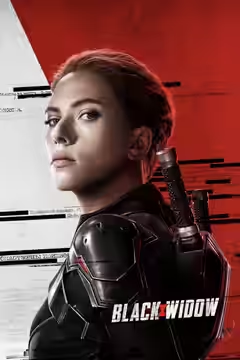
Black Widow

2021 · Directed by Cate Shortland · 2h 14m · MPA PG-13

In a sentenceThe best scene is dinner with a fake Russian family; the last half hour is weather

ActionAdventureScience Fiction

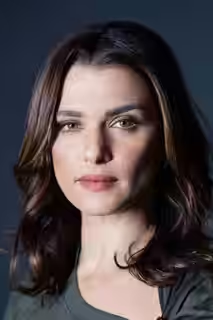
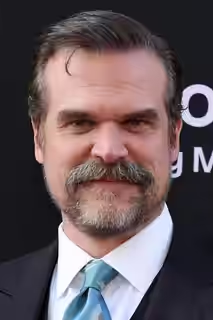
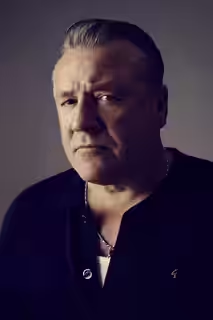
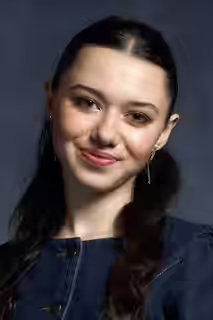
Ohio, 1995. Alexei (David Harbour) and Melina (Rachel Weisz) pose as an ordinary suburban couple with two young daughters, until a night flight to Cuba ends the pretence and the girls are handed to Dreykov (Ray Winstone) and his Red Room. Years later, Natasha Romanoff (Scarlett Johansson) is a fugitive from Secretary Ross (William Hurt), living in a caravan in Norway on supplies brought by her fixer Mason (O-T Fagbenle). A parcel from her estranged sister Yelena Belova (Florence Pugh) brings a masked assassin to her door, and Natasha goes to Budapest to find out why. The parcel holds a red gas that frees Dreykov’s Widows from his control, which means the programme both sisters believed was finished is still running, and they are the only two people outside it who know.

Plays from YouTube when you press play; nothing loads from them until then.

Fi1m review

Cate Shortland’s spy film is at its best as a comedy about a fake Russian family around a kitchen table, and Florence Pugh runs off with it. The villain is a man at a desk and the last half hour is digital weather.

Cate Shortland’s Black Widow arrives eleven years after the character first appeared in Iron Man 2 (2010) and slots itself into a gap between earlier films, which means it can change nothing. Eric Pearson’s screenplay, from a story by Ned Benson and Jac Schaeffer, gets round this by making a film about a family rather than a hero: four Russian agents who once pretended to be a household in Ohio and have not spoken since. When those four are in a room together, Black Widow is as good as anything Marvel has made in years. When it remembers it also needs a villain and a fortress, it becomes the film you were expecting.

Florence Pugh is the reason to see it. Yelena Belova has spent her adult life as one of Dreykov’s controlled Widows and has just been freed, and Pugh plays her as someone who has decided to be unimpressed by everything as a matter of policy. The sisters’ first meeting, in a Budapest flat, is a fight Shortland stages at close quarters with curtains, a sink and a hob, and Gabriel Beristain shoots it hand-held and near enough that we can see both women getting tired. Then they sit on the floor and talk, and when Yelena says the Ohio years were real to her whatever they were to everyone else, we were caught off guard and moved. Pugh says it as an accusation, not a plea, and that is why it works.

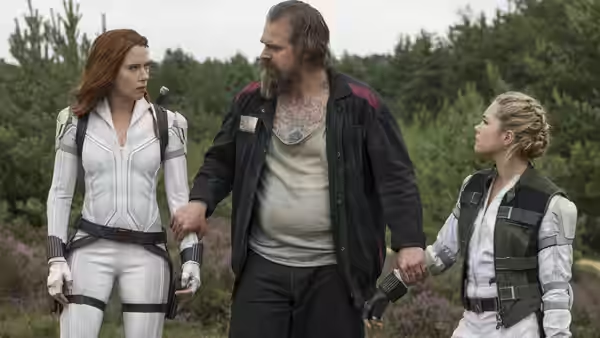
David Harbour is Alexei, once the Soviet answer to Captain America and now a heavy man in a prison yard, arm-wrestling for a living. He plays a boastful, sentimental father who has forgotten the daughters were not his, and he gets most of the laughs. Rachel Weisz has the harder job as Melina, a scientist alone on a farm where the pigs do what she tells them, and she plays her cool and tired and gives the dinner scene its only adult. She deserved another twenty minutes and the film spent them elsewhere.

The craft is steady rather than distinctive. Charles Wood’s production design is best when it is smallest: the Budapest flat, the farmhouse with its clutter of chemistry and feed. Beristain lights Norway in flat grey and the prologue in the orange of a suburban evening. Lorne Balfe’s score leans on low choir and a slow, mournful theme that suits the family and has nothing to offer the action. Matthew Schmidt and Leigh Folsom Boyd cut the first hour with room to breathe and the last half hour in fragments, which is what happens when there is little to cut between except falling metal.

Ray Winstone plays Dreykov from behind a desk, and he is given speeches about controlling women and no scenes in which he does anything but sit. Behind him is the darkest material Marvel has touched: girls bought, trained, sterilised and steered like drones. Yelena describes the surgery, flatly, to a father who does not want to hear it; the scene is sharp and the film then moves on, and that is the last we hear of it as anything but plot. When the last act turns grey with digital smoke and debris, we watched with the resignation of people who have seen this ending eight or nine times under other titles, and we had stopped caring which sister landed where.

Shortland’s Lore (2012) followed children across Germany at the end of the war and trusted silence for long stretches. That director is here, on the Budapest floor and at the farmhouse table, and there are other stretches where it could be anyone. The film keeps nodding towards Bond: Natasha watches Moonraker (1979) alone in her caravan, and the plot has a lair and a henchman with a gimmick. Bond films stop for dinner. This one does too, once, and it is the best scene in it.

It runs 134 minutes at 12A, and about ninety of them are worth your evening if you want to see what four good actors do with a kitchen table. Watch it with someone who will laugh at the dinner, and put the kettle on when the smoke comes in.


Critical consensus AI synthesised

67
Positive
19
Mixed
8
Negative
3

Most critics come away pleased, if not thrilled. The reviews lean positive by a clear margin, and the praise clusters on Florence Pugh, whose Yelena is named again and again as the film’s chief asset, with Weisz and David Harbour close behind. The bickering assassin family is the part almost everyone enjoys, and Shortland’s fight scenes are credited with a grounded, Bourne-flavoured physicality that several reviewers find refreshing after the usual Marvel scale.

The reservations gather around the final act, which many find cluttered and formulaic, and around how little room Natasha herself is given in her own film. The spread is wide. The Times and the Evening Standard treat it as an outright delight, while the Los Angeles Times and The New York Times argue the Marvel machine flattens both Shortland and Johansson, and The i Paper calls the result visually interchangeable. The dissenters are few, but they are not quiet.

Evening Standard
5 July 2021 · Charlotte O'Sullivan
90*

This is a wondrous, hilarious goodbye to Natasha that might be 2021’s funniest film, thanks to perfect comic timing from Johansson and strong additions from Pugh, Weisz and Harbour. The film celebrates diverse body types and women’s agency while delivering satisfying fights.

Read the full review →
The Hollywood Reporter
29 June 2021 · David Rooney
90*

The critic calls it a stellar vehicle for Johansson with first-rate support from Pugh, Weisz and Harbour, praising Shortland's propulsive direction, humor, emotional interludes and shift into espionage thriller territory with strong family dynamics.

Read the full review →
The Times
8 July 2021 · ★★★★☆ · Kevin Maher
90*

The critic praises the film as a sublime, exhilarating spy romp that benefits from being free of the Avengers, with Florence Pugh as its secret weapon who brings soul and heart. It singles out the family dynamics and character work for praise.

Read the full review →
Total Film
29 June 2021
90*

The long-overdue solo movie delivers action and emotion as a rousing addendum to Johansson’s MCU story. It succeeds in injecting emotion into the backstory while foregrounding intimate character moments amid non-stop action.

Read the full review →
IndieWire
29 June 2021 · B+ · Eric Kohn
83

The review finds it a solid, quaint Bourne-meets-Marvel romp that gets the job done with effective banter and fights between Johansson and Pugh.

Read the full review →
Little White Lies
5 July 2021 · 3/4/3 · Fatima Sheriff
80

The review calls it an enjoyable adventure about messed-up families that fulfils cravings for big-screen action. It praises the energetic set-pieces and Pugh’s charismatic performance but complains that it loses standalone value with plotlines added to set up future films.

Read the full review →

Cast

If you liked this, try…

The Americans poster

The Americans

2013 · Soviet agents playing an American family for six seasons, and the marriage is the mission

Haywire poster74

Haywire

2011 · Soderbergh’s spy film where every fight hurts and nobody quips afterwards

Lore poster

Lore

2012 · Shortland’s earlier film, quiet and hard, about children walking through a ruined Germany

Captain America: The Winter Soldier poster77

Captain America: The Winter Soldier

2014 · Natasha’s best outing before this one, in a proper paranoid thriller

Nikita poster76

Nikita

1990 · Besson’s original: a girl made into a killer, and the cost of it counted