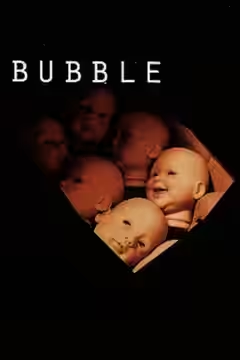
Bubble poster

Bubble

2006 · Directed by Steven Soderbergh
1h 13mDramaCrimeMystery
68
Fi1m score
Critics · 3 so far
Audience · not yet

Where to watch in the UK

Not streaming, renting or buying in the UK at the last check.

Synopsis

Martha (Debbie Doebereiner) is a middle-aged woman in a small town who lives with her elderly father (Omar Cowan), works on the line at a doll factory, and drives her much younger colleague Kyle (Dustin James Ashley) to work every morning. They eat lunch together and say little. Then Rose (Misty Wilkins), a young single mother with a small daughter, Jesse (Madison Wilkins), is taken on at the factory, and the arrangement between Martha and Kyle shifts. Steven Soderbergh directs, shoots and edits, from a script by Coleman Hough, with a cast of non-professional actors from the area. It runs 73 minutes.

Fi1m review

In a sentenceSeventy-three minutes, three people, one doll factory, and the fluorescent light never once flatters anybody

Steven Soderbergh’s small, cool film about two women and a young man in a doll factory is closely watched and exactly cast, and it earns its quiet. It also stops before it has finished.

Steven Soderbergh made this between two Ocean’s films, and it is hard to think of a sharper change of scale. Seventy-three minutes in a doll factory in a town nobody would visit on purpose, acted by people who had never acted before, shot and cut by the director himself on digital video. The tagline calls it “Another Steven Soderbergh Experience”, which is about the right level of self-mockery. Bubble is a careful, cool, exactly cast small film that we admired for an hour and then watched run out of things to do.

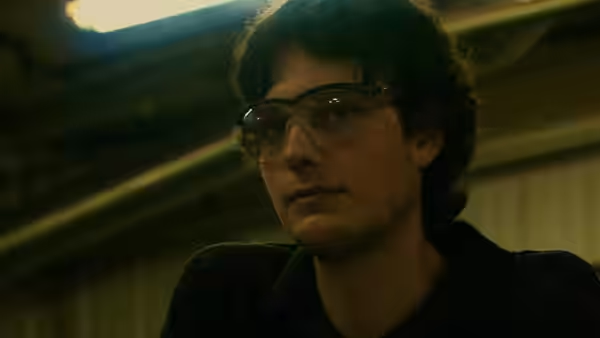
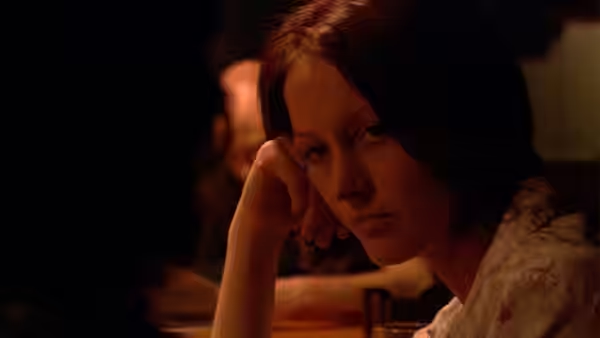
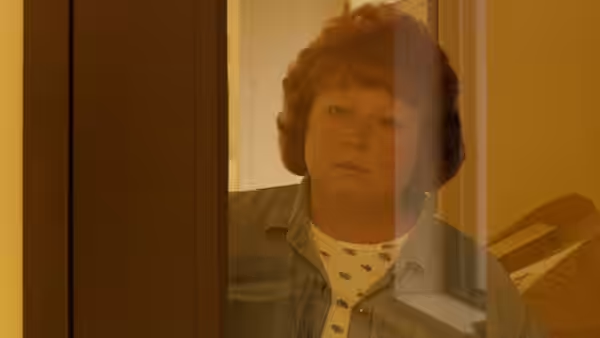
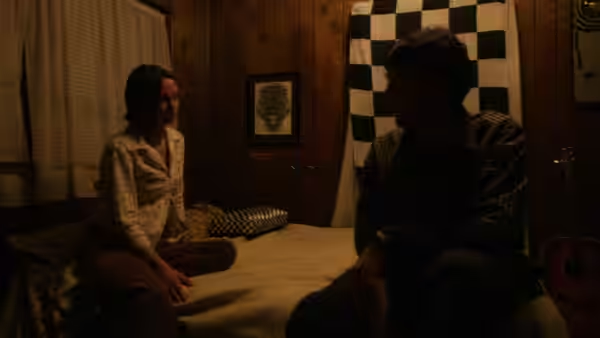
Martha (Debbie Doebereiner) is large, kind and unhurried. She lives with her father (Omar Cowan), makes his meals and drives Kyle (Dustin James Ashley), a thin young man who barely speaks, to the factory each morning. They eat lunch together on a bench. Coleman Hough’s script gives them conversations so ordinary that at first we wondered whether the sound was on. Then Rose (Misty Wilkins) is hired, with a small daughter and a quicker way of talking than anyone else in the building, and Martha offers to babysit.

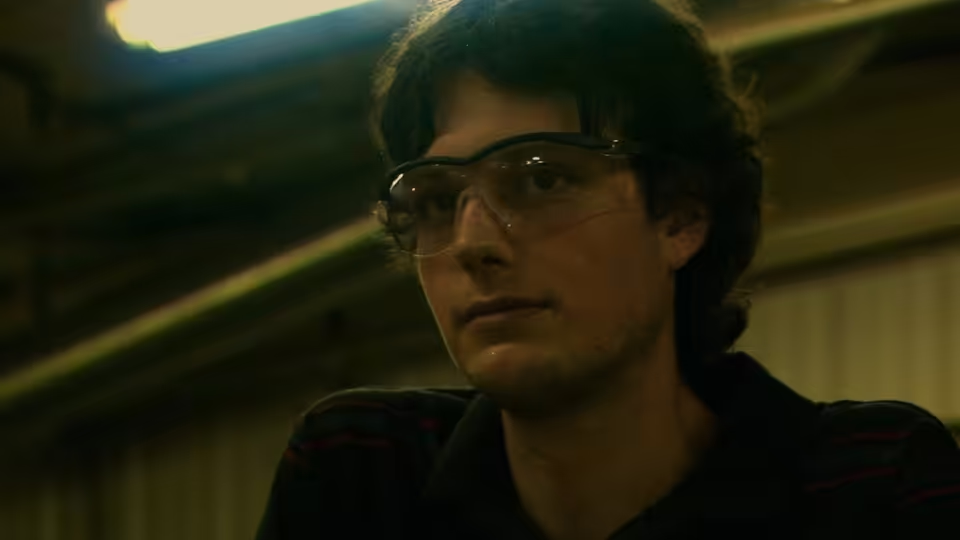
The factory is where Soderbergh’s camera is happiest. He holds it still and keeps everything in focus, so the vinyl heads on their racks and the workers pressing eyes into sockets are equally sharp, equally lit, equally unremarkable. Nobody plays music over the work; we hear the compressors and the small thump of a head going into a mould. He cuts each scene off a beat early, to black, so the day is a run of short rooms with nothing between them. It is a plain way to shoot and it is the right one for these lives.

Doebereiner is the film. Her face does almost nothing, and the film has been built so that almost nothing reads. There is a moment in the break room, early, when Kyle laughs at something Rose has said and Martha watches from a table away, and we felt a small, exact ache that we had not braced for. Nothing has happened. A woman has noticed that a boy she gives lifts to is happy, and that she is not the cause. Ashley mumbles and looks at the floor, which is right for Kyle, and Wilkins gives Rose an edge of impatience that the town has not managed to sand off.

Robert Pollard and Todd Tobias supply the music, short acoustic guitar figures that arrive between scenes rather than under them, so the film is never told what to feel by its own soundtrack. It is a modest choice and it holds. The non-professional cast mostly holds too, though not always: some pauses are a character thinking and some are a person waiting for the next line, and we could tell which.

The second half takes a turn we will not describe. Decker Moody arrives late, patient and unshowy, and his scenes are shot the same way as the lunches, which is the point. But the point is made quickly, and after that the film’s interest in these people narrows to a single question. The hour of watching Martha at the sink and the line has been traded for talk in a room. Some critics have read the film’s coolness as contempt for its characters. We do not think it is contempt. We think it is distance, and at 73 minutes distance can feel like leaving before the end of the visit.

Soderbergh has been here before in spirit. Sex, Lies, and Videotape (1989) trusted small rooms and long looks and had more to say when it was done. Full Frontal (2002), also written by Hough, was the same kind of experiment with a cast that knew it was one. Bubble is the more honest of the two and the thinner.

Watch it at home, on a weeknight, with nothing planned afterwards. It asks for close attention and gives back a few faces you will remember and one afternoon in a break room that we have not shaken. It does not give back much more than that, and it knows it does not, which is either admirable or a little bit of a shrug. It runs 73 minutes.

Critical consensus AI synthesised

3 of 6
Positive
1
Mixed
2
Negative
0

With only 3 reviews in so far, the early word on Bubble is respectful rather than warm. The praise clusters around Soderbergh’s non-professional local cast, which critics find brings an awkward, convincing realism to the story of jealousy and murder in a depressed doll-factory town, and around the high-definition video, which The New Yorker credits with sharp, deep-focus images that give weight to the characters’ trapped lives. The reservations are about temperature: Film Comment finds the mix of neorealism and tabloid sensationalism disconcerting, and Variety, reviewing from a festival, calls the tale likeable but unexciting. The spread is narrow, with nobody yet dismissing it.

The New Yorker
6 February 2006 · David Denby
70*

The film is strange and off-putting but far from nothing, offering a crabby, unyielding vision of an America suffocating in banality through its story of work, jealousy, and murder in a depressed factory town. It impresses with its use of high-definition digital video for sharp, deep-focus imagery that gives weight to the characters' trapped lives.

Read the full review →
Film Comment
· Amy Taubin
65*

The film is a disconcerting mix of neo-neorealism and tabloid sensationalism rather than the expected quickie genre exercise. Soderbergh's use of non-professional local actors brings verisimilitude and emotional blockages that refresh the familiar narrative.

Read the full review →
Variety
3 September 2005 · festival review · Deborah Young
60*

Soderbergh uses a non-pro cast to deftly sketch the dullness of a mid-American burg, where an unmotivated murder unveils a frightening moral vacuum amid the empty-pocket atmosphere of doll factory workers. The likeable if unexciting little tale has sly humor and commentary, with the three principals well cast and the understated direction complemented by low-key realism.

Read the full review →
Screen Daily
7 September 2005 · festival review

The critic praises the strong storyline, dramatic structure, and the eccentric DV camerawork and non-professional performances in this low-budget tragic love triangle set in small-town Ohio.

Read the full review →
Slant Magazine
20 September 2005 · Keith Uhlich

The critic finds the film an empty, contemptuous exercise in Soderbergh's post-Limey mode, essentially a backwoods remake of Vera Drake that renders its working-class characters vague and its dialogue stilted. He singles out the artificial, affected rhythms of the non-professional cast and the soulless doll-factory setting as emblematic of its failures.

Read the full review →
The Guardian
26 October 2005 · festival review

The critic finds the film completely gripping in its unassuming ordinariness, a leftfield psychological drama shot on HD video with non-professional actors that offers a ringside seat to a real story from real life.

Read the full review →

Cast

Omar Cowan
Martha's Father
Dustin James Ashley
Kyle (as Dustin Ashley)
Phyllis Workman
Bakery Shopkeeper
Laurie L. Wee
Kyle's Mother (as Laurie Lee)
Daniel R. Christian
Factory Supervisor

Stills

If you liked this, try…

Wanda poster

Wanda

1970 · Barbara Loden’s Pennsylvania drifter; the same flat light and nobody looking away.

Rosetta poster

Rosetta

1999 · The Dardennes follow a girl who wants a job, and nothing else matters.

Il Posto poster

Il Posto

1961 · A Milanese boy gets a desk for life; work as a slow, kind trap.

Vera Drake poster

Vera Drake

2004 · Mike Leigh’s kitchens and a police knock; the ordinary made unbearable.

Wendy and Lucy poster

Wendy and Lucy

2008 · Michelle Williams, a dog, a car park, and money running out in real time.