Matthew Heineman’s film about the citizen journalists of Raqqa is Being Slaughtered Silently is the plainest account we have seen of what Isis did to a city. It loses its grip in Germany and the music never stops, but see it.
Matthew Heineman’s last film, Cartel Land (2015), put him in the back of pickup trucks with Mexican vigilantes. City of Ghosts is quieter and worse. Its subjects are the members of Raqqa is Being Slaughtered Silently, a group of young men from a provincial Syrian city who, when Islamic State took it in 2014 and began killing people in the squares, started filming on their phones and sending the footage out. Isis answered by hunting them. By the time Heineman catches up, most of the group are in Turkey and Germany, running the operation from rented flats, and the film is about what happens to men who have left a city and cannot stop looking at it.
It is the plainest film we have seen about Isis and we recommend it, with the warning that the 18 certificate is earned inside ten minutes. Heineman shoots it himself, hand-held and close, in kitchens and on balconies, and cuts, with Pax Wassermann and Matthew Hamachek, between three kinds of picture: his own; the group’s shaky phone footage of Raqqa, bodies left on railings, children standing about; and Isis’s own productions, which are the real shock of the film. The Isis films have slow motion, drone shots, graded colour and a score. They look like trailers. The men fighting them have one laptop and a Wi-Fi router that keeps dropping.
We were horrified, and not mainly by the executions. Heineman and his editors are careful with those; they cut away early, or stay on a face watching a screen rather than on the screen. What got at us was a scene in which Hamoud and his brother Hassan sit in front of a laptop and watch something Isis has made for them to see. The camera stays on Hamoud. He does not move and he does not look away. Afterwards he goes back to work, and we understood, for the first time in a film about this war, that these men are not brave in the way a poster means it. They are too tired to stop.
Heineman has the access a documentary like this lives on, and nobody performs for him. Hamoud says the least of anyone and carries the most. Mohamad keeps his phone within reach the whole time, because people still inside Raqqa are sending him pictures, and when it does not ring his face does something we did not enjoy watching. Hussam is the one who still makes jokes, and the jokes are good. Naji Jerf, who films and edits with them in Turkey, is given the warmest minutes in the film and is the closest thing the group has to an older brother.
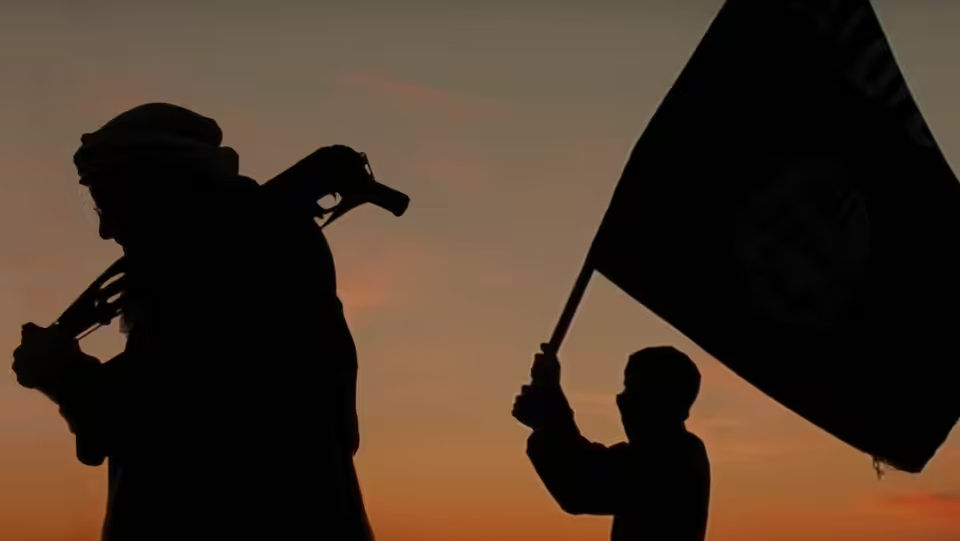
Not all of Heineman’s choices hold. H. Scott Salinas and Jackson Greenberg have written a low drone of strings and electronics that sits under nearly every scene, and it does not trust the footage. When Hamoud looks at his phone in silence, we are frightened. When the strings come in underneath him, we are watching a film again, and we noticed the difference every time. Heineman’s own images are also handsomer than they need to be: men in silhouette on a balcony at dusk, a cigarette ember, a city through a wet window at night. This is a thin complaint to make against a film shot in these circumstances. We make it anyway, because the phone footage from Raqqa is so plainly stronger than anything composed, and the film knows it.
The last stretch, in Germany, is where it loosens. Heineman widens out to what the new country makes of these men, including marches in the streets against people like them, and the point is fair, but it belongs to another film, and the group’s own story idles while he makes it. Some critics have found the structure a problem throughout. We found it a problem for the last twenty minutes, and forgave it, because by then the film had earned a good deal of credit.
Abu Bakr Al-Baghdadi is first in the credits, as Self. He appears in Isis’s own footage, in a black robe at a pulpit, announcing a caliphate in the cadences of a man who has rehearsed. The men who filmed back from bedroom windows get the rest of the billing. Ninety minutes, certificate 18, and a scene with a laptop you will be carrying about for a while.