Matthew Heineman’s documentary rides with vigilantes on both sides of the Mexican border and gets closer to a gunfight than most war films would dare. The Mexican half is remarkable. The Arizona half is a footnote the film keeps insisting is a chapter.
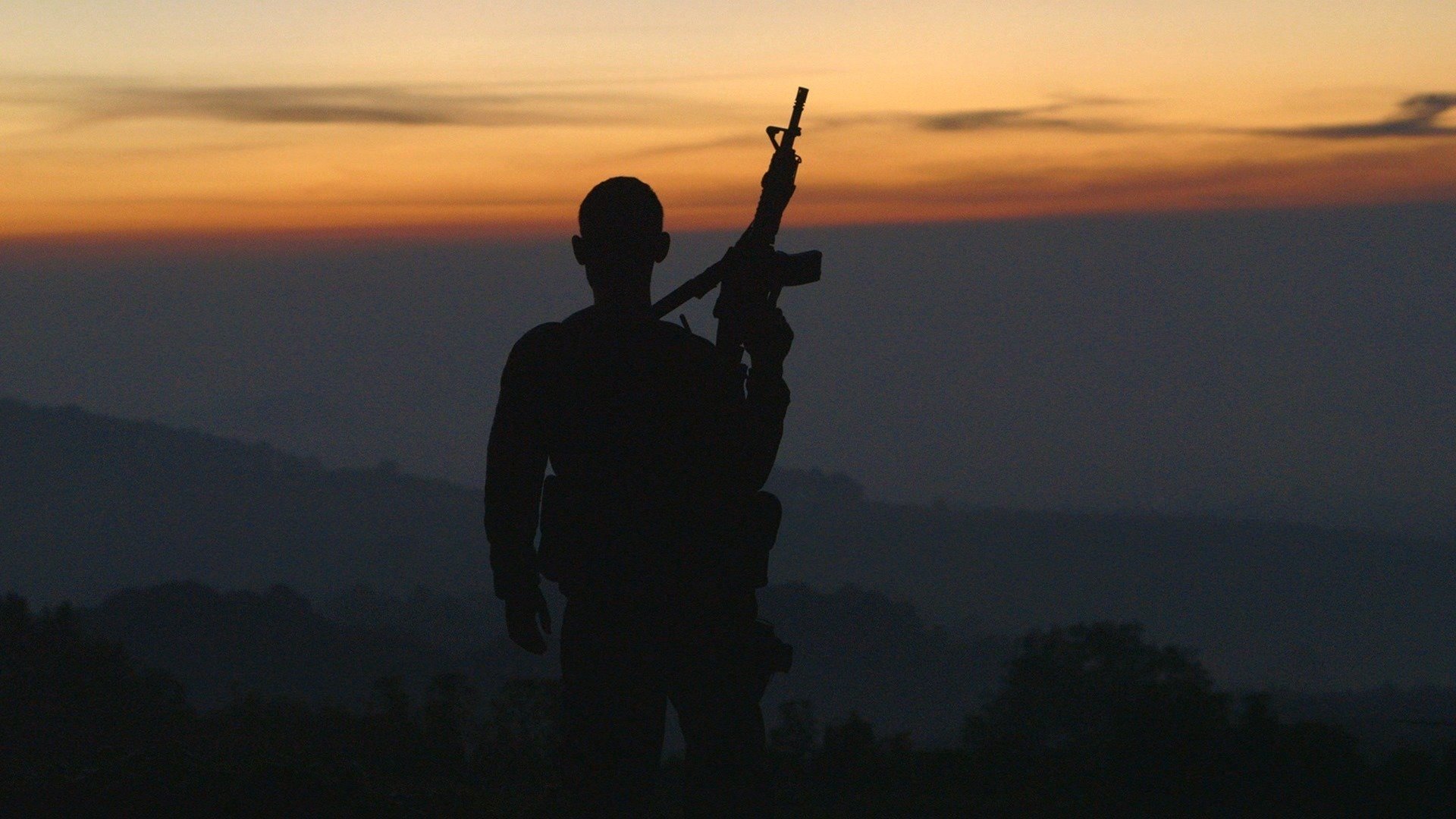
Cartel Land opens at night with men cooking methamphetamine in the Michoacán scrub, faces wrapped, a chemical fog drifting through the torchlight, and one of them telling the camera that if they did not do this someone else would. It is a bold way to begin and it sets out the film’s method. Matthew Heineman, who directs and shares the camera with Matt Porwoll, does not narrate, does not interview experts, and does not stand back. He goes where the guns are and points the lens at them.
The guns belong mainly to the Autodefensas, a militia raised in the town of Tepalcatepec by José Manuel Mireles Valverde, a doctor who decided that since the police and the army would not fight the Knights Templar cartel, he would. Dr Mireles is tall, easy in front of a crowd and easy in front of a camera, and Heineman knows exactly what he has in him. We watch him address a town square and tell the people to arm themselves. We watch him treat a patient, and we watch him come home to his wife, Ana Valencia, who has the expression of a woman who has stopped arguing.
The scene that made us sit forward comes when the militia rolls into a town and the shooting starts. Heineman keeps filming from behind a car door while rounds crack off the walls, and the camera does what a frightened person does: it drops, it swings, it finds a face. We were frightened, and more so than in any staged gunfight we can remember, because nobody had blocked this out and the men in frame did not know how it would end either. Bradley J. Ross, Pax Wassermann, Matthew Hamachek and Heineman himself cut it so that we always know roughly where the street runs, which is a kindness the footage did not have to grant.
Earlier, and quieter, is the moment that horrified us. A woman at a funeral describes, without raising her voice, what the cartel did to her family, the lime pickers who could not pay. The camera holds on her and does nothing else. It is the film’s case for Mireles made in one shot, and it is why, for a long stretch, we found ourselves cheering men with rifles and hoods, which is not a position we expected to be in.
Then the second half takes a turn we will not describe, except to say that it concerns what happens to a movement when it wins territory, when the government arrives to shake hands, and when the spokesman, Estanislao Beltránin, starts speaking for himself. The editors shape this like a thriller, with reversals landing where a screenwriter would put them, and mostly the material earns it. H. Scott Salinas and Jackson Greenberg’s score, a low pulse and drone, sometimes does too much. When a man is being hooded in a town square we do not need to be told to feel tense.
The weakness, and most critics have named it, is Arizona. Tim Nailer Foley leads a small group called Arizona Border Recon through the desert at night, in camouflage, with night-vision and a radio, looking for smugglers who mostly do not appear. His girlfriend, Janet Fields, gets a scene. Foley talks about the cartel a great deal and encounters it very little, and the film cuts back to him at intervals as if to say the two stories are the same story. They are not. One is a town under siege and the other is a few men waiting in the dark, and every trip north drains pressure from the south.
There is a larger complaint. Heineman moves fast, at 101 minutes, and he rarely stops to ask Mireles the questions we were asking from the sofa: who chooses whom to hood, what happens to the men driven away in trucks, how much of this is justice and how much is a new set of bosses. The footage raises those questions on its own. The film does not always stay to hear the answer.
Still, we would put it in front of anyone who wants to understand why a doctor picks up a gun, and we would warn them that the film is a 15 for good reason. Watch it at home with the lights down and the subtitles on. The Spanish is quick and the faces tell you the rest.