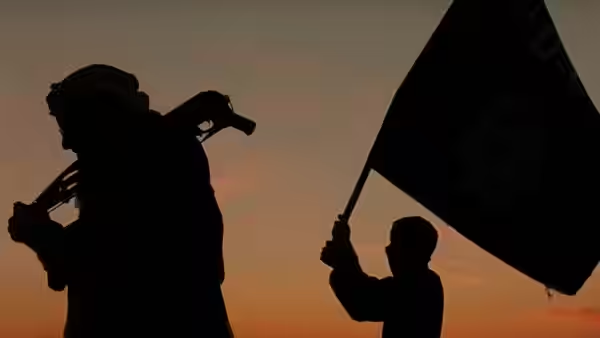
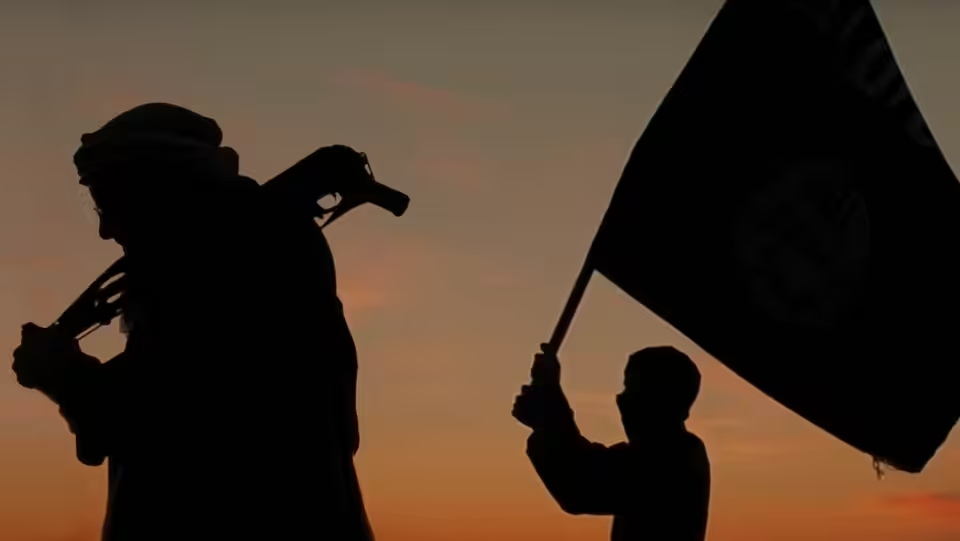
A silhouetted man films as another raises a black flag at sunset
Film review

City of Ghosts

2017 · Directed by Matthew Heineman · 1h 30m

In a sentenceIsis cuts its executions like a trailer; the men filming back have cracked phones, one laptop and no sleep

Raqqa, northern Syria, 2014. Islamic State has taken the city and declared it the capital of its caliphate; it kills people in the public squares, leaves the bodies on display and films the results. A handful of young men who marched against the regime in 2011, among them Hamoud, Mohamad and Hussam, begin filming secretly on their phones and smuggling the footage out under the name Raqqa is Being Slaughtered Silently. Isis names them as enemies and hunts them. Most flee to Turkey, then Germany, where they keep publishing from rented flats while colleagues still inside the city send what they can. Hamoud’s brother Hassan is with him in exile; Naji Jerf, a filmmaker, works alongside them in Turkey. Matthew Heineman follows them with a single camera as the threats cross the border after them.

Plays from YouTube when you press play; nothing loads from them until then.

Fi1m review

Matthew Heineman’s film about the citizen journalists of Raqqa is Being Slaughtered Silently is the plainest account we have seen of what Isis did to a city. It loses its grip in Germany and the music never stops, but see it.

Matthew Heineman’s last film, Cartel Land (2015), put him in the back of pickup trucks with Mexican vigilantes. City of Ghosts is quieter and worse. Its subjects are the members of Raqqa is Being Slaughtered Silently, a group of young men from a provincial Syrian city who, when Islamic State took it in 2014 and began killing people in the squares, started filming on their phones and sending the footage out. Isis answered by hunting them. By the time Heineman catches up, most of the group are in Turkey and Germany, running the operation from rented flats, and the film is about what happens to men who have left a city and cannot stop looking at it.

It is the plainest film we have seen about Isis and we recommend it, with the warning that the 18 certificate is earned inside ten minutes. Heineman shoots it himself, hand-held and close, in kitchens and on balconies, and cuts, with Pax Wassermann and Matthew Hamachek, between three kinds of picture: his own; the group’s shaky phone footage of Raqqa, bodies left on railings, children standing about; and Isis’s own productions, which are the real shock of the film. The Isis films have slow motion, drone shots, graded colour and a score. They look like trailers. The men fighting them have one laptop and a Wi-Fi router that keeps dropping.

We were horrified, and not mainly by the executions. Heineman and his editors are careful with those; they cut away early, or stay on a face watching a screen rather than on the screen. What got at us was a scene in which Hamoud and his brother Hassan sit in front of a laptop and watch something Isis has made for them to see. The camera stays on Hamoud. He does not move and he does not look away. Afterwards he goes back to work, and we understood, for the first time in a film about this war, that these men are not brave in the way a poster means it. They are too tired to stop.

Heineman has the access a documentary like this lives on, and nobody performs for him. Hamoud says the least of anyone and carries the most. Mohamad keeps his phone within reach the whole time, because people still inside Raqqa are sending him pictures, and when it does not ring his face does something we did not enjoy watching. Hussam is the one who still makes jokes, and the jokes are good. Naji Jerf, who films and edits with them in Turkey, is given the warmest minutes in the film and is the closest thing the group has to an older brother.

Not all of Heineman’s choices hold. H. Scott Salinas and Jackson Greenberg have written a low drone of strings and electronics that sits under nearly every scene, and it does not trust the footage. When Hamoud looks at his phone in silence, we are frightened. When the strings come in underneath him, we are watching a film again, and we noticed the difference every time. Heineman’s own images are also handsomer than they need to be: men in silhouette on a balcony at dusk, a cigarette ember, a city through a wet window at night. This is a thin complaint to make against a film shot in these circumstances. We make it anyway, because the phone footage from Raqqa is so plainly stronger than anything composed, and the film knows it.

The last stretch, in Germany, is where it loosens. Heineman widens out to what the new country makes of these men, including marches in the streets against people like them, and the point is fair, but it belongs to another film, and the group’s own story idles while he makes it. Some critics have found the structure a problem throughout. We found it a problem for the last twenty minutes, and forgave it, because by then the film had earned a good deal of credit.

Abu Bakr Al-Baghdadi is first in the credits, as Self. He appears in Isis’s own footage, in a black robe at a pulpit, announcing a caliphate in the cadences of a man who has rehearsed. The men who filmed back from bedroom windows get the rest of the billing. Ninety minutes, certificate 18, and a scene with a laptop you will be carrying about for a while.
Critical consensus AI synthesised

79
Positive
15
Mixed
2
Negative
0

Most critics rate Heineman’s documentary highly, and they agree on where its force lies. Review after review praises the closeness of his access to the citizen journalists of Raqqa is Being Slaughtered Silently, and the way the film keeps their grief, fear and resilience in view rather than the spectacle of Islamic State violence. Several single out the toll on the activists’ families, and one notes the restraint of the editing, which conveys the horror without always showing death.

The reservations are about shape rather than substance. IndieWire finds the film struggles to pull its material into a coherent whole, Slant thinks the final act falters, and Variety suggests it feels less urgent than the journalists’ own work. Little White Lies praises its compassion but rates it lower than most. The spread is narrow: no critic is negative, and the only disagreement is over whether the film’s craft matches the courage it records.

The Guardian
27 January 2017 · ★★★★★ · Charlie Phillips
100

Phillips calls the documentary a triumphant, potentially definitive account of Syria and citizen journalism. He praises its intimate portrayal of activists’ trauma and the chilling detail of their media war with Isis.

Read the full review →
Los Angeles Times
13 July 2017 · Kenneth Turan
90*

Turan finds the documentary powerful and unnerving, emphasizing the grave human cost of reporting on Islamic State. He praises Heineman’s intimate access to the citizen-journalists and their dangerous work.

Read the full review →
Empire
17 July 2017 · Andrew Lowry
80*

Lowry gives the documentary a strongly positive verdict, calling it an important and moving film. He singles out the courage and quiet professionalism of the Syrian citizen journalists it follows.

Read the full review →
Evening Standard
16 November 2017 · ★★★★ · Charlotte O'Sullivan
80

O'Sullivan finds the documentary harrowing yet visually beautiful, tender and often funny, ultimately treating it as hopeful. She praises the journalists’ resilience and resourcefulness as they risk everything to expose Islamic State.

Read the full review →
The i Paper
21 July 2017 · ★★★★ · Matthew Turner
80

Turner calls the documentary vital and upsetting, arguing that its disturbing imagery is justified by the urgency of its story. He singles out its personal account of the activists’ courage and the devastating impact of ISIS’s violence on their families.

Read the full review →
IndieWire
7 July 2017 · B · David Ehrlich
77

Ehrlich finds the documentary harrowing and urgent, though it struggles to shape its material into a coherent whole. He praises its vivid illustration of how media can help resist ISIS.

Read the full review →

Straight answers AI written, from our review

Is City of Ghosts worth watching?
City of Ghosts is worth watching for anyone prepared to see plainly what Isis did to Raqqa, and we scored it 78. Matthew Heineman follows the citizen journalists of Raqqa is Being Slaughtered Silently into exile, and the film is strongest in their kitchens, watching them watch their city. The music never lets up and the German stretch loosens, but we recommend it.
How long is City of Ghosts, and what is it rated?
City of Ghosts runs 1h 30m. It is a war and documentary film.
Where can I watch City of Ghosts in Singapore?
City of Ghosts is streaming on Amazon Prime Video in Singapore, and it is also available to rent from Apple TV from S$5.98. Availability is checked daily; the links above go straight to each service.
How violent or frightening is City of Ghosts, and is it suitable for children?
City of Ghosts carries an 18 certificate and earns it inside ten minutes, so it is not for children. It shows phone footage of bodies left on display in Raqqa and uses Isis's own execution films, though Heineman cuts away early or stays on the face of the person watching. The hardest scene is two brothers in front of a laptop, and the squeamish will find it difficult.
How does City of Ghosts compare to For Sama?
City of Ghosts is the plainer and more composed of the two films, while For Sama is the harder to watch and the harder to forget. Heineman films from outside, following men who have fled Raqqa; Waad al-Kateab filmed the siege of Aleppo from inside a hospital and addresses it to her daughter. We recommend both, and suggest seeing City of Ghosts first.
What should I watch after City of Ghosts?
After City of Ghosts, try For Sama (2019, Fi1m 88): Aleppo under siege, filmed by a mother for her daughter; harder to watch and harder to forget. Then Cartel Land (2015, Fi1m 75): Heineman’s earlier film, embedded with Mexican vigilantes, shows the same nerve and the same weakness for music; and The Act of Killing (2012, Fi1m 88): Indonesian death-squad veterans restage their murders as cinema; the uses of propaganda, from the other side.

Cast

If you liked this, try…

  1. For Sama (2019, Fi1m 88)Aleppo under siege, filmed by a mother for her daughter; harder to watch and harder to forget.

  2. Cartel Land (2015, Fi1m 75)Heineman’s earlier film, embedded with Mexican vigilantes, shows the same nerve and the same weakness for music.

  3. The Act of Killing (2012, Fi1m 88)Indonesian death-squad veterans restage their murders as cinema; the uses of propaganda, from the other side.

  4. Five Broken Cameras (2011) · not reviewed yetA Palestinian farmer films his village’s protests camera by camera, each one destroyed in turn.

  5. Return to Homs (2013) · not reviewed yetA goalkeeper turned fighter in a Syrian city coming apart; raw, close and without commentary.