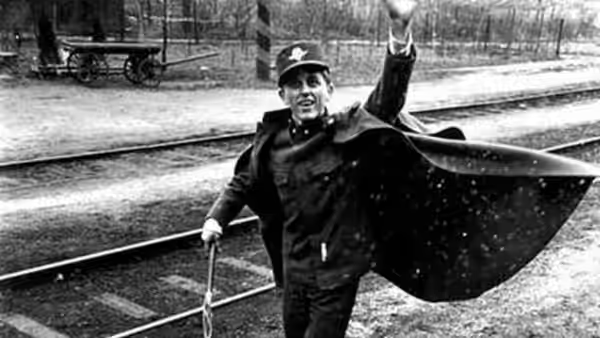
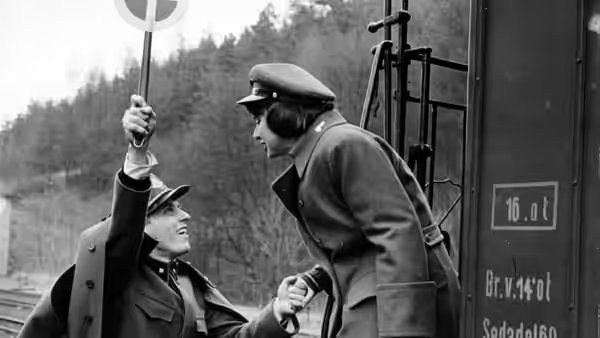
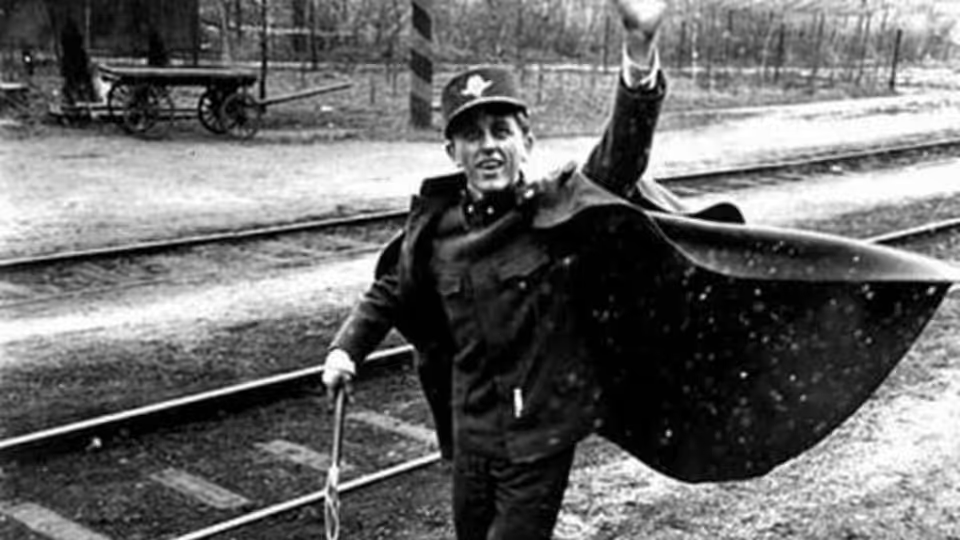
A uniformed railway worker waves beside the tracks, holding an umbrella open overhead
Film review

Closely Watched Trains

1966 · Directed by Jiří Menzel · 1h 33m

In a sentenceSex would be quite enough for this railway trainee to worry about without the war

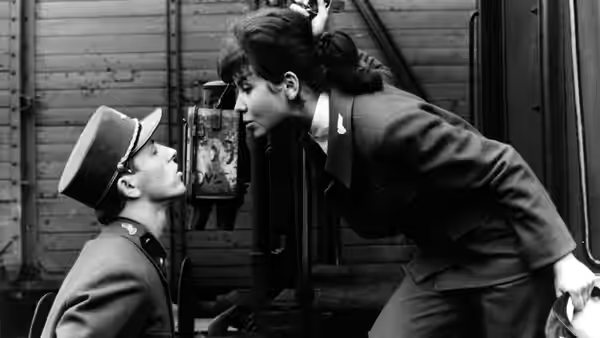
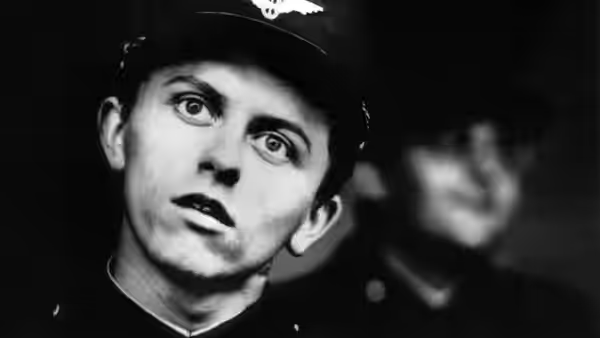
Milos Hrma (Václav Neckář) is a railway trainee during wartime, with sexual inexperience occupying his thoughts alongside his duties. His working world includes Stationmaster Max (Vladimír Valenta), dispatcher Hubicka (Josef Somr) and conductress Masa (Jitka Bendová). Milos wants to find his way into adult sexual life, but has little experience to help him. The station gives him a place within an established hierarchy while leaving his private uncertainties unresolved. As he negotiates railway work and his interest in sex, the war makes it difficult to keep personal concerns apart from political events.

Fi1m review

Jiří Menzel’s wartime railway comedy is funny, patient and more affecting than its modest manner suggests. Its sympathy for a sexually inexperienced trainee is persuasive, though the women deserve more of that attention.

Closely Watched Trains takes a railway trainee’s sexual worries seriously enough to make a funny, affecting film about them. Jiří Menzel lets Milos be distracted by his own inexperience without treating him as a fool for failing to concentrate on the war. That patience is the film’s chief pleasure. We recommend it warmly, with a reservation about how little of its sympathy reaches the women.

Jiří Menzel and Bohumil Hrabal’s screenplay, drawn from the latter’s novel, resists the usual wartime demand that an ordinary person immediately become exemplary. Milos is allowed to be inexperienced, distracted and concerned with something that matters urgently to him. The comedy understands how large sex can seem before it has become part of ordinary life. That makes the political pressure more disturbing: we have first been encouraged to take this young man’s apparently small problems seriously.

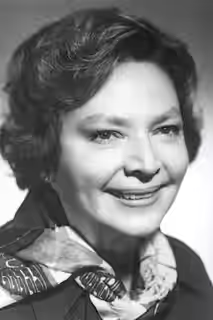
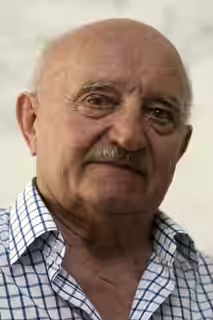
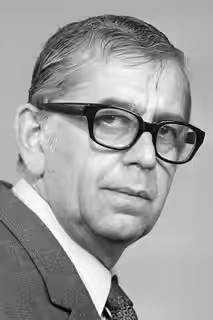
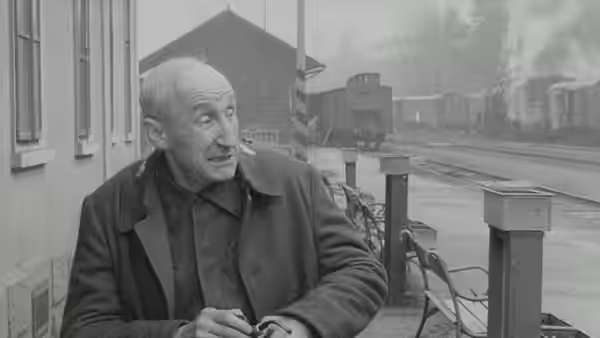
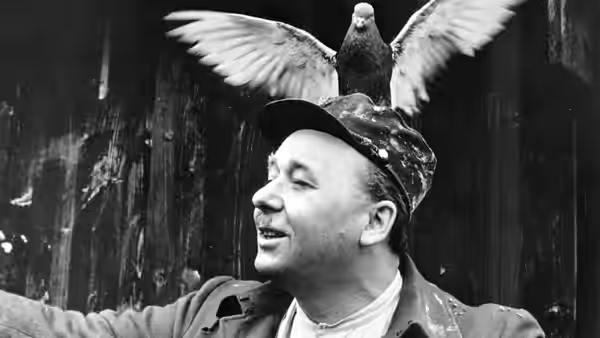
Václav Neckář gives Milos a vulnerability that keeps the sexual comedy from becoming a prolonged invitation to laugh at him. We felt protective of him, because his uncertainty about sex is allowed to trouble him even when it amuses us. Josef Somr as dispatcher Hubicka and Vladimír Valenta as Stationmaster Max give the railway hierarchy comic weight. The job titles give these men a standing that Milos has yet to acquire, and the comedy is alert to how much that can matter.

Jaromír Šofr’s cinematography makes the people worth studying without making their everyday concerns seem grand. The attention to faces suits a story in which embarrassment can matter more than an explanation. Oldřich Bosák’s production design gives the station the settled feel of a workplace whose habits predate its newest employee. The surroundings help make the trainee’s discomfort understandable: we can believe these people have been irritating one another for years, and that joining them requires more than learning the work.

Jiřina Lukešová’s editing lets awkwardness last long enough to become uncomfortable. A faster film might have hurried Milos towards a lesson or reduced his inexperience to a succession of comic mishaps; this one gives us time to become fond of him. Jiří Šust’s music fits that measured approach, supporting the comedy without making Milos’s anxiety seem trivial. Such restraint matters here, because the sexual material could easily have become cosy, and because the war has to remain more than an inconvenient background.

The reservation concerns the women, particularly the limited terms on which the sexual coming-of-age story asks us to consider them. Jitka Bendová’s Masa belongs to a film much more curious about what sex means for Milos than about what it means for her. That imbalance narrows the comedy, and affection for its central character does not make it disappear. Some of the humour assumes we will share a male view of sexual experience simply because the man having it is shy.

Still, Jiří Menzel gets the scale of private worry right. We were moved by the way Milos’s sexual concerns become vulnerable to political events, because we had come to care about those concerns ourselves. For a wartime comedy, that is a welcome willingness to let ordinary people worry about something other than history. Give it 93 minutes when you have the patience for shy people and the irritation they cause themselves.

Critical consensus AI synthesised

72
Positive
2
Mixed
2
Negative
0
Empire
1 January 2000 · David Parkinson
85*

Parkinson gives the film a strongly positive verdict, calling it a bittersweet gem. He praises Menzel’s subversive absurdism and the humane, unsentimental portrayal of its characters.

Read the full review →
Time Out
29 July 2013
66*

The available metadata presents the film as an acclaimed Menzel work, but provides no explicit critical verdict. It highlights the wartime railway worker’s sexual initiation as the central subject.

Read the full review →
The New York Times
13 February 1991
65*

The available page text does not reveal the critic’s verdict. The URL headline refers to a tale of repression, but the review’s specific praise or complaint is unavailable.

Read the full review →
Eye for Film
23 February 2004 · Andrea Mullaney
70*

Mullaney finds the film’s message touching, despite its dated sexism. She especially praises how personal concerns are overwhelmed by larger political events.

Read the full review →

Straight answers AI written, from our review

Is Closely Watched Trains worth watching?
Closely Watched Trains is worth watching for its patient, affecting comedy about sexual inexperience during wartime; we score it 82 out of 100. We recommend it to those who enjoy unhurried character comedy, with the caveat that its sympathy for the young railway trainee extends too little to the women around him.
How long is Closely Watched Trains, and what is it rated?
Closely Watched Trains runs 1h 33m. It is a comedy and drama film.
Where can I watch Closely Watched Trains in Iceland?
Closely Watched Trains is not on any streaming or rental service in Iceland at the moment. It is available in 3 other countries; change your country at the top of the page to see where. Availability is checked daily.
How violent or frightening is Closely Watched Trains, and is it suitable for children?
Closely Watched Trains has no UK or US certificate listed, so there is no age classification here to guide a choice for children. Its sustained interest in sexual inexperience and wartime pressures makes it a film we would suggest for older audiences. We cannot give a reliable assessment of violence or frightening imagery from the material described.
Is Closely Watched Trains based on a true story or a book?
Closely Watched Trains is adapted from Bohumil Hrabal’s novel, with a screenplay by Hrabal and director Jiří Menzel. We find its railway trainee’s sexual worries and working life accessible without knowing the book, though we cannot say how closely the adaptation follows it.

Cast

Awards

Academy Awards, 1968

Won
Best International Feature Film

International Submission to the Academy Awards, 1968

Nominated
International Submission to the Academy Awards

If you liked this, try…

  1. The Firemen's Ball (1967) · not on Fi1m yetPetty authority and human foolishness receive an equally patient, less forgiving inspection.

  2. The Shop Around the Corner (1940) · not on Fi1m yetWorkplace hierarchies complicate private longing, with tenderness earned through sharply observed behaviour.

  3. Good Morning (1959) · not on Fi1m yetSmall embarrassments and everyday routines expose the rules adults take for granted.

  4. The Last Detail (1973) · not on Fi1m yetUniformed men negotiate duty, pleasure and the limits of looking after one another.

  5. The Match Factory Girl (1990) · not on Fi1m yetAnother overlooked worker, though the deadpan humour is considerably more unforgiving.