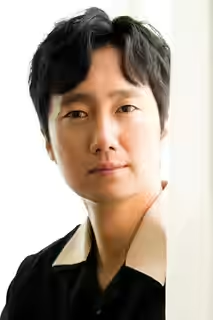
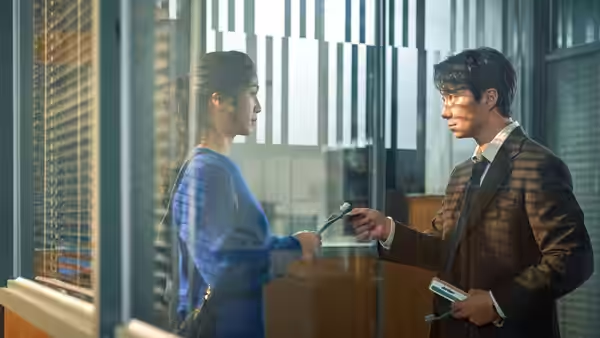
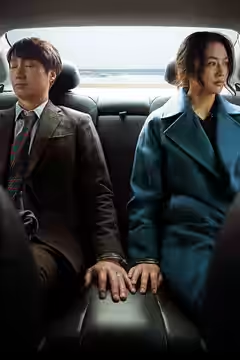
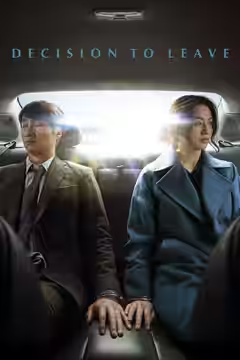
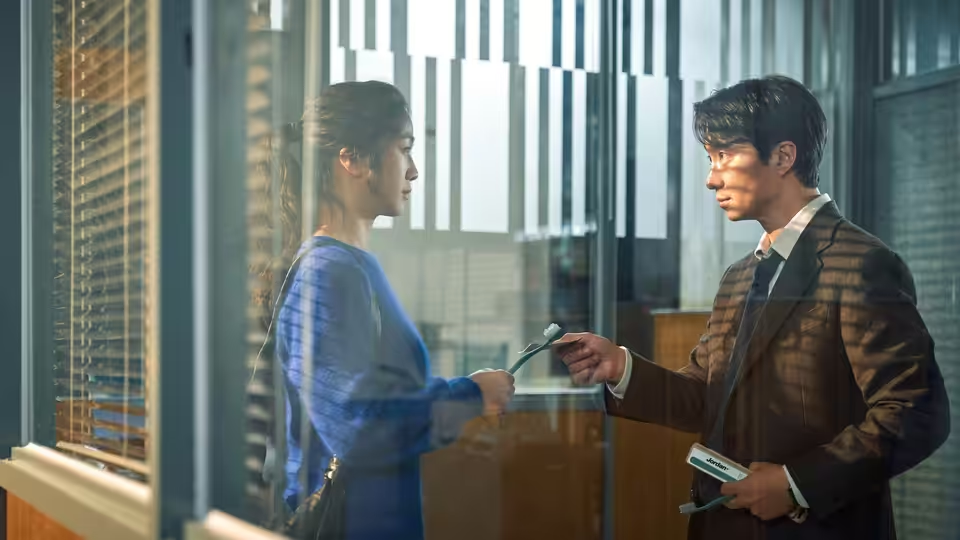
Jang Hae-joon (Park Hae-il) offers Song Seo-rae (Tang Wei) an item through a glass partition
Film review

Decision to Leave

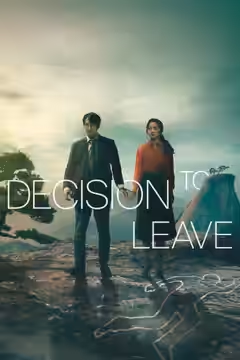
2022 · Directed by Park Chan-wook · 2h 19m

In a sentenceThe gentlest film ever made about a policeman going to pieces, with a translation app as go-between

Busan. Detective Jang Hae-joon (Park Hae-il), who has not slept properly in years, is called to the foot of a rock face where Ki Do-soo (Yoo Seung-mok), a man who climbed it every week, has fallen to his death. The widow is Song Seo-rae (Tang Wei), a Chinese immigrant who cares for elderly women and speaks a careful, slightly formal Korean, sometimes through the translation app on her phone. She does not seem to grieve much. Hae-joon’s junior partner Soo-wan (Ko Kyung-pyo) is sure she killed him. Hae-joon is married to Jeong-ahn (Lee Jeong-hyeon), who lives in the foggy coastal town of Ipo and sees him at weekends. He begins staking out Seo-rae’s flat at night, watching her eat ice cream and fall asleep in front of the television, and brings her sushi to the interview room.

Plays from YouTube when you press play; nothing loads from them until then.

Fi1m review

Park Chan-wook’s quietest film is a murder inquiry with a love story where its case should be, and the love story is the best thing he has made in years. The second half ties itself in plot it does not need; Tang Wei and Park Hae-il untie it.

Park Chan-wook is the man who gave us the corkscrew in Oldboy and the octopus in The Handmaiden, and Decision to Leave has almost no blood in it. A body at the foot of a cliff, a bruise or two, and that is about all. It is a detective story in which the detective falls in love with his suspect, and Park treats the falling with the same care he once gave to hammers. It is his best film since The Handmaiden, it runs 139 minutes, and it is about twenty of those too clever.

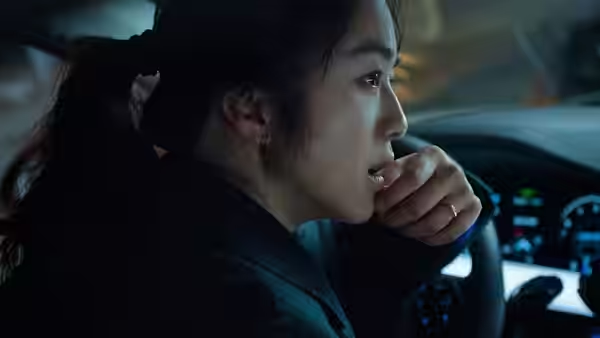
Hae-joon, played by Park Hae-il, is a good policeman and a tidy one. He keeps hand cream in his desk, his shirts are pressed, his wall at home is covered in the photographs of cases he has not solved. He cannot sleep. Seo-rae, played by Tang Wei, is the widow of the man on the rocks, and she answers his questions with a politeness that never quite becomes an answer. Their first long scene together is in an interview room, where he lays out expensive sushi for her as if it were a date and then seems to remember what room they are in. We found it funnier and sadder than we expected, and by the time he admits to her that he has stopped sleeping we were on his side and knew we should not be.

Kim Ji-yong’s camera is the film’s other detective. When Hae-joon watches Seo-rae’s flat from across the road, Kim puts him beside her, standing at her shoulder while she eats, so that the stakeout looks like the cohabitation he is imagining. The camera looks out from a dead man’s eye, from the screen of a phone, from inside a fridge. Kim Sang-bum cuts on matched actions, her spoon going up as his eye drops go in, so two people in different buildings seem to share a table. It is showing off, and it is also exactly how obsession feels from the inside, which is why we forgave it.

Ryu Seong-hie’s production design gives Seo-rae a flat papered in mountains, in a colour the characters argue about: he says blue, she says green, and Kwak Jung-ae dresses her in the same undecided shade. Hae-joon’s flat is clean and grey and full of pins. Cho Young-wuk’s score is mostly strings that rise towards something and stop short, and Park leans hard on an old Korean ballad called ‘Mist’, which turns up more often than it needs to and works every time.

Tang Wei is doing something difficult here. Seo-rae’s Korean is learned, and Tang plays a woman choosing every word and occasionally handing the job to her phone, which reads out her Chinese in a flat synthetic voice. The gap between what she means and what comes out is where the whole film lives. Park Hae-il’s unravelling is a matter of posture: the shirts stay pressed, the shoulders go. Lee Jeong-hyeon, as the wife who talks about sex the way other people talk about vitamins, has a thankless part and is drily good in it.

The trouble arrives with the second half. The story moves to Ipo, where the fog comes in off the sea and nobody can see across a car park, and the script by Park and Jeong Seo-kyeong sets up a second case that echoes the first with the variables changed. This involves phones, watches, recordings, deleted files and a number of things we will not describe. We lost the thread twice. The first time we got it back and did not mind. The second time we minded, because Tang Wei was on screen and we were doing arithmetic.

Most critics have liked this film, and a few have found it cold. We think the few are wrong. It is the warmest film Park has made, and the coldness they are describing is the plot, which is a different thing. The debt to Vertigo is plain and unhidden: a policeman, a woman who may not be what she says, a second act that replays the first. Park is not embarrassed by it and neither were we.

The last scene we will not describe, except to say that it moved us more than the preceding half hour had earned, and that this is both Park’s point and his problem. See it twice. The first time for the case, the second for what is happening in the corners of the frame while the case is being explained.
Critical consensus AI synthesised

77
Positive
27
Mixed
5
Negative
0

Most critics like it, and many like it a great deal. The reviews describe a murder mystery that turns out to be a love story, and the praise gathers in two places: Park Chan-wook’s direction, particularly the inventiveness of his compositions and the precision of the editing, and Tang Wei’s performance as the suspect, which several critics name as the thing that makes an enigmatic character worth following. Her chemistry with Park Hae-il comes up nearly as often.

The reservations are about the second half. Several critics find the middle baggy or the final third drifting, and some feel the plot’s technology and twists grow overcomplicated. The spread is narrow, with no outright negative reviews, but a few dissent: Slant finds the thriller so convoluted that the romance goes inert, Vulture finds it fragmentary and emotionally distant despite a haunting finale, and Deadline faults the pacing and an unfeeling conclusion. Even they praise Tang Wei.

IndieWire
23 May 2022 · A- · David Ehrlich
90

Ehrlich calls it an unexpectedly romantic procedural whose restrained approach still delivers a deeply affecting finale. He praises Park’s precise editing and staging, while noting that the technology-driven plot and complicated third act can feel overworked.

Read the full review →
Los Angeles Times
13 October 2022 · Justin Chang
90*

Chang finds the film an invigorating, despairing love story and a luxuriant romantic noir. He especially praises Park’s inventive visual style and Park Hae-il and Tang Wei’s performances.

Read the full review →
The AV Club
13 October 2022 · A- · Mark Keizer
90

Keizer praises the film as an intricate, restrained, and probing drama, though its tragic ending feels more intellectual than emotional. He singles out Park’s visual inventiveness and the leads’ finely calibrated chemistry.

Read the full review →
The Guardian
23 May 2022 · festival review · Peter Bradshaw
90*

Bradshaw gives the film a strongly positive verdict, calling it gorgeously made and gripping. He particularly praises Tang Wei’s magnificent performance and the film’s suspenseful, consistently surprising storytelling.

Read the full review →
The Hollywood Reporter
23 May 2022 · festival review · David Rooney
90*

Rooney finds the film intoxicating and praises Park as a world-class artist at the top of his game. He singles out the leads’ smoldering chemistry and the film’s ravishing visuals, especially its striking compositions.

Read the full review →
Empire
19 October 2022 · Nick de Semlyen
85*

The critic calls it a tremendous, sophisticated erotic thriller and praises Park’s inventive visual storytelling. The middle section occasionally feels baggy, but Tang Wei’s mesmerizing performance and the film’s precise camerawork stand out.

Read the full review →

Straight answers AI written, from our review

Is Decision to Leave worth watching?
Decision to Leave is worth watching for anyone who wants a detective story that is really a love story, and we scored it 82. Park Chan-wook's quietest film puts Tang Wei and Park Hae-il in an interview room and lets the case fall away around them. The second half adds plot it does not need, and we lost the thread twice.
How long is Decision to Leave, and what is it rated?
Decision to Leave runs 2h 19m. It is a thriller and mystery film.
Where can I watch Decision to Leave in Estonia?
Decision to Leave is available to rent from Apple TV from €3.99. Availability is checked daily; the links above go straight to each service.
How violent or frightening is Decision to Leave, and is it suitable for children?
Decision to Leave carries a UK 15 certificate but has almost no blood in it: a body at the foot of a cliff, a bruise or two, and that is about all. It is slow, adult in its concerns and not frightening in any ordinary sense. It is not for children, who would be bored long before they were troubled.
How does Decision to Leave compare to Vertigo?
Decision to Leave takes its shape from Vertigo openly: a policeman, a woman who may not be what she says, a second act that replays the first. Park's film is the warmer of the two and the funnier; Hitchcock's is the tighter and the more uncomfortable. Anyone who likes one has good reason to see the other.
What should I watch after Decision to Leave?
After Decision to Leave, try Vertigo (1958, Fi1m 92): The policeman, the woman, the second act that replays the first; Park’s model, unhidden. Then In the Mood for Love (2000, Fi1m 91): Two people not having an affair, shot as if every corridor were a confession; and Memories of Murder (2003, Fi1m 91): Korean detectives failing, in the rain, with more feeling than most films manage succeeding.

Cast

Awards

Golden Globes, 2023

Nominated
Best Non-English Language Film

International Submission to the Academy Awards, 2023

Nominated
International Submission to the Academy Awards

If you liked this, try…

  1. Vertigo (1958, Fi1m 92)The policeman, the woman, the second act that replays the first; Park’s model, unhidden.

  2. In the Mood for Love (2000, Fi1m 91)Two people not having an affair, shot as if every corridor were a confession.

  3. Memories of Murder (2003, Fi1m 91)Korean detectives failing, in the rain, with more feeling than most films manage succeeding.

  4. The Handmaiden (2016, Fi1m 85)Park and Jeong Seo-kyeong’s previous script; louder, crueller, and just as much in love.

  5. Lust, Caution (2007) · not on Fi1m yetTang Wei earlier, playing another woman whose every sentence has a second purpose.