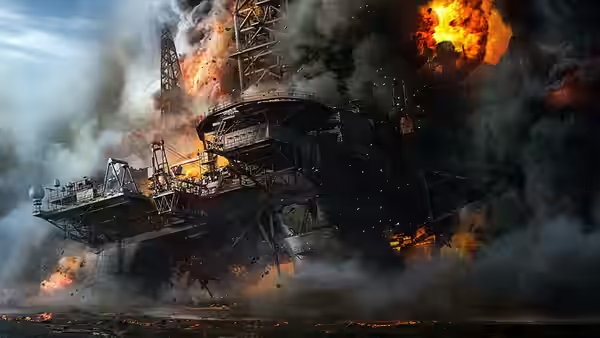
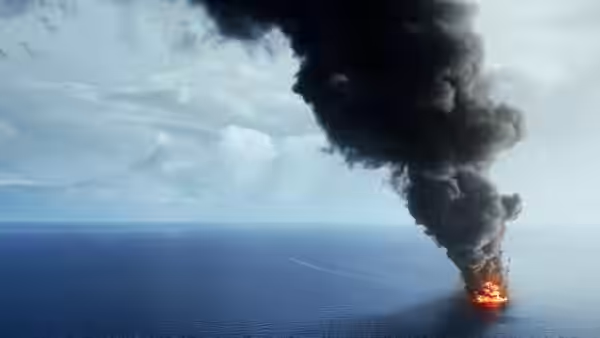
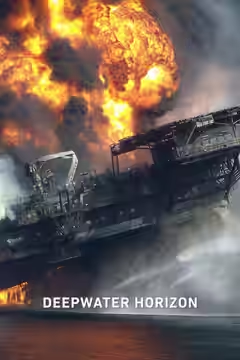
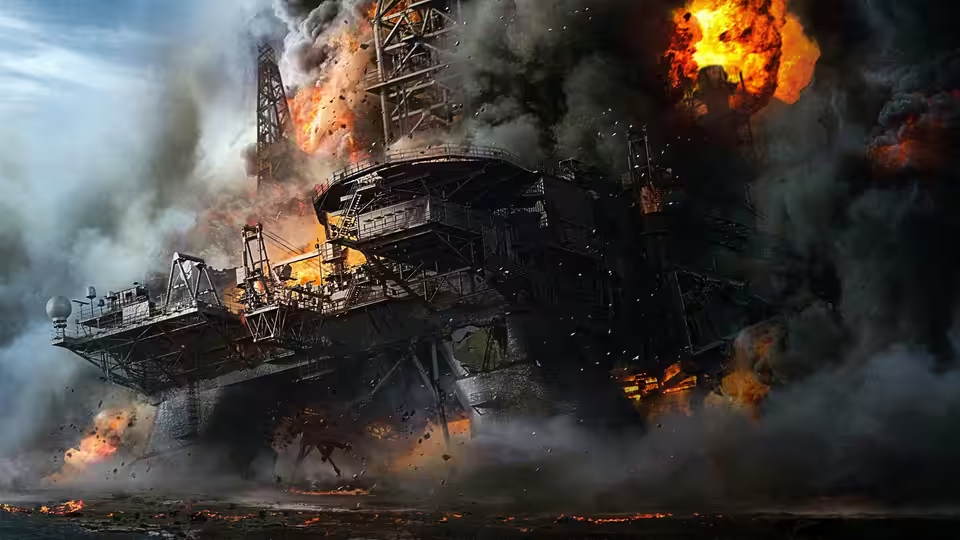
The Deepwater Horizon drilling rig erupts in flames and smoke above the water
Film review

Deepwater Horizon

2016 · Directed by Peter Berg · 1h 47m · PISF 12

In a sentenceAn hour of men in hard hats explaining mud, and then the mud explains itself

Gulf of Mexico, April 2010. Mike Williams (Mark Wahlberg), chief electronics technician on the drilling rig Deepwater Horizon, kisses his wife Felicia (Kate Hudson) goodbye, lets his daughter practise a school talk about his job with a shaken can of cola and a drinking straw, and takes the helicopter forty-odd miles out to sea for a three-week shift. On the rig he finds the well forty-three days behind schedule and the cement-testing crew already flying home. Jimmy Harrell (Kurt Russell), who runs the rig, wants the well tested properly; the two BP company men, Donald Vidrine (John Malkovich) and Robert Kaluza (Brad Leland), want to move on. On the bridge, Andrea Fleytas (Gina Rodriguez) watches the instruments. The night of 20 April, the pressure readings start to disagree with each other.

Plays from YouTube when you press play; nothing loads from them until then.

Fi1m review

Peter Berg’s reconstruction of the Deepwater Horizon blowout is at its best in the hour before anything goes wrong, and the fire, when it comes, is as frightening as anything in a horror film. It then loses sight of the men it came to honour.

On 20 April 2010 the Deepwater Horizon, a drilling rig in the Gulf of Mexico, blew out, burned for two days and sank. Eleven men died and the well beneath it leaked oil for months. Peter Berg’s film is about the night, not the months, and that choice shapes everything in it. The script by Matthew Sand and Matthew Michael Carnahan is built in two halves: an hour of what the rig was and who was on it, and forty minutes of it coming apart. The first half is excellent. The second is spectacular and then, in a way that matters, careless.

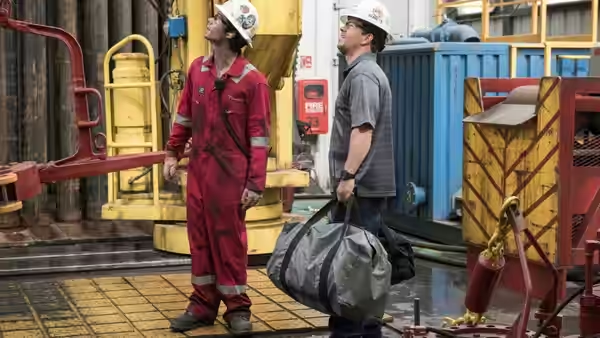
The hour of set-up is the best stretch of filmmaking Berg has managed. The cola-can demonstration Williams’s daughter gives at the kitchen table tells us in ninety seconds what a well is and what mud does, and the film trusts us to remember it. Chris Seagers designs the rig as a working place rather than a set, grey steel and yellow handrails, a drill floor slick with brown fluid, a bridge with too many screens and a galley with a cake in it. Enrique Chediak shoots it handheld, close to faces, and at night lets the rig’s own sodium lamps do the lighting, so the sea around it is simply black. Colby Parker, Jr. and Gabriel Fleming cut this hour with patience, holding on gauges and on the men reading them, and the arguments about the negative pressure test are as tense as any gunfight.

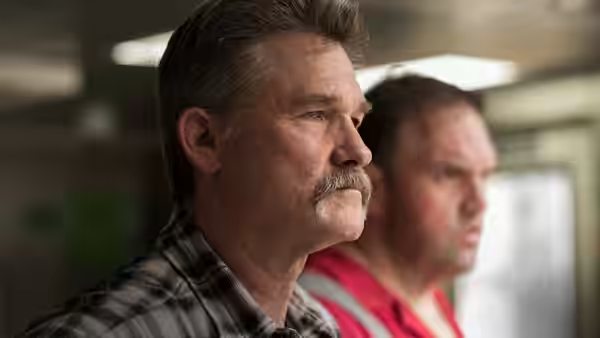
Kurt Russell carries that tension. His Jimmy Harrell, Mr Jimmy to the crew, talks slowly, says please, and makes it plain that the courtesy is a warning. Watching him stand on the drill floor and explain to the company men why their schedule is not his problem, we understood why a rig full of men would follow him. John Malkovich plays Vidrine with a Louisiana accent so thick it keeps pulling attention from what he is saying, which is a pity, because the script gives him a decent argument for impatience and he plays the man as someone who believes it. Wahlberg does what he does: capable, quiet, a man who checks things.

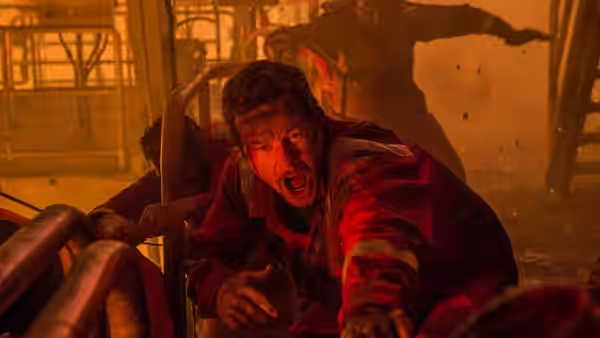
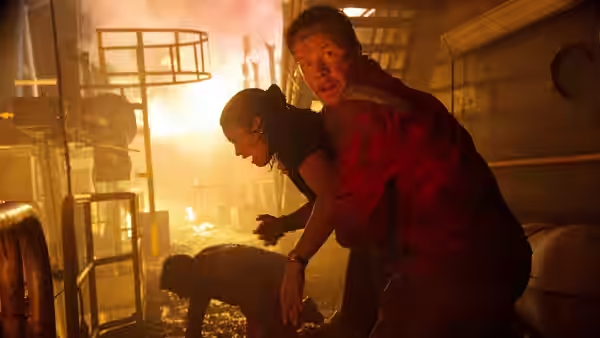
Then the well kicks. Mud comes up through the derrick, then gas, then the lights go, and when it finally ignites Berg stages it as a series of blows rather than one explosion, each worse than the last. We were horrified, plainly and physically. It was the men on the deck that did it, lit from one side by the fire and running with nowhere obvious to run to, and the sound of the rig itself, a noise like a jet engine that does not stop. Steve Jablonsky’s score has the sense to stay almost silent through this; the roar is the music. For ten minutes the film is as frightening as anything we have sat through in a long while.

The trouble is what the fire does to the people. Once everyone is covered in mud and blood, the cutting speeds up until we could no longer tell Dylan O’Brien’s Caleb Holloway from the half-dozen other young men on the drill floor, or work out which deck anyone was on and why they were going up rather than down. Gina Rodriguez has a strong scene on the bridge and is then handed a stretch of screaming. Kate Hudson, at home on the telephone, is cut back to again and again for no better reason than to remind us someone is waiting. Eleven men died that night, and the film means to honour them, but it rarely slows down long enough to let us know which ones they were.

It also ends where it ends. Berg’s anger is all in the first hour, aimed squarely at the men in the clean shirts, and it is well aimed. But the largest consequence of that night was not on the rig, and a film this sure of its villain might have found a minute for it. We will say no more than that the last scenes reach for an emotion the preceding forty minutes had not earned.

Against Berg’s own work it sits above Lone Survivor (2013), his previous film with Wahlberg, and below Friday Night Lights (2004), which understood that the people are the point. See it for Russell and for that first hour, which is a model of how to make an audience care about a pressure reading. It runs 107 minutes and carries a 12A, and the fire is loud enough that the certificate feels generous.

Critical consensus AI synthesised

68
Positive
15
Mixed
8
Negative
4

Most critics come down in favour, with fifteen of twenty-seven positive, and the praise is consistent about what works. The disaster itself is the draw: the sound design, the convincing physical recreation of the rig, and the chaos once the explosion begins are singled out again and again. Several reviews also credit the first hour’s patient attention to how the platform actually functions, and Kurt Russell’s performance is mentioned more often than any other.

The reservations cluster around what the film leaves out. A recurring complaint is that it stays on the rig and barely touches the environmental aftermath or the wider question of corporate blame, and some find the technical dialogue of the opening half hard to follow. The spread is wide: The Guardian credits the film with keeping BP’s responsibility in view, while Slant argues that centring one man’s heroism blunts the critique, and Deadline finds the spectacle crowding out the human story altogether.

Little White Lies
29 September 2016 · 3/5/4 · Elena Lazic
100

Lazic calls it a thrilling, expertly constructed action movie that succeeds without oppressive patriotism. She praises its precise explanation of the rig’s logistics and the realism of its effects.

Read the full review →
The i Paper
29 September 2016 · ⋆⋆⋆⋆ · Matthew Turner
87*

The critic calls it a gripping, realistic disaster drama and a worthy tribute to the victims and survivors. They praise the visceral, terrifying destruction, heightened by disorienting camerawork and stunning sound design.

Read the full review →
Radio Times
★★★★ · Trevor Johnston
80

Johnston gives the film a favorable four-star assessment. He praises its realistic depiction of oil-rig professionals, while noting that the technical dialogue can be impenetrable.

Read the full review →
The Guardian
14 September 2016 · ★★★★ · Benjamin Lee
80

The critic calls it a gruelling, effective disaster movie and a worthy tribute to the men involved. He praises its tense, clearly delivered technical detail and its forceful focus on BP’s responsibility.

Read the full review →
Los Angeles Times
29 September 2016 · Justin Chang
78*

Chang finds the film gripping and emotionally forceful, praising its harrowing disaster sequences and compassion for the workers. He singles out Kurt Russell’s performance and the realistic, beautifully filmed inferno, while noting the film leaves larger environmental questions unexplored.

Read the full review →
The Hollywood Reporter
13 September 2016 · festival review · Todd McCarthy
75*

McCarthy finds the film an effective, fast-moving disaster drama that vividly recreates the rig’s catastrophe. He especially praises the convincing physical production and seamless technical execution, which keep the action from feeling artificial.

Read the full review →

Straight answers AI written, from our review

Is Deepwater Horizon worth watching?
Deepwater Horizon is worth watching for its first hour, a patient and tense account of how a drilling rig works and who runs it, and we scored it 71. Kurt Russell's rig boss carries that stretch, and the fire that follows is as frightening as anything in a horror film. Once the blaze is burning, though, the editing speeds up and the men it means to honour become hard to tell apart.
How long is Deepwater Horizon, and what is it rated?
Deepwater Horizon runs 1h 47m and is rated 12 by the PISF in Poland. It is a drama and action film.
Where can I watch Deepwater Horizon in Poland?
Deepwater Horizon is available to rent from Amazon Prime Video from zł 9.99. Availability is checked daily; the links above go straight to each service.
How violent or frightening is Deepwater Horizon, and is it suitable for children?
Deepwater Horizon carries a 12A and is a disaster film rather than a violent one, but the fire is loud, prolonged and physically frightening, and men are shown burned, bloodied and running from an exploding rig. It is too intense for younger children, and we found the certificate generous. Teenagers with a tolerance for peril should cope; the squeamish should expect injuries rather than gore.
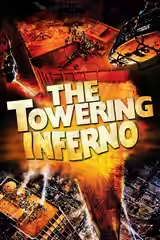
How does Deepwater Horizon compare to The Towering Inferno?
Deepwater Horizon is the tighter film and The Towering Inferno the longer and grander one; both are about bad decisions made by men in clean shirts and paid for by men in overalls. Berg's film is the stronger in its quiet first hour, which makes an audience care about a pressure gauge, while Irwin Allen's fire is the more sustained spectacle. Neither is much interested in its people once the flames arrive.
What should I watch after Deepwater Horizon?
After Deepwater Horizon, try The Towering Inferno (1974, Fi1m 68): The grandfather of the form: bad building decisions, good men in overalls, a very long fire. Then United 93 (2006, Fi1m 88): Greengrass reconstructs a real catastrophe in real time, without stars, and the dread is unbearable.

Cast

Awards

Academy Awards, 2017

Nominated
Best Sound Editing
Nominated
Best Visual Effects

If you liked this, try…

  1. The Towering Inferno (1974, Fi1m 68)The grandfather of the form: bad building decisions, good men in overalls, a very long fire.

  2. The China Syndrome (1979) · not reviewed yetJack Lemmon’s control-room operator knows something is wrong and nobody with a tie will listen.

  3. United 93 (2006, Fi1m 88)Greengrass reconstructs a real catastrophe in real time, without stars, and the dread is unbearable.

  4. Chernobyl (2019) · not reviewed yetFive hours on how a machine fails and how the people in charge explain it away.

  5. Only the Brave (2017) · not reviewed yetWorking men, a slow first hour, a disaster we know is coming; Josh Brolin is the Mr Jimmy.