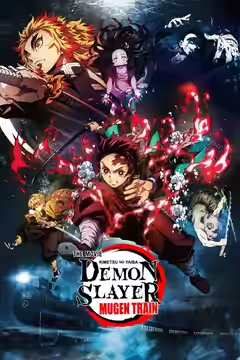
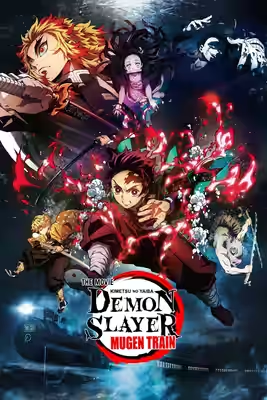
Kyojuro Rengoku (Satoshi Hino) clashes blades with the demon Akaza
Film review

Demon Slayer -Kimetsu no Yaiba- The Movie: Mugen Train

2020 · Directed by Haruo Sotozaki · 1h 57m

In a sentenceKyojuro Rengoku has our sympathy; the soundtrack could stop asking for it quite so loudly

Tanjiro Kamado (Natsuki Hanae), Nezuko Kamado (Akari Kitō), Zenitsu Agatsuma (Hiro Shimono) and Inosuke Hashibira (Yoshitsugu Matsuoka) are among the principal characters in this animated action fantasy. Kyojuro Rengoku (Satoshi Hino) also has a central role, with particular attention given to his backstory. Haruo Sotozaki directs the 117-minute film, which carries a 15 certificate. The voice cast also includes Takahiro Sakurai as Giyu Tomioka and Saori Hayami as Shinobu Kocho. Yuichi Terao handles cinematography, with music by Go Shiina and Yuki Kajiura.

Plays from YouTube when you press play; nothing loads from them until then.

Fi1m review

Haruo Sotozaki’s animated fantasy earns its emotion through Kyojuro Rengoku, with detailed images and forceful music adding to the pleasure. We recommend it for action fans, though the insistence can become tiring.

Haruo Sotozaki’s Demon Slayer -Kimetsu no Yaiba- The Movie: Mugen Train is a good animated action fantasy that occasionally works too hard to keep us excited. We recommend it for its detailed images and the care it takes over Kyojuro Rengoku, with a caveat about its persistent emotional pressure. Haruo Sotozaki wants the fighting to matter, and is prepared to be emphatic about the people involved. That sincerity is welcome, even when we wish he would lower the volume.

Kyojuro Rengoku, voiced by Satoshi Hino, supplies the strongest reason to stay involved. His backstory receives enough attention to give the film’s appeals to our feelings some substance. We were moved by the care given to Kyojuro Rengoku’s history. The time devoted to understanding him makes the emotional emphasis easier to accept, and Satoshi Hino’s directness suits the film’s earnestness.

Natsuki Hanae voices Tanjiro Kamado, with Akari Kitō as Nezuko Kamado, Hiro Shimono as Zenitsu Agatsuma and Yoshitsugu Matsuoka as Inosuke Hashibira. Natsuki Hanae’s earnestness gives the film a useful human focus amid all that force. The performances ask us to take the characters’ feelings seriously, and we think that is the right choice. For this kind of fantasy to work, we need permission to care without waiting for a joke to dismiss the whole business.

Yuichi Terao’s cinematography supplies a separate pleasure. The visual detail rewards looking more closely than the immediate action requires, and helps the fantasy hold our attention even when the story is pressing hard for a response. We appreciate animation that gives the eye something to enjoy beyond the next impact. Here, the care in the images makes the action worth watching closely, rather than merely keeping track of who is doing what.

Go Shiina and Yuki Kajiura’s music contributes substantially to the excitement, though it sometimes continues insisting after the feeling has already arrived. We wanted it to ease off and allow the voices a little more space. A timid score would be wrong for this film, but there are passages where its determination becomes distracting. The music could keep its character and still leave more room around the performances.

Manabu Kamino’s editing is efficient at sustaining momentum, but the 117-minute running time makes the film’s insistence noticeable. The pace could use more variation, particularly when the music and cutting keep asking for a response the characterisation has already earned. A little less repetition would help without requiring a different sort of film. Haruo Sotozaki could afford to trust his characters through a few quieter stretches.

Against the usual demands of action fantasy, the attention paid to Kyojuro Rengoku is a sound choice. The film gives its excitement a person worth caring about, rather than expecting animation alone to do the job. Its excesses did not cancel that achievement for us. Choose it when there is an appetite for emphatic fantasy; save it for another night if quiet is part of the requirement.


Critical consensus AI synthesised

2 of 6
Positive
2
Mixed
0
Negative
0
Los Angeles Times
70*

The headline presents the review as positive, highlighting the film’s visuals and soundtrack. The supplied article text is unrelated, so it does not reveal the critic’s fuller verdict or other points of praise.

Read the full review →
NME
25 May 2021 · ★★★★
80

The review finds the film gripping and accessible even for anime newcomers. It singles out Rengoku’s carefully built backstory and the film’s impressive visual detail for praise.

Read the full review →

Straight answers AI written, from our review

Is Demon Slayer -Kimetsu no Yaiba- The Movie: Mugen Train worth watching?
Demon Slayer -Kimetsu no Yaiba- The Movie: Mugen Train is worth watching for action-fantasy fans, and we score it 77 out of 100. Its detailed animation and care for Kyojuro Rengoku make the excitement matter, though the forceful music and relentless pace can become tiring across 117 minutes.
How long is Demon Slayer -Kimetsu no Yaiba- The Movie: Mugen Train, and what is it rated?
Demon Slayer -Kimetsu no Yaiba- The Movie: Mugen Train runs 1h 57m. It is an animation and action film.
Where can I watch Demon Slayer -Kimetsu no Yaiba- The Movie: Mugen Train in Greece?
Demon Slayer -Kimetsu no Yaiba- The Movie: Mugen Train is not on any streaming or rental service in Greece at the moment. It is available in 29 other countries; change your country at the top of the page to see where. Availability is checked daily.
How violent or frightening is Demon Slayer -Kimetsu no Yaiba- The Movie: Mugen Train, and is it suitable for children?
Demon Slayer -Kimetsu no Yaiba- The Movie: Mugen Train carries a UK 15 certificate and is not suitable for younger children. That classification places it with audiences aged 15 and over; we also find its fighting, forceful music and sustained emotional pressure better suited to teenagers comfortable with intense action fantasy than those seeking something gentle.
How does Demon Slayer -Kimetsu no Yaiba- The Movie: Mugen Train compare to Princess Mononoke?
Demon Slayer -Kimetsu no Yaiba- The Movie: Mugen Train is our pick for emphatic action centred on one particularly affecting character; Princess Mononoke is the better choice for sympathy extending to both sides of a conflict. We recommend both, but their demands differ: Mugen Train can tire us with its musical insistence, while Princess Mononoke asks for patience with crowded storytelling.
What should I watch after Demon Slayer -Kimetsu no Yaiba- The Movie: Mugen Train?
After Demon Slayer -Kimetsu no Yaiba- The Movie: Mugen Train, try Princess Mononoke (1997, Fi1m 88): For fierce animated combat that gives its wounded characters room to matter. Then Paprika (2006, Fi1m 80): Dreams become dangerous, with animated detail worth watching as closely as the plot; and Song of the Sea (2014, Fi1m 82): A quieter animated fantasy that takes family sorrow seriously without labouring it.

Cast

If you liked this, try…

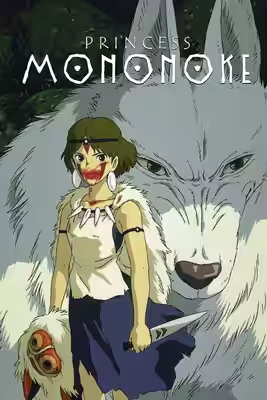
  1. Princess Mononoke (1997, Fi1m 88)For fierce animated combat that gives its wounded characters room to matter.

  2. Paprika (2006, Fi1m 80)Dreams become dangerous, with animated detail worth watching as closely as the plot.

  3. Song of the Sea (2014, Fi1m 82)A quieter animated fantasy that takes family sorrow seriously without labouring it.

  4. Ne Zha (2019, Fi1m 72)Another forceful animated fantasy, with supernatural action and an unruly central character.

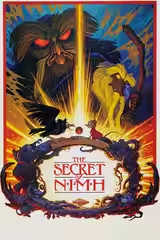
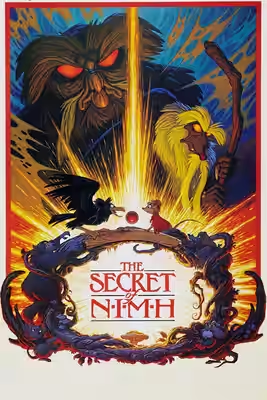
  5. The Secret of NIMH (1982, Fi1m 74)For darker family animation whose danger never cancels its tenderness.

Free account

Know what to watch tonight

Two lists that know where things are streaming, collections you can share, your own score beside ours, and Discover that remembers what you have seen.

  • Want to see, sorted by what is streaming now
  • Seen, with your score out of ten
  • No adverts, ever