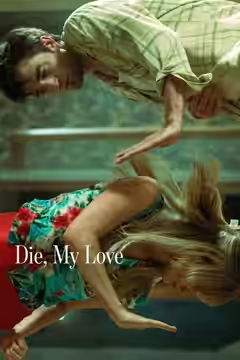
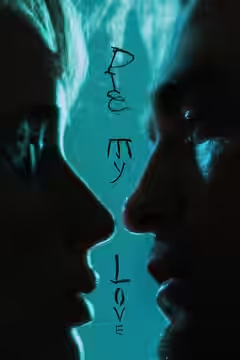
Die My Love poster

Die My Love

2025 · Directed by Lynne Ramsay
1h 59mDrama15
71
Fi1m score
81
Critics · 15
Audience · not yet

Where to watch in the UK

Checked 10 September at 22:29. Prices and availability change; the service’s page is the last word.

Plays from YouTube when you press play; nothing loads from them until then.

Synopsis

Grace (Jennifer Lawrence) and Jackson (Robert Pattinson) leave the city for a farmhouse in rural Montana that belonged to his late uncle. They have a baby. Across the fields live Jackson’s parents, Pam (Sissy Spacek) and Harry (Nick Nolte), and on the road outside a stranger (LaKeith Stanfield) passes on a motorbike. Grace starts crawling through the long grass with a kitchen knife and picking fights at parties. Lynne Ramsay directs, from Ariana Harwicz’s novel, with a screenplay she wrote with Alice Birch and Enda Walsh, and the film stays close to Grace as she comes apart.

Fi1m review

In a sentenceThe baby sleeps, the dog barks, and Jennifer Lawrence crawls through the grass with a knife; her husband suggests a rest

Lynne Ramsay’s film about a new mother coming apart in a farmhouse is loud, fearless and often striking, and Jennifer Lawrence is as good as you have heard. But Ramsay keeps us outside Grace’s head, and the second hour repeats the first.

This is Lynne Ramsay’s fifth feature and her first since You Were Never Really Here in 2017. She wrote it with Alice Birch and Enda Walsh from Ariana Harwicz’s novel about a woman who goes to pieces after having a baby. Grace (Jennifer Lawrence) and Jackson (Robert Pattinson) move into his dead uncle’s house in rural Montana, have sex on the bare floor before the furniture has arrived, and the film is loud from that minute on. It is worth seeing, for Lawrence and for perhaps a dozen images we will not forget. We did not believe all of it, and by the second hour we were not sure the film did either.

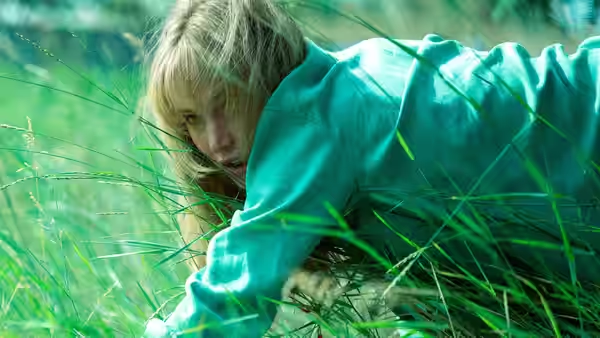
Ramsay is not making a case study. Nobody says the word postnatal in the first hour and nobody hands anyone a leaflet. Grace is shown as an animal from the start: prowling, sniffing, biting, watching a stranger on a motorbike (LaKeith Stanfield) pass on the road outside. The first time we see her in the long grass with a kitchen knife, moving on all fours while Seamus McGarvey holds the shot in low gold light, we were frightened before anything had happened, because the film had already told us how it intended to look at her. Lawrence, who also produced the film, with Martin Scorsese among the other producers, does the rest. She is funny, then frightening, then funny again, and she never once asks us to feel sorry for Grace.

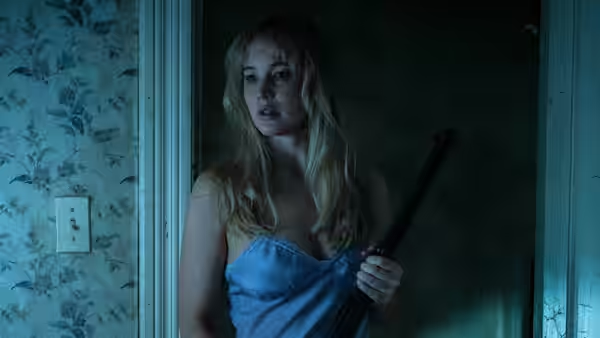
The house is the other lead. Tim Grimes fills it with the uncle’s leftovers and stained wallpaper, and McGarvey uses the open fridge as the main lamp for half the night scenes. The sound is relentless by design: pop songs at kitchen volume, a baby, and a dog Jackson brings home that barks through the night, laid over a score credited to Ramsay, George Vjestica and Raife Patrick Burchell. Toni Froschhammer cuts the days short and out of order, so we lose track of how long any of this has been going on. That is the point, and for an hour it works.

Pattinson is the film’s quiet success. Jackson is not a villain. He is a tired man who buys a dog when the problem is his wife, who keeps suggesting she get some rest, who goes away for work and does not ask what happened while he was gone. Pattinson plays him as decent, useless and slightly afraid, and he is the character we understood best, which is an odd thing to say about a film that is about her. Sissy Spacek, as Jackson’s mother Pam, has a couple of scenes of plain sense the film badly needs. Nick Nolte, as his father Harry, says almost nothing and does not need to.

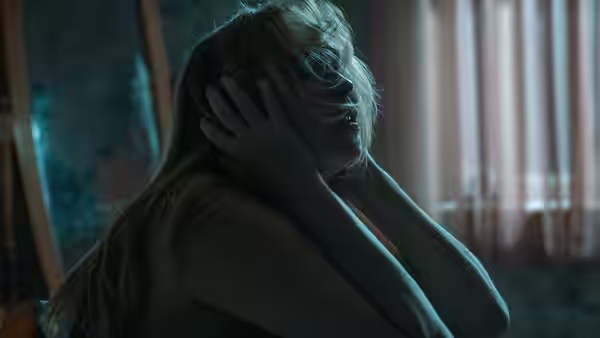
Here is the trouble. Ramsay keeps Grace at arm’s length. We see her put herself through glass, dance alone in the kitchen, scream at a party; we rarely learn what she thinks about any of it. Hallucination and event are cut together without a join, so that when Jackson says a thing did not happen we cannot tell either, and after the fourth or fifth time we stopped caring which. The second hour brings another party, another fight, another night in the grass. We were exhausted, and then we noticed that our exhaustion was doing the film’s work for it.

Set against her own films it is her loudest and her least precise. We Need to Talk About Kevin kept us locked inside a mother’s guilt for two hours and never let us out. Morvern Callar gave us a woman we could not read and stayed calm around her so we could look. This one shouts at us for 119 minutes, and shouting is not the same as showing.

See it in a cinema, where the volume is not yours to turn down and the racket lands as intended. It is a 15. Do not take a new parent unless they have asked to go.


Critical consensus AI synthesised

81
Positive
13
Mixed
2
Negative
0
Time Out
17 May 2025 · ★★★★★ · Dave Calhoun
100

Ramsay delivers an artistically exciting and deeply uncomfortable portrait of a marriage and mind in free fall, with Lawrence giving a wildly impressive performance. The film is bleak yet has a musical, black-comic, big-hearted spirit that pulls the viewer through the despair.

Read the full review →
Empire
6 November 2025 · Iana Murray
85*

The critic praises the feral energy and Lawrence's uninhibited, career-best performance in this raw, animalistic character study of motherhood and postpartum psychosis. It notes the film can occasionally get lost in its turbulent dream-state but remains arresting and immersive.

Read the full review →
Evening Standard
10 November 2025 · Nick Howells
80*

The critic calls it a daring, full-throttle blast with bonkers brilliance, highlighting Lawrence's superb, fun, and unhinged performance as a mother in meltdown alongside a spiky, audacious portrait that mixes heartbreak and berserk energy. It notes some tonal unevenness but finds the subject matter fitting.

Read the full review →
Radio Times
19 May 2025 · ★★★★ · James Mottram
80

Ramsay crafts a supremely well-crafted atmosphere piece that showcases Lawrence's raw talents in a measured decline into postpartum depression and mental unraveling. It is absorbing, quietly devastating and heartbreaking, with stunning cinematography building a cacophony of noise inside the protagonist's head.

Read the full review →
The Telegraph
6 November 2025 · ★★★★
80

The review hails Lawrence's prowling, feral, unhinged intensity as Grace in this delirious drama of hormonal chaos and fragile ferocity, crediting Ramsay's hallucinatory style and the raw emotional power of the lead performance.

Read the full review →
The i Paper
7 November 2025 · Francesca Steele
75*

The critic finds Lawrence captivating and intelligent in this strange, angry, maximalist depiction of maternal rage and psychosis, capturing visceral confusion through folk-horror strangeness and expressionist imagery. It praises the unflinching approach to rage without easy resolution or clichés.

Read the full review →

Cast

Stills

If you liked this, try…

We Need to Talk About Kevin poster

We Need to Talk About Kevin

2011 · Ramsay’s other film about motherhood, quieter and more controlled, and harder to shake off.

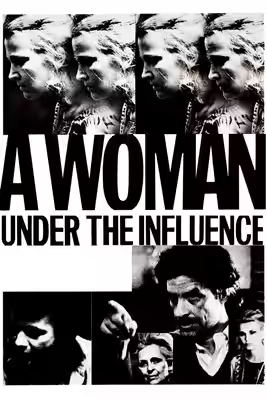
A Woman Under the Influence poster

A Woman Under the Influence

1974 · Gena Rowlands as a wife coming apart, with a husband who loves her and cannot help.

Repulsion poster

Repulsion

1965 · Polanski shuts a young woman in a London flat and lets the walls start moving.

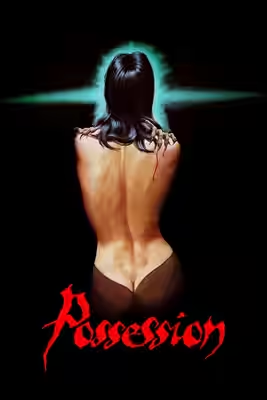
Possession poster

Possession

1981 · A marriage ends in Berlin, at full volume, with Isabelle Adjani going further than Lawrence.

Tully poster

Tully

2018 · The same exhaustion played as comedy, with Charlize Theron and a night nanny who arrives too late.