Gregory Nava’s account of two Guatemalan siblings walking north is earnest, sometimes clumsy and too often told by its score. It does not matter much. The Guatemalan opening is as good as anything made about migration, and the crossing left us shaking.
Gregory Nava’s film takes a brother and sister from Guatemala to Los Angeles, and it takes 141 minutes to do it. It follows them out of their own country, through Mexico and into the United States, and it is plainly meant as an epic about the poor, told from inside their shoes for once rather than from the charity’s doorway. It is sincere to a fault, and the fault is real. It is also a good film for most of its length, and for one stretch in the middle it is something more than that.
The Guatemalan stretch is the best written. Nava and Anna Thomas, who wrote the script together, spend their time on ordinary things: work, the family at table, the godmother Josefita (Stella Quan) telling the children what she has heard about the North. When the soldiers come, Nava keeps the violence mostly at the edge of the frame, so we hear more than we see. Ernesto Gómez Cruz gives Arturo a tired, level intelligence in his few scenes. He knows what speaking up will cost him, and he speaks anyway.
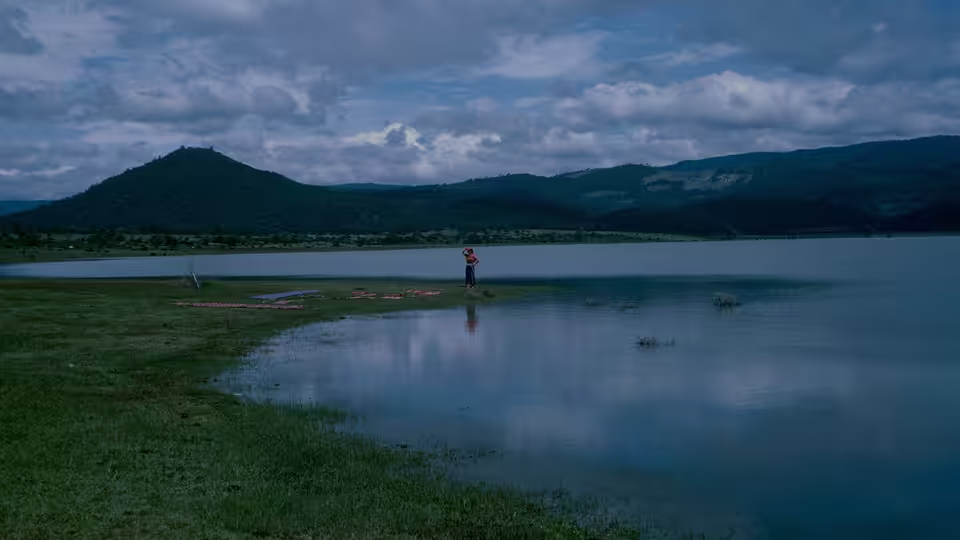
James Glennon shoots the village in deep colour, the reds and purples of the women’s woven clothes against green hillsides and morning mist, and Hilary Wright and Daniel Lemus Valenzuela dress the villagers as if the cloth were the last thing anyone would sell. The further north the siblings go, the flatter and greyer Glennon lets the light become, until Los Angeles looks like a car park at noon. The film looks cheaper the moment they arrive, which we take to be the point. Betsy Blankett Milicevic cuts the village slowly and the border in short, nervous pieces, and the difference is felt before it is noticed.
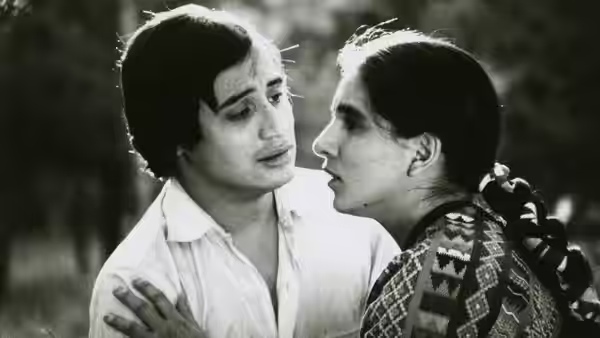
Zaide Silvia Gutiérrez plays Rosa with a watching face that gives very little away and misses nothing. David Villalpando’s Enrique is quicker, prouder, a boy who believes what he has been told about the North. Lupe Ontiveros, as Nacha, the woman who shows Rosa how the city works, is brisk and funny and supplies most of the film’s air. Trinidad Silva’s Monte, who runs the motel and finds them work, is the first American they meet who understands exactly what they are worth.
Here is what we felt. The crossing itself, which we will not describe, was the most frightened we have been in a cinema for some time. Glennon lights it with almost nothing and Nava refuses to cut away, so that we are in the dark with them for as long as they are, and what they meet on the way is shown plainly. We had our hands at our mouths. Then the film lifts them out into the light, and we found we were as relieved and as suspicious of the light as they were.
The flaws are the ones you would guess. Emil Richards and Malecio Martinez’s score tells us to grieve at moments when Gutiérrez has already done the grieving for us, and it does this often. The dream sequences, in slow motion and white light, belong to a softer film. The Los Angeles stretch has speeches in it: characters stop to say what the picture means, and the picture had already said it. Most critics have found it sentimental, and they are right; we simply did not mind as much as they did.
Set against what else was being made in 1983, there was almost nothing that put two Guatemalan peasants at the centre of the frame and asked an audience to walk with them for two and a quarter hours. That is not an excuse for the speeches. It is a reason to sit through them.
See it for the first two-thirds and forgive the last its explaining. Bring a handkerchief and do not be embarrassed about needing it; the film is not.