Annette Bening and Jamie Bell are tender, funny and wholly convincing as a faded Hollywood star and the young Liverpudlian who loved her. The film around them is gentler and thinner than they deserve, and leans on its score when it should trust their faces.
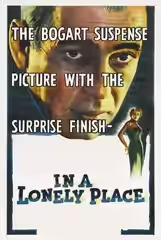
Paul McGuigan’s film is drawn from Peter Turner’s memoir of the two years he spent with Gloria Grahame, the Hollywood actress of In a Lonely Place and The Big Heat, when she was in her fifties and he was not yet thirty. It is a love story first and a film about a film star a distant second, and that is the right order. The result is tender, well acted and slightly timid. We liked it, and we kept wanting it to be braver.
Bening plays Grahame as a woman who has not stopped performing and has nearly stopped being hired. She has the breathy voice from the 1950s pictures, the pout, and a hardness that arrives the moment anyone mentions her age, which she will not give. She wants to play Juliet, and she is serious. Bening does not do an impression; she does the habits of someone who built a self out of being looked at and is still checking the mirror. The early scenes in Primrose Hill, where she asks the young man upstairs to help with a dance routine and they end up dancing to a disco record on her carpet, are loose, funny and sexier than we expected, and they are the best thing in the film.
Jamie Bell matches her. Peter is an actor waiting for work, and Bell plays him as a decent young man who is flattered, then smitten, then frightened. The film gives him long stretches of sitting with a woman who is not telling him the truth, and he lets us see him decide not to push. Julie Walters, as his mother Bella, makes up the bed, carries the tray and sits on the edge of the mattress, and the film is at its warmest when the Turners are simply in a room with their unlikely guest. Stephen Graham and Kenneth Cranham, as brother and father, are given less to do than they could carry.
McGuigan’s one formal idea is a door. Peter walks out of the Liverpool bedroom in 1981 and, without a cut, into the London boarding house in 1979, and the past is simply there in the next room. It works every time, and Nick Emerson’s cutting around it never leaves us in doubt about when we are.
The trouble is that the film is not curious about Gloria Grahame. Her four marriages, her career, the reason Hollywood stopped calling: each comes up in a line or two and is let go. In California her sister Joy (Frances Barber) raises an old scandal about Gloria’s last marriage, Peter asks, and the film changes the subject as quickly as Gloria does. Vanessa Redgrave, as her mother Jeanne, gets one scene of recited Shakespeare and is gone. J. Ralph’s score, piano and strings, turns up whenever a scene threatens to be quietly sad and tells us to be loudly sad instead. We did not need the help, and neither did Bening.
We were moved, properly moved, once, and it was not where the music wanted us to be. There is a scene late on that we will not place exactly, in which Peter and Gloria read a play together with nobody watching, and Bening stops performing for a minute and lets us see how frightened she is. Bell, across from her, barely moves. We had a lump in our throat, and we were slightly annoyed about it, because the film had spent the previous twenty minutes trying to put it there with strings and had failed.
It is far kinder than Sunset Boulevard about a woman in roughly the same position. The kindness is why we liked it. It is also why we came out knowing little more about Gloria Grahame than we went in with, except that a family in Liverpool loved her and so, for a while, did a young man who wrote it all down.
See it for Bening and Bell, and for Walters with the tea tray. Watch it at home, with someone who has loved the wrong person at the wrong time, and keep a handkerchief within reach. It runs 105 minutes and carries a 15.