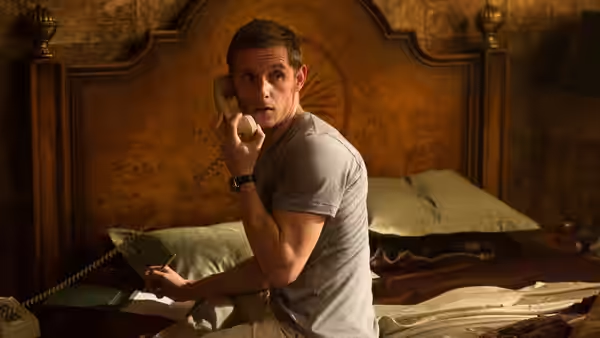
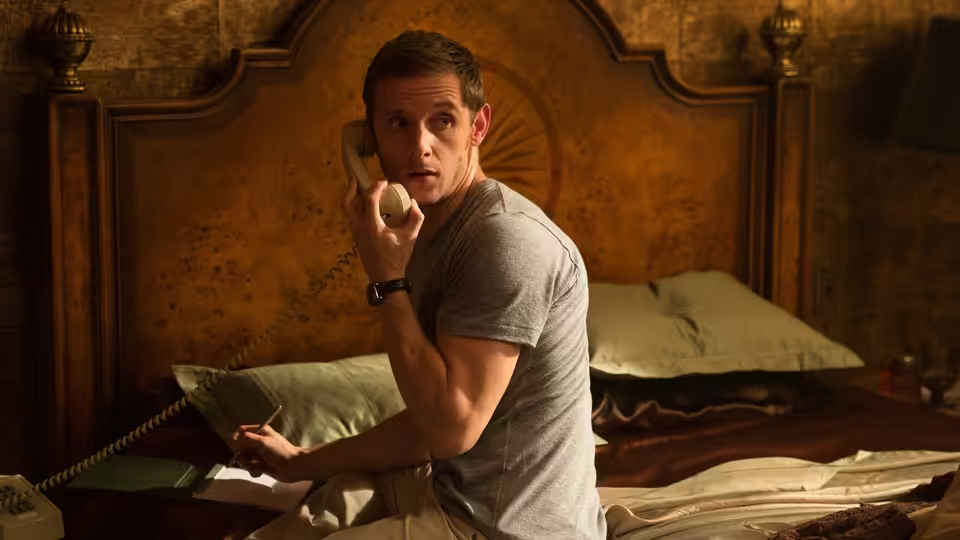
Peter Turner (Jamie Bell) sits on a bed, holding a telephone receiver and a book
Film review

Film Stars Don't Die in Liverpool

2017 · Directed by Paul McGuigan · 1h 45m

In a sentenceHollywood washes up in a Liverpool back bedroom and the Turners, bless them, put the kettle on

Lancaster, 1981. Gloria Grahame (Annette Bening), once of Hollywood, collapses in her dressing room before a performance and refuses hospital. She asks instead for Peter Turner (Jamie Bell), the young Liverpool actor she left two years before, and he brings her home to his parents’ terraced house, where his mother Bella (Julie Walters) makes up the back bedroom and his father Joe (Kenneth Cranham) and brother Joe Jr (Stephen Graham) try not to stare. From there the film steps back to 1979 and a boarding house in Primrose Hill, where she knocks on the door of the young actor upstairs, asks for help with a dance routine, and ends up moving to disco on her carpet. Gloria wants to work again and to keep Peter; her body, and a past she will not discuss, stand in the way.

Plays from YouTube when you press play; nothing loads from them until then.

Fi1m review

Annette Bening and Jamie Bell are tender, funny and wholly convincing as a faded Hollywood star and the young Liverpudlian who loved her. The film around them is gentler and thinner than they deserve, and leans on its score when it should trust their faces.

Paul McGuigan’s film is drawn from Peter Turner’s memoir of the two years he spent with Gloria Grahame, the Hollywood actress of In a Lonely Place and The Big Heat, when she was in her fifties and he was not yet thirty. It is a love story first and a film about a film star a distant second, and that is the right order. The result is tender, well acted and slightly timid. We liked it, and we kept wanting it to be braver.

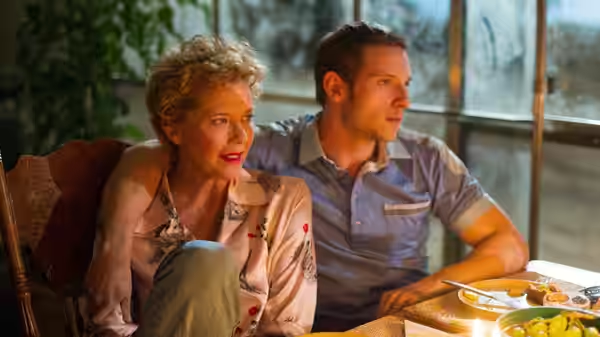
Bening plays Grahame as a woman who has not stopped performing and has nearly stopped being hired. She has the breathy voice from the 1950s pictures, the pout, and a hardness that arrives the moment anyone mentions her age, which she will not give. She wants to play Juliet, and she is serious. Bening does not do an impression; she does the habits of someone who built a self out of being looked at and is still checking the mirror. The early scenes in Primrose Hill, where she asks the young man upstairs to help with a dance routine and they end up dancing to a disco record on her carpet, are loose, funny and sexier than we expected, and they are the best thing in the film.

Jamie Bell matches her. Peter is an actor waiting for work, and Bell plays him as a decent young man who is flattered, then smitten, then frightened. The film gives him long stretches of sitting with a woman who is not telling him the truth, and he lets us see him decide not to push. Julie Walters, as his mother Bella, makes up the bed, carries the tray and sits on the edge of the mattress, and the film is at its warmest when the Turners are simply in a room with their unlikely guest. Stephen Graham and Kenneth Cranham, as brother and father, are given less to do than they could carry.

McGuigan’s one formal idea is a door. Peter walks out of the Liverpool bedroom in 1981 and, without a cut, into the London boarding house in 1979, and the past is simply there in the next room. It works every time, and Nick Emerson’s cutting around it never leaves us in doubt about when we are.

The trouble is that the film is not curious about Gloria Grahame. Her four marriages, her career, the reason Hollywood stopped calling: each comes up in a line or two and is let go. In California her sister Joy (Frances Barber) raises an old scandal about Gloria’s last marriage, Peter asks, and the film changes the subject as quickly as Gloria does. Vanessa Redgrave, as her mother Jeanne, gets one scene of recited Shakespeare and is gone. J. Ralph’s score, piano and strings, turns up whenever a scene threatens to be quietly sad and tells us to be loudly sad instead. We did not need the help, and neither did Bening.

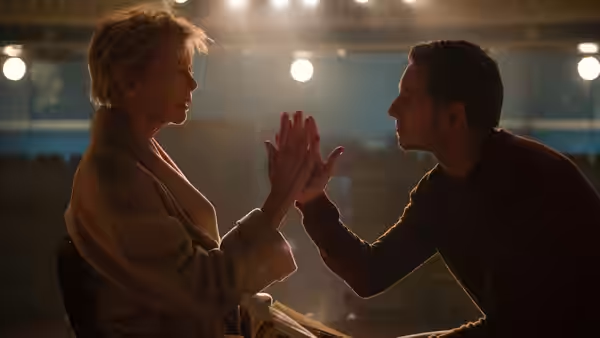
We were moved, properly moved, once, and it was not where the music wanted us to be. There is a scene late on that we will not place exactly, in which Peter and Gloria read a play together with nobody watching, and Bening stops performing for a minute and lets us see how frightened she is. Bell, across from her, barely moves. We had a lump in our throat, and we were slightly annoyed about it, because the film had spent the previous twenty minutes trying to put it there with strings and had failed.

It is far kinder than Sunset Boulevard about a woman in roughly the same position. The kindness is why we liked it. It is also why we came out knowing little more about Gloria Grahame than we went in with, except that a family in Liverpool loved her and so, for a while, did a young man who wrote it all down.

See it for Bening and Bell, and for Walters with the tea tray. Watch it at home, with someone who has loved the wrong person at the wrong time, and keep a handkerchief within reach. It runs 105 minutes and carries a 15.

Critical consensus AI synthesised

62
Positive
10
Mixed
4
Negative
6

Most critics come down in favour, if not by much, and almost all of them agree on the reason: Annette Bening. The praise for her Gloria Grahame is close to unanimous, with reviewers singling out the restraint and vulnerability of the early romance scenes in particular. Jamie Bell gets warm notices alongside her, and the chemistry between the two is the thing the kinder reviews keep returning to. The British press is the warmest, finding the film tender, witty and properly moving.

The reservations cluster around the writing rather than the acting. Several critics find the story thin and the sentiment laid on too thickly, and more than one complains that the shuffled timeline drains the later sections of urgency. The spread is wide, running from the twenties to ninety, with American outlets such as The New Yorker and Variety among the coolest. The one real outlier is Eye for Film, which alone finds Bening unconvincing.

Evening Standard
11 December 2017 · ★★★★ · Charlotte O'Sullivan
80

O’Sullivan finds the film sexy, polished and emotionally engaging, praising Jamie Bell’s witty, heartfelt performance and Annette Bening’s portrayal of Gloria Grahame. She faults the film for raising but then abandoning the serious allegation about Grahame’s stepson.

Read the full review →
Radio Times
★★★★ · Jeremy Aspinall
80

Aspinall’s verdict is strongly positive, describing the romance as beautifully made and incredibly moving. He singles out its witty, affecting portrayal of the love affair between Gloria Grahame and Peter Turner.

Read the full review →
The Guardian
2 September 2017 · ★★★★ · Peter Bradshaw
80

Bradshaw finds the film a warm, tender and affecting love story. He particularly praises the chemistry and relaxed performances of Annette Bening and Jamie Bell.

Read the full review →
The Hollywood Reporter
1 September 2017 · festival review · Stephen Farber
80*

Farber finds the film a tender, emotionally forceful romantic drama, despite a few underexplored elements. He especially praises Annette Bening and Jamie Bell, calling their performances subtle and riveting.

Read the full review →
Time Out
13 November 2017 · ★★★★ · Phil de Semlyen
80

The review describes the film as a tender-hearted love story. Its praise singles out the soulful blend of everyday realism and Hollywood glamour.

Read the full review →
Empire
13 November 2017 · Olly Richards
75*

Richards finds the film a classy, sentimental weepie that earns its melodrama. He singles out Annette Bening’s nuanced, compelling performance as its biggest strength.

Read the full review →

Straight answers AI written, from our review

Is Film Stars Don't Die in Liverpool worth watching?
Film Stars Don't Die in Liverpool is worth watching for the performances, and we scored it 66. Annette Bening and Jamie Bell are tender, funny and wholly convincing as the faded star and the young Liverpudlian who loved her, with Julie Walters quietly fine as his mother. The film around them is gentler and thinner than they deserve, and leans on its score when it should trust their faces.
How long is Film Stars Don't Die in Liverpool, and what is it rated?
Film Stars Don't Die in Liverpool runs 1h 45m. It is a romance and drama film.
Where can I watch Film Stars Don't Die in Liverpool in Vietnam?
Film Stars Don't Die in Liverpool is not on any streaming or rental service in Vietnam at the moment. It is available in 27 other countries; change your country at the top of the page to see where. Availability is checked daily.
How violent or frightening is Film Stars Don't Die in Liverpool, and is it suitable for children?
Film Stars Don't Die in Liverpool carries a UK 15 certificate and is a love story, not a frightening or violent film. It is an adult romance between a woman in her fifties and a man under thirty, and the certificate reflects that, along with illness and a death in the family. There is nothing here to scare a teenager, but children would find little in it.
How does Film Stars Don't Die in Liverpool compare to Sunset Boulevard?
Film Stars Don't Die in Liverpool is the kind version of the story Sunset Boulevard tells cruelly: a forgotten Hollywood star, a younger man, and in this case a family in Liverpool with a tea tray. Billy Wilder's film is the better and braver of the two, viciously funny where this one is gentle. Watch this if you want to be moved rather than unsettled.
What should I watch after Film Stars Don't Die in Liverpool?
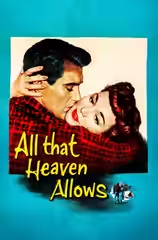
After Film Stars Don't Die in Liverpool, try Sunset Boulevard (1950, Fi1m 91): The cruel version of the same story: a forgotten star, a younger man, no tea tray. Then Stan & Ollie (2018, Fi1m 77): Two more fading stars on a British tour, played with the same affection and more jokes; and All That Heaven Allows (1955, Fi1m 86): Sirk’s older woman and younger man, with the neighbours’ disapproval in full Technicolor.

Cast

Awards

IFFR audience award, 2018

Nominated
IFFR audience award

If you liked this, try…

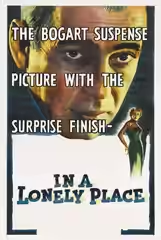
  1. In a Lonely Place (1950) · not reviewed yetGrahame herself opposite Humphrey Bogart, young and wary; the real thing before the legend.

  2. Sunset Boulevard (1950, Fi1m 91)The cruel version of the same story: a forgotten star, a younger man, no tea tray.

  3. Stan & Ollie (2018, Fi1m 77)Two more fading stars on a British tour, played with the same affection and more jokes.

  4. All That Heaven Allows (1955, Fi1m 86)Sirk’s older woman and younger man, with the neighbours’ disapproval in full Technicolor.

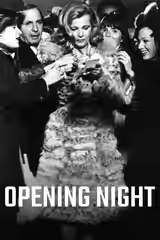
  5. Opening Night (1977) · not reviewed yetGena Rowlands as an actress coming apart on stage; rawer than anything McGuigan attempts here.