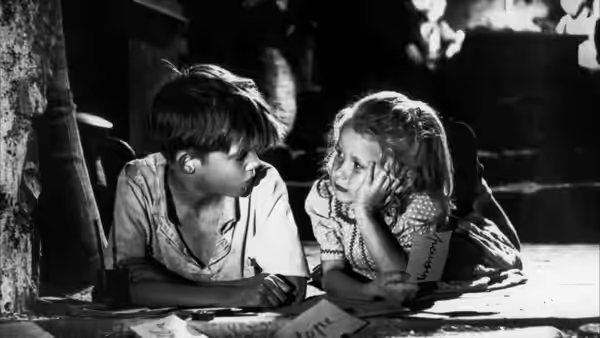
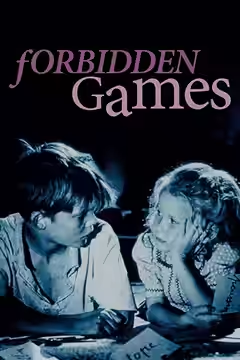
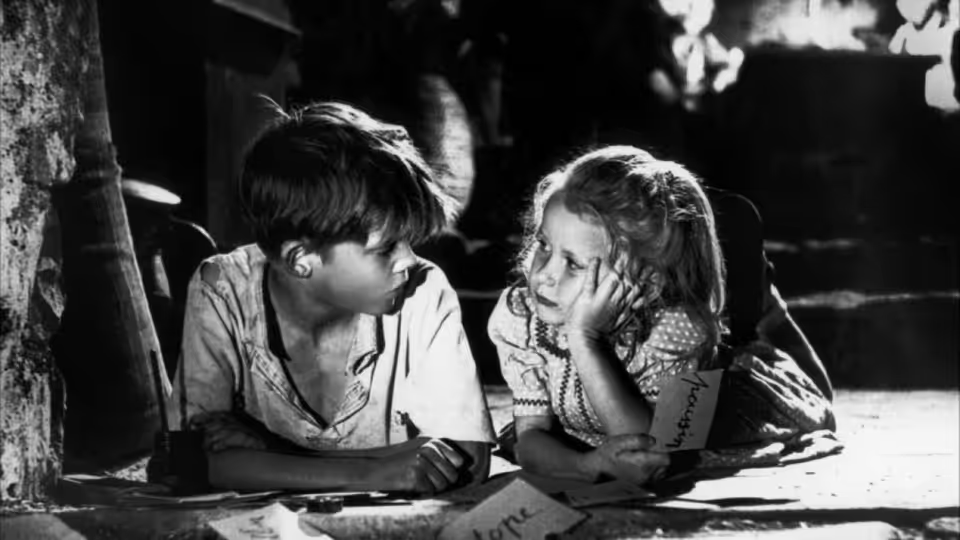
Michel Dolle (Georges Poujouly) and Paulette (Brigitte Fossey) lean together over a table indoors
Film review

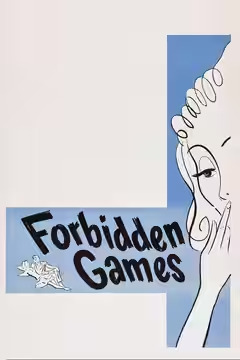
Forbidden Games

1952 · Directed by René Clément · 1h 27m

In a sentenceThe adults could learn a little dignity from the children burying animals

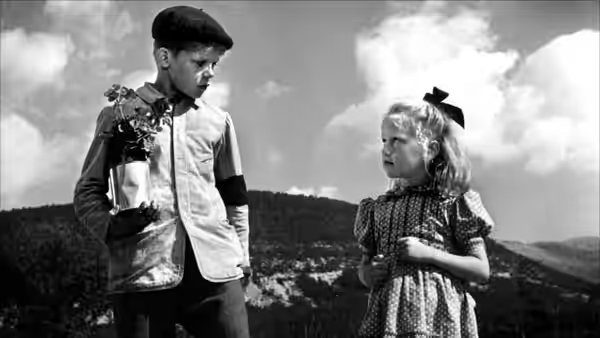
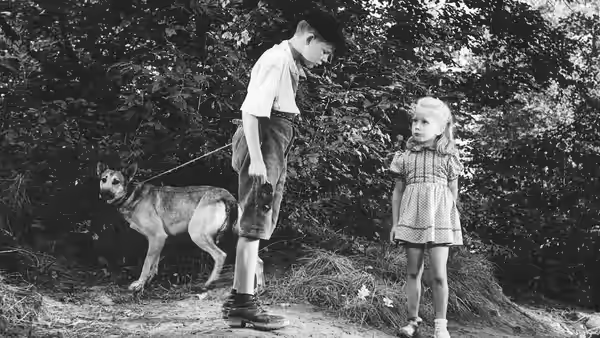
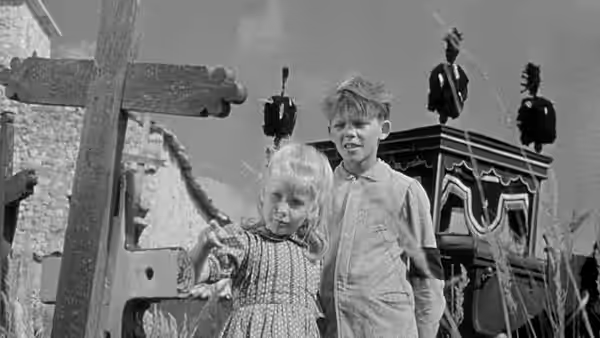
War brings death into the lives of Paulette (Brigitte Fossey) and Michel Dolle (Georges Poujouly). The children try to understand it by burying animals, making a game out of the rituals surrounding death. The adult world includes Madame Dolle (Suzanne Courtal) and a family feud that keeps the grown-ups occupied with their own grievances. While the adults quarrel, the children attend to their burials. They have animals to lay to rest and questions that the grown-ups, distracted by their disputes, do little to settle. Their game gives them something to organise amid the violence.

Plays from YouTube when you press play; nothing loads from them until then.

Fi1m review

René Clément’s war drama is deeply moving when it stays with its children and their animal burials. The adult feuding is drawn more crudely, but Brigitte Fossey and Georges Poujouly give the film a tenderness that survives the rough edges.

René Clément’s Forbidden Games is a moving war drama with children worth watching closely and adults who are sometimes drawn too crudely. We recommend it for the children’s performances, and for its willingness to let their behaviour remain unsettling. War films about children can become rather pleased with their own sensitivity, leaving little room for children to be difficult or strange. Here, the attempt to understand death takes the form of burying animals.

Brigitte Fossey, as Paulette, and Georges Poujouly, as Michel Dolle, give that activity a practical concentration which makes it convincing. Neither performance seems arranged around making the audience feel protective. We were moved by their care for the dead animals, and disturbed by how readily burial becomes a game. The acting allows both responses without insisting that we choose between them, because the children take what they are doing seriously.

The adult scenes are less finely judged. Suzanne Courtal’s Madame Dolle and Lucien Hubert’s Monsieur Dolle belong to the broader comic side of the film, where the family feud gives the grown-ups plenty to occupy them. There is something recognisable about people maintaining their grievances when circumstances ought to have made them irrelevant. But the depiction of peasant life leans too heavily on foolishness, and the quarrelling takes up time we would rather spend with the children.

Robert Juillard’s photography gives the animal burials enough attention for us to understand their importance without accepting the game as harmless. This is delicate work: making the children’s activity absorbing could easily soften what has prompted it. The images keep the dead animals before us as something that needs attending to. That concrete business gives the film more force than a general appeal to pity would have done.

Roger Dwyre’s editing has to accommodate wartime cruelty, the children’s preoccupation with death and the comedy of the feud. The changes of tone mostly work because the game itself already contains something ordinary and something troubling. Occasionally, though, the adult comedy feels like an interruption, and the return to the children requires an adjustment the film has not quite earned. At 87 minutes, it has little spare time for those detours.

Narciso Yepes’s music brings tenderness to material that could easily be treated as a grim lesson. It helps us remain close to the children even when their behaviour is uncomfortable to consider. The performances need little assistance, but the music gives the film room for affection alongside its distress. Without that warmth, the repeated attention to death could become punishing.

It is worth resisting the temptation to call these children innocent and consider the matter settled. Their game asks us to think about what children learn when death becomes part of ordinary life, including things the adults would rather they did not notice. The burials remain troubling even when we understand the need behind them. Choose it when there is time afterwards to sit quietly for a while.

Critical consensus AI synthesised

79
Positive
4
Mixed
1
Negative
0
Slant Magazine
4 December 2005 · ★★★½/4 · Ed Gonzalez
88

Gonzalez praises the film as a clear-eyed and enduring portrait of childhood amid war, despite some shortcomings in its depiction of peasant life. He singles out its contrast between the brutality of war and the children’s haunting animal burials.

Read the full review →
The Guardian
13 January 2013 · Philip French
85*

French praises the film as deeply moving and darkly comic. He singles out the child performances as among the finest ever given.

Read the full review →
Los Angeles Times
27 August 2015 · Kenneth Turan
80*

Turan presents the film as a distinctive classic whose mixed tones and shifting perspective still work. He especially praises its portrayal of the children’s unsettling attempts to understand death and the family feud’s dark comedy.

Read the full review →
Time Out
19 April 2015 · ★★★★ · David Ehrlich
80

The review gives the film four out of five stars. It singles out the first five minutes as extraordinarily depressing.

Read the full review →
The New York Times
9 December 1952 · Bosley Crowther
64*

The available page shell does not expose the critic’s verdict. It provides no verifiable praise or complaint to summarize.

Read the full review →

Straight answers AI written, from our review

Is Forbidden Games worth watching?
Forbidden Games is worth watching for its moving, unsettling account of children trying to understand death, and we score it 86 out of 100. We recommend it for Brigitte Fossey and Georges Poujouly’s concentrated performances, though the broadly drawn adult feuding sometimes interrupts the more affecting story of their animal burials.
How long is Forbidden Games, and what is it rated?
Forbidden Games runs 1h 27m. It is a drama and war film.
Where can I watch Forbidden Games in Lithuania?
Forbidden Games is streaming on Netflix in Lithuania. Availability is checked daily; the links above go straight to each service.
How violent or frightening is Forbidden Games, and is it suitable for children?
Forbidden Games has no UK or US certificate supplied here, and its wartime cruelty, dead animals and children’s burial games call for caution with younger viewers. We find the children’s practical attention to death disturbing as well as moving; those sensitive to animal death may find it especially upsetting.
How does Forbidden Games compare to The Night of the Hunter?
Forbidden Games is a moving war drama, while The Night of the Hunter offers a more frightening fairy tale about children facing adult cruelty. We favour The Night of the Hunter as the stronger film, despite its broad comedy and soft ending; choose Forbidden Games for the children’s closely observed attempts to understand death through burial rituals.
Is Forbidden Games based on a true story or a book?
Forbidden Games is based on a novel by François Boyer, rather than presented as a true story. We cannot judge its fidelity to the book from the film alone, but the children’s practical efforts to understand death give the drama a clear focus that does not depend on familiarity with the source.
What should I watch after Forbidden Games?
After Forbidden Games, try The Night of the Hunter (1955, Fi1m 91): Children face adult cruelty in a frightening film with room for tenderness. Then The Spirit of the Beehive (1973, Fi1m 87): A child’s fascination with a film unsettles an already uneasy adult world.

Cast

Awards

Academy Awards, 1955

Nominated
Best Story

BAFTA Film Awards, 1954

Won
Best Film

Academy Honorary Award, 1952

Won
Academy Honorary Award

Venice Film Festival, 1952

Won
Golden Lion

If you liked this, try…

  1. Germany Year Zero (1948) · not on Fi1m yetA child’s life in a ruined city, with considerably less shelter.

  2. The Night of the Hunter (1955, Fi1m 91)Children face adult cruelty in a frightening film with room for tenderness.

  3. The Spirit of the Beehive (1973, Fi1m 87)A child’s fascination with a film unsettles an already uneasy adult world.

  4. Ponette (1996) · not on Fi1m yetA young child tries to understand death; the performance needs no embellishment.

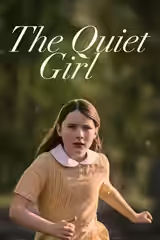
  5. The Quiet Girl (2022) · not on Fi1m yetAn observant child and an adult household, handled with patience and restraint.