Film review

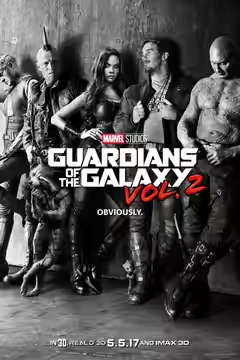
Guardians of the Galaxy Vol. 2

2017 · Directed by James Gunn · 2h 17m · MPA PG-13

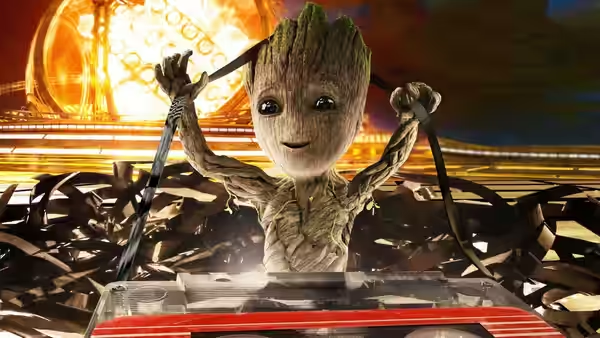
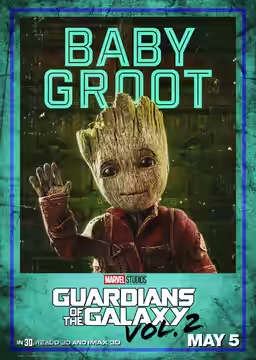
In a sentenceBaby Groot dances through the opening fight and the rest of the film spends two hours trying to get that feeling back

Science FictionAdventureAction

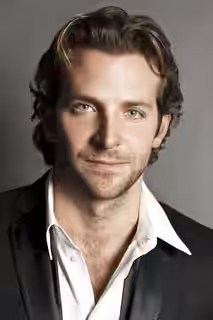
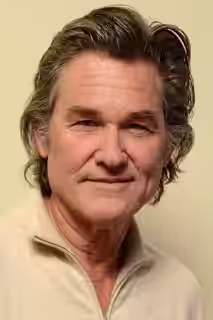
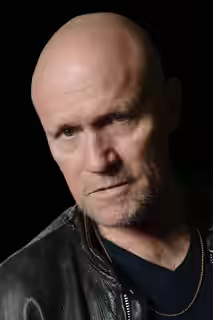
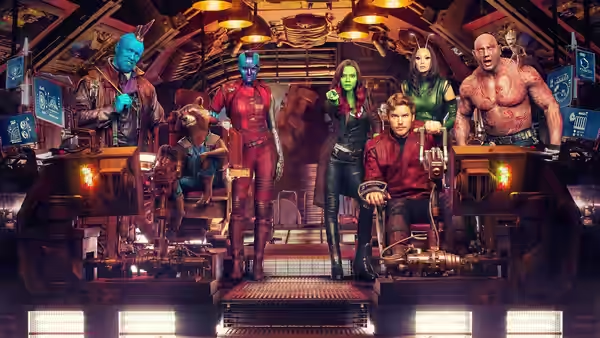
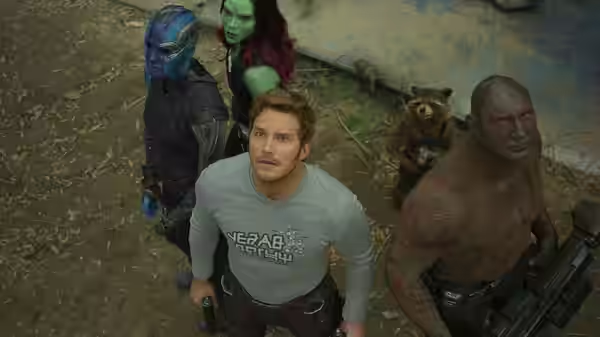
Missouri, 1980: a young man drives a young woman through the woods and shows her a strange plant he has put in the ground. Thirty-four years later her son Peter Quill (Chris Pratt), who calls himself Star-Lord, leads the Guardians in a paid job for the Sovereign, a gold-skinned people ruled by Ayesha (Elizabeth Debicki): kill the beast attacking their batteries. Rocket (Bradley Cooper) steals some of those batteries on the way out, the Sovereign fleet gives chase, and a stranger blows it apart before the Guardians crash-land. He is Ego (Kurt Russell), and he says he is Quill’s father. He wants Quill to come home with him; Gamora (Zoe Saldaña) doubts him, and the Sovereign hire Yondu (Michael Rooker) and his Ravagers to bring the thieves in.

Plays from YouTube when you press play; nothing loads from them until then.

Fi1m review

James Gunn’s sequel is brighter, sadder and about half an hour longer than it needs to be. The jokes still land and the last stretch is moving; in between, the story is a man walking around a planet with his father.

James Gunn’s second Guardians film opens in Missouri in 1980, with a young man driving a young woman through the trees, and then jumps thirty-four years to a battle with a many-toothed thing on a golden planet, during which a tiny tree dances to Electric Light Orchestra and the fight goes on behind him, unwatched. Gunn wants to tell us where Peter Quill (Chris Pratt) came from, and he wants to keep the jokes and the songs that made the first one a surprise. He manages the songs and the jokes. The story is thinner than he thinks, and he stretches it across 137 minutes regardless.

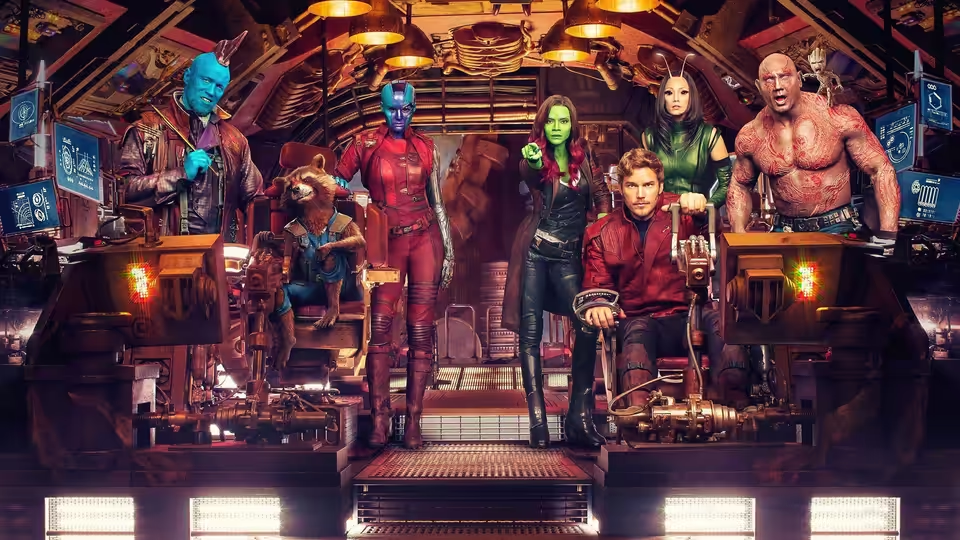
The setup is quick. The Sovereign, a gold-skinned people ruled by Ayesha (Elizabeth Debicki), hire the Guardians to protect some batteries; Rocket (Bradley Cooper) steals a few on the way out; the Sovereign fleet gives chase; a stranger destroys it and the Guardians crash. The stranger is Ego (Kurt Russell), who says he is Quill’s father, has a soft-voiced empath called Mantis (Pom Klementieff) at his elbow, and would like his son to come home. Ayesha then hires Yondu (Michael Rooker) to fetch the thieves, and Yondu’s own crew, led by Taserface (Chris Sullivan), have views about how soft he has gone.

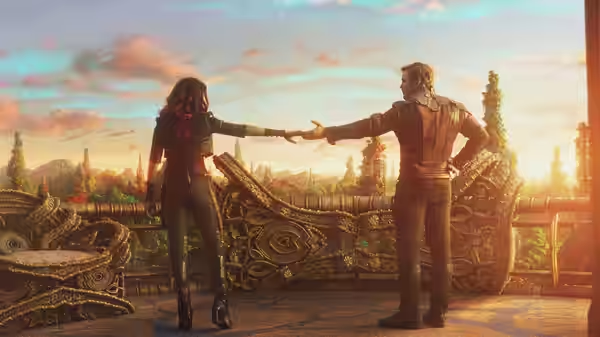
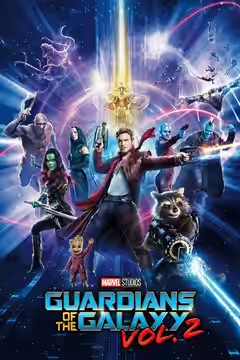
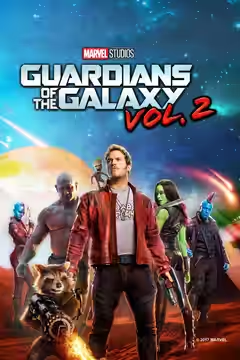
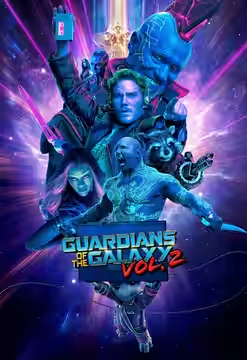
It is the best-looking of these films. Scott Chambliss builds Ego’s planet out of pastel bubbles, glass fronds and a palace that seems to have been blown rather than built, and puts the Sovereign in a gold so total that Judianna Makovsky’s costumes and the walls behind them are the same colour. Henry Braham shoots it all saturated, purples against ambers, pink skies, stars in every window, and holds his frames long enough for us to see what the money bought. It is a great deal to look at. Twenty minutes in we found ourselves wanting a plain grey room.

The people hold it up. Michael Rooker’s Yondu, a blue kidnapper with a whistle-guided arrow, is the film’s best performance, hurt and mean and funnier than his lines. His scenes with Rocket are the reason the film exists: two men who insult anyone who comes near them, each seeing the trick in the other. Dave Bautista plays Drax as a man who says every thought as he has it, and his double act with Klementieff’s Mantis, who has never met anyone rude before, had us laughing harder than we care to admit. He tells her she is hideous. She thanks him. We felt slightly ashamed, and then he said it again.

The trouble is the middle, on Ego’s planet, where the plot is Quill walking around with his father while everyone else waits for him to finish. Pratt and Russell are good together, two easy charmers who talk alike. But there are only so many ways to film two men in a garden, and Fred Raskin and Craig Wood, who cut the opening with such wit, have nothing to cut away to for half an hour but a ship in a forest and a quarrel. Gamora (Zoe Saldaña) and Nebula (Karen Gillan) argue about their childhoods in lines that read like case notes. Tyler Bates’s score does honest work under the fights; the songs are asked to carry feelings the script has not yet earned.

And then the last stretch happened, and it got us. We will not say how. A film we had been checking our watches through for forty minutes produced, in its final fifteen, a lump in the throat we had not braced for, and it did it with a character rather than a spectacle. We were moved, and slightly cross at how much wandering it had taken to get there.

Against the first film this is the odder, sadder sibling. That one had a plot you could say in a sentence and a team who did not yet like one another; this one has a team who like one another and say so, often, and a villain plan that turns up late and is settled with the usual noise. See it with someone who liked the first one. At home the middle can be paused for the kettle. It runs 137 minutes and carries a 12A.

Critical consensus AI synthesised

65
Positive
16
Mixed
3
Negative
5

Most critics like it, and most of them like it a little less than the first film. The praise gathers around the characters rather than the plot: the crew are given interior lives, the family material about fathers and siblings carries real feeling, and the jokes mostly land. Baby Groot, Rocket and Drax are singled out repeatedly, as is the soundtrack, and James Gunn is credited with keeping the focus on his ensemble while the scale grows.

The reservations are consistent even among admirers. The plot is thin, the second act sags, the running time is long and several of the jokes come round twice. The spread is wide. British reviews are warm, with the Guardian the coolest of them, finding the whole thing amiable but pointless. The sharpest dissent comes from a bloc of American outlets, among them the Hollywood Reporter, Variety and the New York Times, which find the film strained, the bickering grating and the charm of the original mislaid. The sentiment divides them most: earned for some, forced for others.

Empire
24 April 2017 · Chris Hewitt
80*

Gunn has done it again, crafting a sequel that keeps the focus on the characters while adding genuine emotion beneath the sass. It is not quite as fresh as the original but remains a triumph.

Read the full review →
Evening Standard
21 November 2017 · Matthew Norman
80*

The sequel adds emotional heft and psychological conflicts while preserving the ironic wit, making the emotional elements feel natural without cheap sentimentality. It is every inch an equal to the original despite some pacing slackening.

Read the full review →
Slant Magazine
2 May 2017 · Jake Cole
80*

The critic praises the film for escalating action scale and inventive sequences while delivering the finest sustained emotional storytelling in a Marvel production through its family themes. Some repetitive jokes and cutesy elements undermine the irreverent tone at times.

Read the full review →
The Independent
26 April 2017 · ★★★★
80

The sequel gives even the most outlandish characters an interior life and blends humour, action and soul-searching almost perfectly. It risks turning overly sentimental in the final reel.

Read the full review →
The Telegraph
28 April 2017 · ★★★★ · Robbie Collin
80

The playful space sequel looks like an explosion in a nursery school craft cupboard and feels like another yarn from the comic-book annals.

Read the full review →
Screen Daily
24 April 2017
70*

The critic calls it a lively and unabashedly sentimental sequel that turns into a family affair, with dynamic visuals, emotional depth in character arcs involving fathers and siblings, and genuine pathos beneath the sarcasm, though it can feel overstuffed.

Read the full review →

Cast

Awards

Academy Awards, 2018

Nominated
Best Visual Effects

Kids' Choice Award for Favorite Movie, 2018

Nominated
Kids' Choice Award for Favorite Movie

If you liked this, try…

Galaxy Quest poster

Galaxy Quest

1999 · A crew of misfits who do not want the job; funnier and half an hour shorter.

Serenity poster

Serenity

2005 · A ship of outlaws who bicker like family; Whedon’s crew film, made on far less.

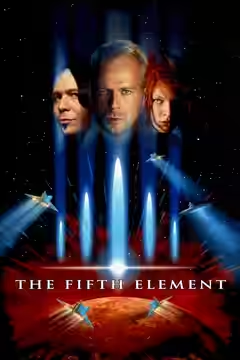
The Fifth Element poster73

The Fifth Element

1997 · Besson’s candy-coloured space opera, equally loud, and fond of its own silliness.

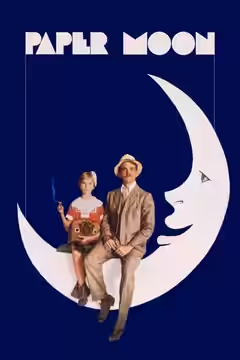
Paper Moon poster

Paper Moon

1973 · A con man and a girl who may be his daughter, in black and white Kansas.

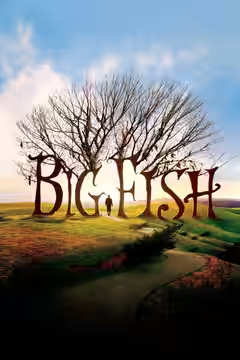
Big Fish poster78

Big Fish

2003 · Burton on a son who cannot tell his father’s stories from his father.