Film review

The Fifth Element

1997 · Directed by Luc Besson · 2h 06m · MPA PG-13

In a sentenceThe end of the world, dressed by Gaultier and delayed by a radio host who will not stop talking

Science FictionActionAdventure

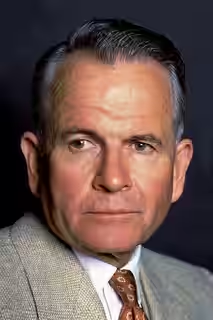
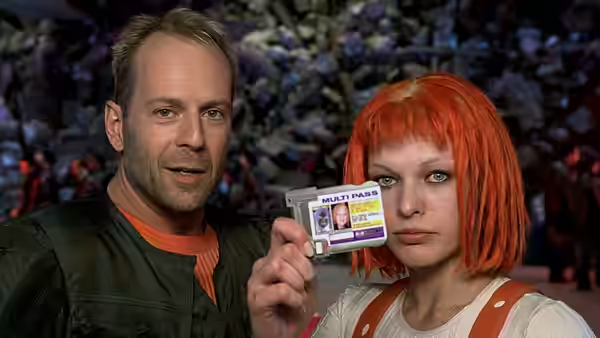
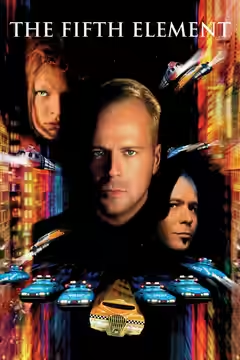
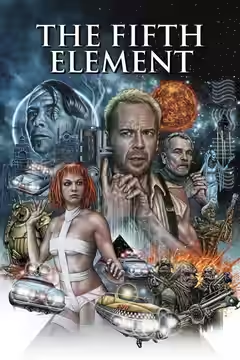
Egypt, 1914. A race of armoured aliens, the Mondoshawan, collect four elemental stones from a temple and promise to return them when the Great Evil comes back. Three hundred years later a ball of fire is heading for Earth, the Mondoshawan ship is shot down, and scientists in a New York laboratory rebuild the sole survivor from a single hand. She is Leeloo (Milla Jovovich), the fifth element, and she escapes by crashing through the roof of a flying taxi driven by Korben Dallas (Bruce Willis), an ex-soldier who wants only to be left alone. The priest Cornelius (Ian Holm), keeper of the prophecy, needs the stones, which are with an opera singer at the resort Fhloston Paradise. The industrialist Zorg (Gary Oldman) wants them too.

Plays from YouTube when you press play; nothing loads from them until then.

Fi1m review

Luc Besson’s comic-strip future is one of the best-dressed places cinema has built, and the film sprints through it. The story is thin and Chris Tucker is an acquired taste, but the pleasure is real and mostly earned.

Luc Besson had made two small, sad films about lonely killers, Nikita (1990) and Léon (1994), and then he made this. The Fifth Element is a space adventure drawn in the flat bright colours of a French comic strip. Every five thousand years a Great Evil comes for the Earth; four stones and a fifth element can stop it; somebody has to fetch them. The film is a joy to look at and a chore to follow, and for most of its 126 minutes the looking wins.

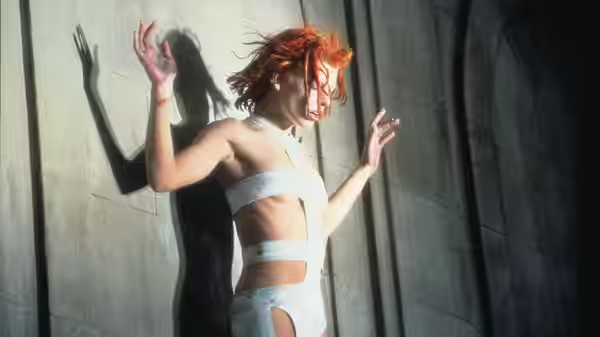
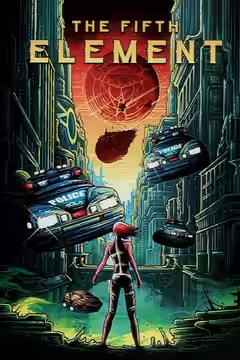
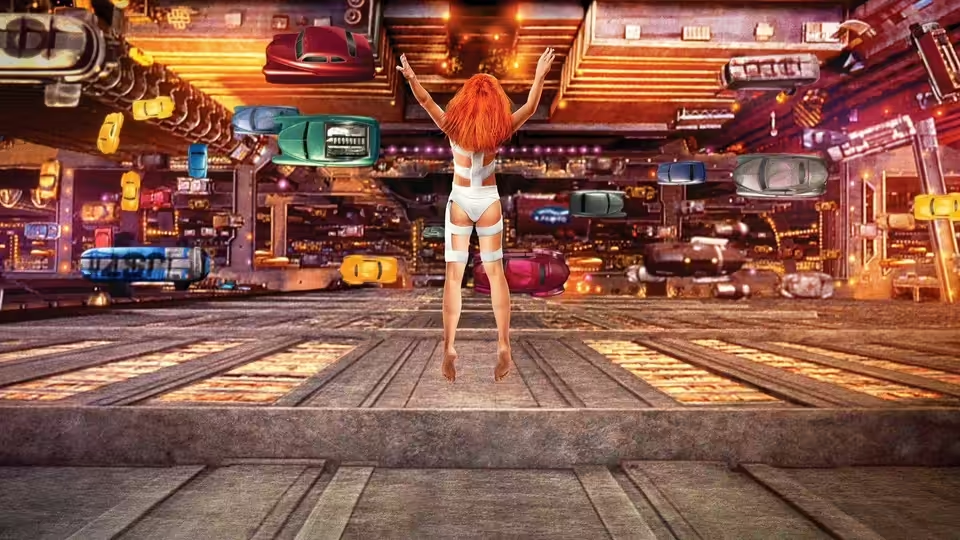
The look belongs first to Dan Weil, who builds a New York where traffic hangs in stacked lanes hundreds of storeys deep and a cab can shake off the police by dropping fifty floors. Korben Dallas’s flat is one room in which the bed slides into the wall and the shower slides out of it. Fhloston Paradise, the resort where the stones are hidden, is a cruise liner the size of a town. Jean-Paul Gaultier dresses everyone: the cab driver in an orange rubber vest, the heroine in a few white bandages, the villain with a plastic half-dome over one temple. Thierry Arbogast and Nick Tebbet light all of it in daylight. After a decade of futures shot in rain and neon, this one is orange and sky blue, and it cheers us before anyone says a line.

Sylvie Landra cuts fast, most of all in the cab chase, which drops through a tunnel of traffic and out over the skyline without once losing the cab. Éric Serra’s score is nearly as busy as the pictures: jittery techno under the action, a twanging guitar for the villain, and a long operatic set piece in the middle of the film. A blue singer with tendrils down her back performs an aria in a hotel concert hall while, in a suite upstairs, Leeloo (Milla Jovovich) fights a room of soldiers, and the music slides from opera into drum machines and back with the fight cut to the beat. We grinned through the whole thing and were surprised at how happy it made us. It is the reason a good many people still love this film.

Bruce Willis is the reason the rest of it holds. He plays Korben, an ex-soldier driving a cab, as a man who was tired before the plot arrived, and when a shrieking broadcaster or a green alien enters the frame he looks at it the way we would. Gary Oldman’s Zorg is an arms dealer with a Southern drawl and a limp, and he is having a splendid time; the script keeps him and Korben apart for the entire film, which is a strange thing to do with your two best actors. Ian Holm fusses nicely as Cornelius, the priest who knows the prophecy. Jovovich, whose Leeloo learns English from a screen in an afternoon, is asked to be a weapon, a child and a saviour in turn, and she does the fighting with conviction. As a person she is barely written.

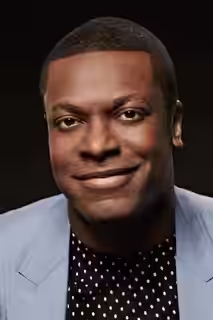
Then there is Ruby Rhod. Chris Tucker plays the galaxy’s favourite broadcaster in leopard print and a falsetto, and he is funny for about five minutes. He is in the film for closer to forty, and he spends most of the last act screaming in the hero’s ear during a gunfight. We started to dread his entrances, and by the final half hour we were tired, which a film this fast should never allow. The script, by Besson and Robert Mark Kamen, has the same trouble everywhere: it announces the end of the world, then cuts to a joke about a fridge. The Great Evil is a ball of fire.

Against Besson’s own films this is the loud one. Léon had one relationship and let it breathe; here the love between Korben and Leeloo is supposed to be the point of the story and gets about three scenes. Against the genre it does better. Few science fiction films of its decade look as if anyone enjoyed making them, and this one looks like a fairground.

It runs 126 minutes and carries a PG, which will surprise anyone who remembers the body count in the hotel. Watch it with the sound up and save the plot questions for afterwards. There will not be many, because the film does not leave room for them.

Critical consensus AI synthesised

64
Positive
6
Mixed
1
Negative
3
The Telegraph
5 August 2017
90*

The piece celebrates the film as a thrillingly overblown, pop-art masterwork and one of the craziest and most pleasurable sci-fi films, whose inventive style influenced later fantasy cinema; the critic has loved it since first viewing and sees it as pure blockbuster fun.

Read the full review →
The Times
22 November 2003
90*

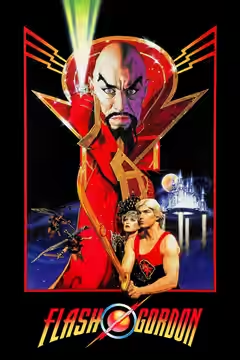
The critic calls Besson’s film a riotously daft, fun sci-fi adventure that is light-years ahead in entertainment value compared to more serious entries like The Matrix, drawing on camp traditions like Flash Gordon with its flamboyant European style and strong supporting cast.

Read the full review →
Empire
1 January 2000 · Adam Smith
80*

The critic praises the film's groundbreaking visuals as unlike anything seen before, with a bright, comic-strip-inspired future that could redefine sci-fi imagery. They note some conceptual overload and uneven comedy in the third act but conclude that the stunning look makes up for minor story issues.

Read the full review →
Little White Lies
10 May 2017 · Patrick Sproull
80*

The critic celebrates the film's enduring off-kilter charm and visual inventiveness twenty years on. They single out its unique world-building and comic tone as setting the template for playful, idiosyncratic big-budget sci-fi.

Read the full review →
Los Angeles Times
9 May 1997 · Kevin Thomas
80*

The critic praises the film as a warmer, more fun, and campy sci-fi extravaganza with some of the most sophisticated and witty production and costume design imaginable. He singles out Bruce Willis as the true fifth element who holds everything together with smarts, style, humor, and humanity.

Read the full review →
Radio Times
★★★★ · Alan Jones
80

The critic hails the film as a superb, socially conscious sci-fi adventure with slick satire, unusual visuals and futuristic thrills. They single out Gary Oldman's villain and the camp resort-planet sequence for particular praise.

Read the full review →

Cast

Awards

Academy Awards, 1998

Nominated
Best Sound Editing

BAFTA Film Awards, 1998

Won
Best Special Visual Effects

César Award for Best Cinematography, 1998

Won
César Award for Best Cinematography

César Award for Best Costume Design, 1998

Nominated
César Award for Best Costume Design

César Award for Best Director, 1998

Won
César Award for Best Director

César Award for Best Editing, 1998

Nominated
César Award for Best Editing

César Award for Best Film, 1998

Nominated
César Award for Best Film

César Award for Best Music Written for a Film, 1998

Nominated
César Award for Best Music Written for a Film

César Award for Best Production Design, 1998

Won
César Award for Best Production Design

César Award for Best Sound, 1998

Nominated
César Award for Best Sound

Hugo Awards, 1998

Nominated
Best Dramatic Presentation

MTV Movie Award for Best Fight, 1998

Nominated
MTV Movie Award for Best Fight

Satellite Award for Best Visual Effects, 1998

Nominated
Satellite Award for Best Visual Effects

European Film Award for Best Film, 1997

Nominated
European Film Award for Best Film

Golden Raspberry Award for Worst Supporting Actress, 1997

Nominated
Golden Raspberry Award for Worst Supporting Actress

Saturn Awards, 1997

Nominated
Best Costume

If you liked this, try…