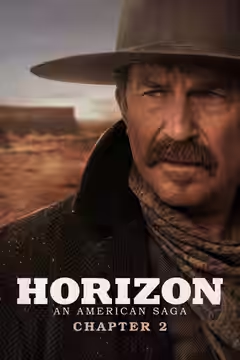
Kevin Costner’s Western has handsome landscapes, detailed settings and little sense of where its many stories are going. His screen presence helps, but 190 minutes is a long time to spend waiting for the drama to gather force.
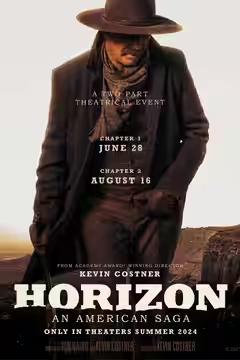
Kevin Costner’s Horizon: An American Saga – Chapter 2 is a frustrating Western, carefully made and poorly organised. It wants room for a large cast and several stories, and there is nothing wrong with that ambition. At 190 minutes, however, it also has room to give those stories shape. Too often, another change of scene arrives before the previous strand has become compelling. There is a lot of starting again.
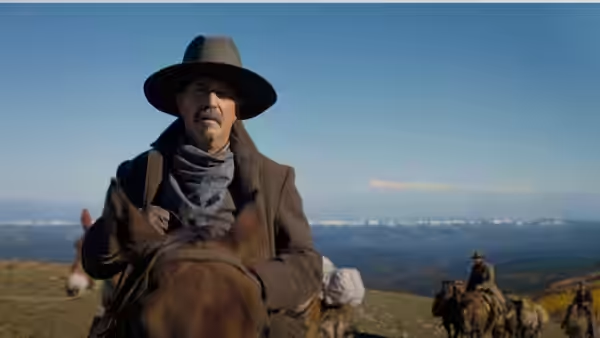
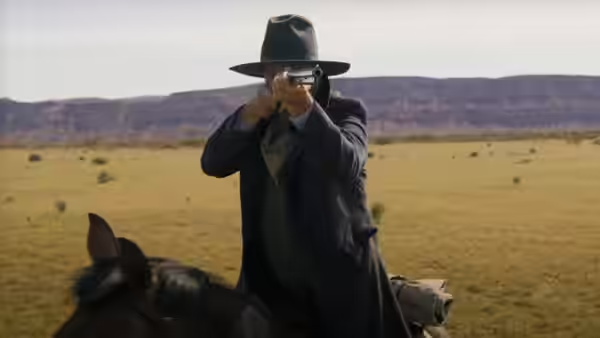
J. Michael Muro’s cinematography gives the Utah landscapes the attention they deserve, with clear images that let us take in the country rather than struggle to see it. The horse-wrangling ranch provides the sort of concrete setting this wandering narrative needs. We have something specific to look at while the larger story takes its time. The outdoor photography remains a reliable pleasure when the plot starts to sag.
Derek R. Hill’s production design rewards close attention, as do Lisa Lovaas’s costumes. The care taken over the settings and clothes helps us settle into a film that otherwise makes that difficult. John Debney’s score adopts an old-fashioned sweep that suits the director’s approach. Yet it promises a degree of excitement that the scenes seldom provide. With so few dramatic peaks, the music has too much encouragement to supply.
The larger problem belongs to the screenplay by Kevin Costner and Jon Baird, and to the way Miklos Wright’s editing moves between its strands. Abrupt transitions repeatedly make us start again, just when a stretch of story ought to be developing. We grew restless because those switches kept postponing the reward for paying attention. A long running time can accommodate digression, but each return needs to deepen our involvement. Here, the repeated work of finding our bearings wears away the interest the individual scenes have earned.
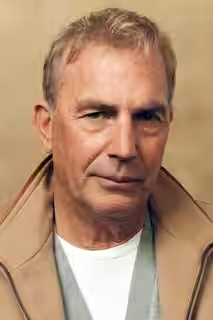
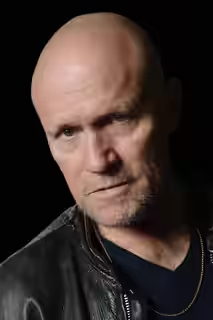
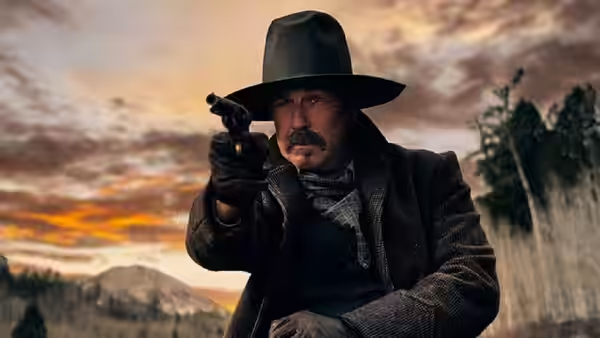
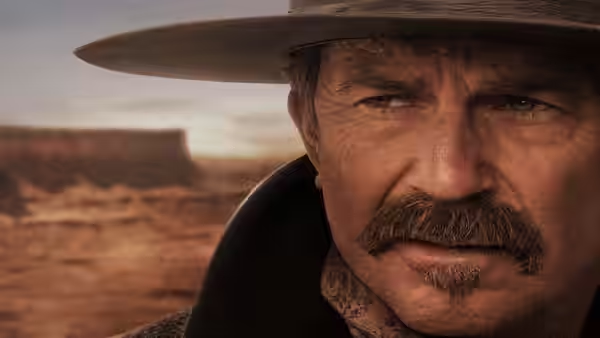
Kevin Costner is more persuasive as Hayes Ellison than the film is as a whole. His screen presence gives us a useful point of focus amid the dispersed action, without requiring the character to carry every strand. Michael Rooker, as Sgt. Major Riordan, also makes an impression in a film where that is not easily done. Their performances offer reasons to keep watching even when the connections between the stories remain unconvincing.
There is pleasure here for those who like an unhurried, traditional Western and are happy to spend time with its landscapes. The difficulty is that unhurried storytelling still needs to take us somewhere, especially when so many characters compete for attention. The director seems reluctant to choose which of them should matter most in any given stretch. The film needs longer passages in which one story can hold our attention without interruption.
We can understand the attraction of continuing with these people, and the care spent on their surroundings deserves recognition. But admiration for the work does not make the running time pass more easily. Anyone already committed to the saga may find enough in the performances and landscapes to justify another chapter. For newcomers, we cannot recommend beginning with 190 minutes of interrupted introductions.