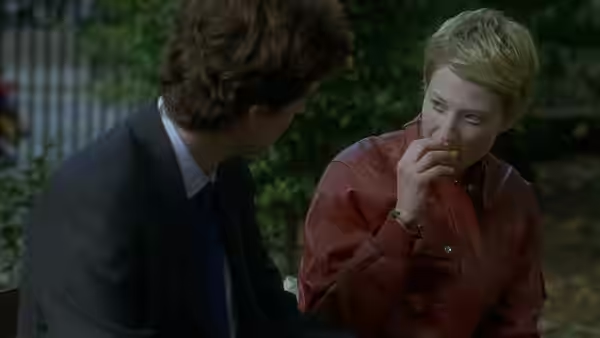
Emma Recchi (Tilda Swinton) leans over her handbag beneath a Milan cathedral spire
Film review

I Am Love

2010 · Directed by Luca Guadagnino · 2h 00m · MPA R

In a sentenceEven the music seems determined to get Tilda Swinton out of that family

In Milan, Emma Recchi (Tilda Swinton) is part of a wealthy Italian family. The Recchis include Edoardo Recchi Junior (Flavio Parenti), Elisabetta Recchi (Alba Rohrwacher) and Tancredi Recchi (Pippo Delbono). Emma’s romance brings her own wishes into conflict with an established family life, as she begins to consider what she wants beyond her place in the household. Moving between Milan and the surrounding landscapes, the story follows her growing awareness of those desires and the difficulty of giving them room within the life she already has.

Plays from YouTube when you press play; nothing loads from them until then.

Fi1m review

Luca Guadagnino’s I Am Love is a moving, sometimes overbearing melodrama, carried by Tilda Swinton’s sensitive performance. We recommend it, despite stretches of slow pacing and music that occasionally overwhelms the actors.

Luca Guadagnino takes the upheaval within a wealthy Italian family seriously, and asks us to do the same. We recommend I Am Love: it is absorbing, often moving, and willing to risk excess when a tidier film would keep its feelings small. Its weakness is a tendency to underline what Tilda Swinton has already made clear as Emma Recchi. The film needs her restraint, especially when its music and images try to make every feeling unmistakable.

Tilda Swinton gives Emma enough uncertainty to keep the romance from becoming a simple declaration of independence. As Emma becomes more conscious of what she wants, apprehension remains visible alongside the pleasure in her face. We were moved by that uncertainty: she makes happiness seem unfamiliar enough to require some care. The performance suggests someone still learning to trust what she feels, and that hesitation keeps her recognisable when the direction grows more forceful.

Yorick Le Saux lets us spend time looking at Milan, and allows the landscapes beyond the city to hold our attention too. Francesca Di Mottola’s production design gives the family’s prosperity a formality that makes Emma’s uncertainty seem conspicuous. The care given to these surroundings helps explain why anyone in this family might resist change. We understand why the film looks so closely, although the pleasure of looking occasionally delays the next meaningful exchange.

John Adams’s music gives the romance an urgency that the leisurely storytelling does not always supply on its own. Its force often feels right, but there are passages where its insistence draws attention away from Emma. Walter Fasano’s editing shares the film’s patience, sometimes usefully and sometimes beyond what a scene can bear. At 120 minutes, this is hardly an unreasonable demand on an evening; it is the uneven pace within those minutes that we notice.

The screenplay, credited to Barbara Alberti, Ivan Cotroneo, Walter Fasano and Luca Guadagnino, is most persuasive when it keeps Emma’s wishes close to her doubts. We believe in the difficulty of wanting something that threatens an established life. Some of the dramatic pressure is applied too bluntly, however, and the characters can briefly seem to be serving the plot. We would have liked the writers to trust the quieter exchanges more often, since Tilda Swinton has already given them enough to work with.

As a melodrama, the film understands that a change in someone’s private life can feel large enough to disturb everything around them. It takes that feeling seriously without asking us to admire Emma simply for having it. Anyone who dislikes a lingering image or an emphatic musical passage will find plenty to object to, and some of those objections are fair. Yet the romance remains tender enough to justify staying with a film that occasionally makes rather a lot of itself. Choose it when there is time to let a romance be a little unreasonable.


Critical consensus AI synthesised

75
Positive
10
Mixed
7
Negative
0
Time Out
5 April 2010 · ★★★★★ · Dave Calhoun
100

Calhoun presents the film as a work of masterly daring and skill. He singles out its boldness, while the story unfolds within a powerful, wealthy Italian family.

Read the full review →
Variety
7 September 2009 · festival review · Jay Weissberg
90*

Weissberg calls the film a stunning achievement and predicts worldwide arthouse buzz. He praises its meticulous visual craft and performances, especially Tilda Swinton’s commanding portrayal of Emma.

Read the full review →
RogerEbert.com
18 August 2010 · ★★★½/4 · Roger Ebert
88

Ebert gives the film a strongly favorable assessment. He singles out Tilda Swinton's performance and the film's visual elegance.

Read the full review →
IndieWire
16 June 2010 · Eric Kohn
80*

Kohn finds the film’s bold style and emotional storytelling mostly compelling, despite a misstep in its dramatic confrontation. He especially praises the final sequence, where the visuals and music give the story’s ending powerful emotional weight.

Read the full review →
Little White Lies
19 March 2010 · 3/4/4 · Adam Woodward
80

The critic sees the film as an elevating, stylish reclamation of melodrama, though its impression may not last. They praise its lingering visual gaze over Milan and the surrounding landscapes.

Read the full review →
Empire
29 March 2010 · Damon Wise
78*

The review finds the film stately, original and moving, though it drags at times. It praises the effective score and the bold use of Italian genre-cinema flourishes.

Read the full review →

Straight answers AI written, from our review

Is I Am Love worth watching?
I Am Love is worth watching for its moving romance and Tilda Swinton’s sensitive performance; we score it 81 out of 100. We recommend it to anyone who enjoys patient, emotionally expansive melodrama, with a caveat: the pace sometimes drags, and the music occasionally overwhelms feelings Swinton has already made clear.
How long is I Am Love, and what is it rated?
I Am Love runs 2h 00m and is rated R by the MPA in the US. It is a drama and romance film.
Where can I watch I Am Love in the US?
I Am Love is streaming on Amazon Prime Video, Tubi and The Roku Channel in the US, and it is also available to rent from Amazon Prime Video and Apple TV from $2.99. Availability is checked daily; the links above go straight to each service.
How violent or frightening is I Am Love, and is it suitable for children?
I Am Love carries a UK 15 certificate and is not suitable for children under 15. Its focus is an adult romance and the strain it places on an established family life, which may interest older teenagers. We cannot give a specific assurance about violence or frightening scenes from the content information available.
How does I Am Love compare to All That Heaven Allows?
I Am Love is our recommendation for intimate uncertainty within a wealthy family, while All That Heaven Allows is the stronger choice for a romance confronting cruel social judgement. Swinton makes Emma’s pleasure and apprehension moving, despite some overbearing music and uneven pacing. Sirk’s film is tender but angrier about respectable people, with Jane Wyman carrying much of its emotional weight.
What should I watch after I Am Love?
After I Am Love, try All That Heaven Allows (1955, Fi1m 86): A widow’s romance exposes the cruelty beneath respectable suburban manners. Then The Age of Innocence (1993, Fi1m 86): Drawing rooms, fine clothes and a society determined to police desire; and In the Mood for Love (2000, Fi1m 91): Suppressed longing gives every shared corridor and unfinished conversation its weight.

Cast

Awards

Academy Awards, 2011

Nominated
Best Costume Design

Dorian Award for Film of the Year, 2010

Won
Dorian Award for Film of the Year

If you liked this, try…

  1. All That Heaven Allows (1955, Fi1m 86)A widow’s romance exposes the cruelty beneath respectable suburban manners.

  2. The Age of Innocence (1993, Fi1m 86)Drawing rooms, fine clothes and a society determined to police desire.

  3. In the Mood for Love (2000, Fi1m 91)Suppressed longing gives every shared corridor and unfinished conversation its weight.

  4. The Piano (1993, Fi1m 88)A woman’s desire becomes difficult to contain within an arranged marriage.

  5. The Lunchbox (2013) · not on Fi1m yetFood creates intimacy between two people whose daily routines have narrowed.