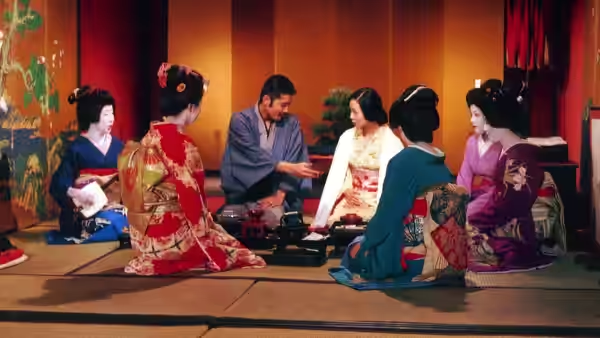
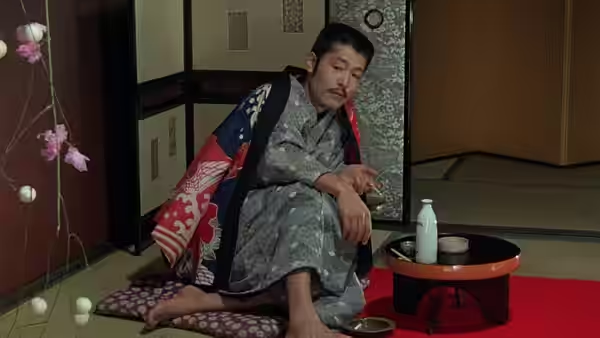
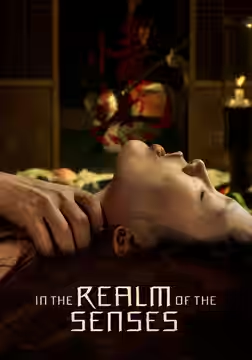
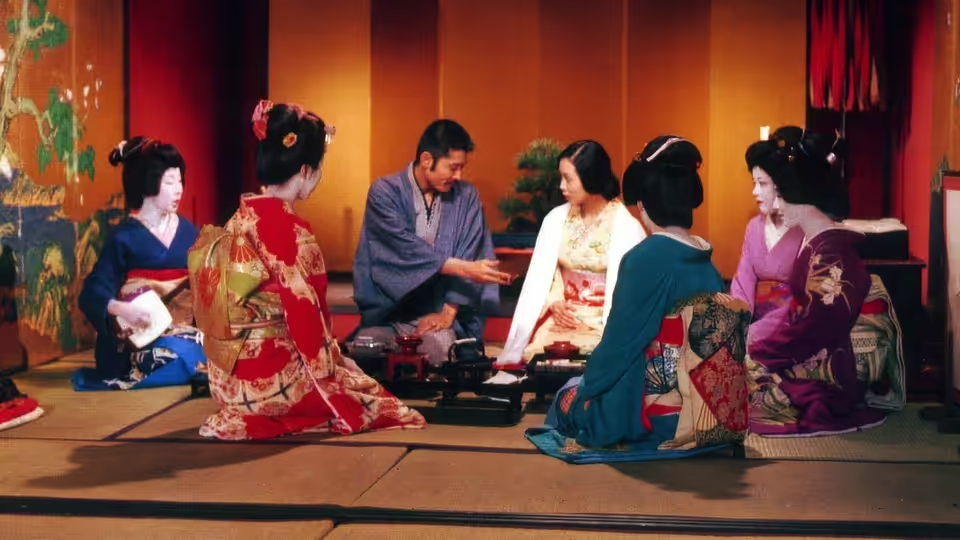
Kichizo Ishida (Tatsuya Fuji) sits among geishas in a traditional Japanese room
Film review

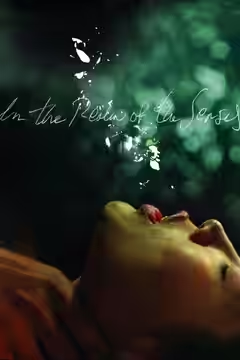
In the Realm of the Senses

1976 · Directed by Nagisa Ōshima · 1h 42m

In a sentenceJapan marches to war outside the window; inside, nobody has the slightest intention of getting dressed

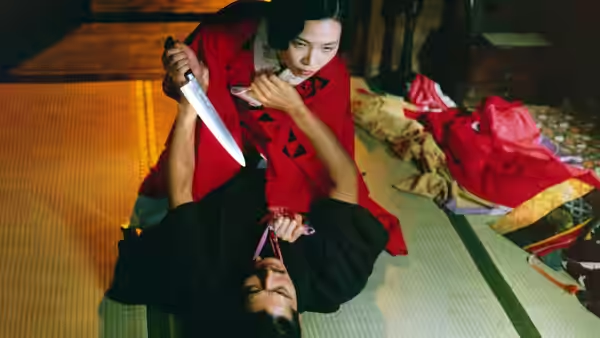
Tokyo, 1936. Sada Abe (Eiko Matsuda), who has worked the streets and would rather not again, takes a job as a maid at the Yoshidaya, an inn run by Kichizo Ishida (Tatsuya Fuji) and his wife Toku (Aoi Nakajima). Sada has a temper: she draws a knife on a fellow maid, Matsuko (Meika Seri), within days. She also has a habit of watching the master and his wife through the screens. Kichizo notices her, follows her into the kitchen and does not take no for an answer, and she does not offer one for long. Soon he is spending his afternoons with her in a room at a nearby teahouse, then whole days, while his wife runs the inn without him and the country outside prepares for war.

Fi1m review

Nagisa Ōshima’s account of the Sada Abe case is explicit, patient and entirely serious, a film about two people who shut the door on 1936 and mean it. It tests the nerves and the attention span, and it is worth seeing once.

Nagisa Ōshima takes a real case from 1936, the maid and the innkeeper who left everyone they knew to stay in a rented room together, and films it with nothing simulated. That decision got In the Realm of the Senses banned, cut and argued over for years; it did not reach a British cinema until 3 May 1991. Watched now, the scandal has thinned and what is left is stranger and more serious than the fuss suggested. It is a film about two people who decide the world beyond a paper screen is not worth their time, made by a director who half agrees with them. It is not an easy 102 minutes. It is a considered one.

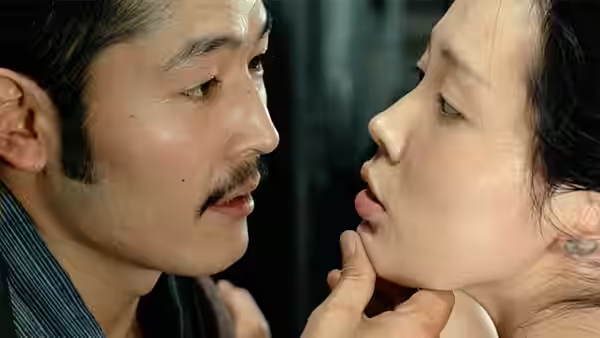
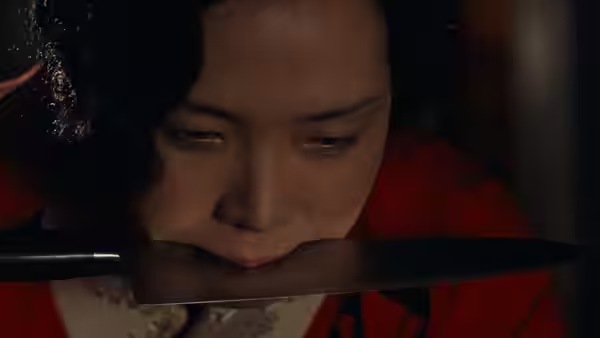
Eiko Matsuda plays Sada with a flat, fixed attention that never breaks into the softness the word romance promises. She wants him, then she wants him not to leave, then she wants him not to sleep, and Matsuda plays each stage as the same look held a little longer. Tatsuya Fuji is the surprise. His Kichizo is amused, indulgent and oddly restful, a man who lets himself be led and smiles about it, and the smile is what makes the later scenes hard to watch. He is having a lovely time right up until the point at which he is not sure he is.

Hideo Itō shoots almost the whole film indoors and from the floor, in lantern light, so the rooms are gold, the bedding is red and the outside world is a grey square glimpsed past a sliding door. Shigemasa Toda, who did the production design and shared the costumes with Masahiro Katō, keeps the inns close to bare: a futon, a screen, a tray, a kimono that matches the quilt. There is nothing to look at but the two of them, which is the point, and it is a point Ōshima is content to make for an hour and three quarters.

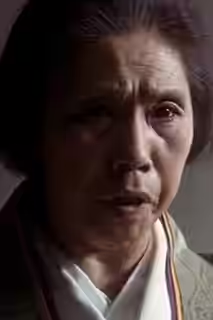
The sex scenes are many, and they do change. Ōshima builds them as a progression, each a step further from the ordinary: food and drink brought in, then other people, geisha and maids and, in one scene we will come back to, an old woman. Whether the progression holds your attention will decide the film for you. We will be honest: somewhere around the hour we were restless, and had stopped being surprised. Then came the scene with the old geisha Kikuryû (Kanae Kobayashi), and later one involving an egg, and we were horrified, and more to the point we were frightened for these two, which is not a feeling we expected a film this explicit to leave room for. The horror was in Matsuda’s face, which does not change at all.

One exterior shot carries the film’s argument. Kichizo walks down a street against a column of soldiers, children waving flags at the men marching past him, and he does not so much as glance at them. Japan is going to war and this man is going back to bed. It is a good shot and it is on its own; the rest of the time Ōshima trusts us to know what 1936 in Tokyo means, and a British viewer on a sofa may not, in which case the room is just a room.

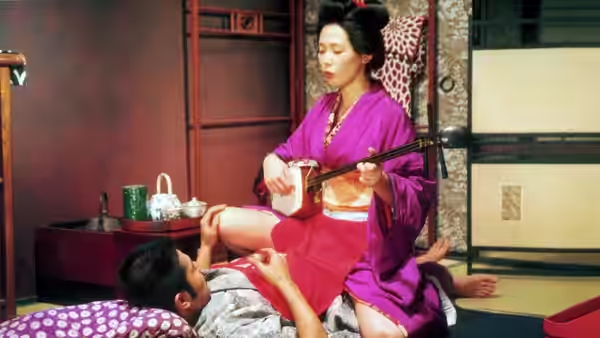
Patrick Sauvion and Keiichi Uraoka cut slowly and hold on faces after the words have stopped. Minoru Miki’s score stays out of the way; most of the music is played in the rooms, a shamisen and a song from a geisha hired for the evening, which keeps the film in its period and in its building. The story moves towards an end that many readers will already know from the history books. We will not describe it. We will say that the film earns it, and that there is nothing in the last stretch that feels like a director enjoying himself.

Most critics land somewhere near where we do, admiring and a little worn down, and one found it tedious. We understand the complaint and think it mistakes the design for a failing: the repetition is what these two did with their lives, and the film would be dishonest if it were livelier. See it once, alone or with someone you do not need to explain yourself to afterwards. It is not a film for a first date, or a fortieth.

Critical consensus AI synthesised

69
Positive
6
Mixed
5
Negative
1

Most critics take the film seriously and lean positive. The praise gathers around Ōshima’s direction: the careful camerawork that keeps the couple’s sexual exploration disturbing rather than titillating, the exquisite composition, and a claustrophobic, almost ritual handling of erotic obsession. Several reviews treat it as a study of consuming desire and note that the sex scenes grow more complex as the relationship turns desperate. More than one critic admits the hardcore content makes a level-headed judgement harder than it should be.

The reservations cluster on the same material. The Independent finds it difficult and often grim while admiring the artistry, and Eye for Film concedes the repetition may drive some viewers away. The lone negative review, in The Skinny, calls it tedious, says the shock wears off quickly, and argues the endless sex scenes and misogynistic fantasies leave no room for story or character. Three of the twelve reviews are only partly readable, which thins the middle of the spread.

Empire
29 July 2009 · David Parkinson
80*

The critic calls the film powerful, stylish and impressive, while noting its disturbing subject matter. They praise its sensuality and sensitivity alongside its documentary-like portrayal of the lovers’ increasingly desperate relationship.

Read the full review →
Radio Times
★★★★ · David Parkinson
80

Parkinson presents the film as a complex study of gender, status and oppression. He notes that its hardcore eroticism can obstruct a considered assessment.

Read the full review →
Slant Magazine
27 April 2009 · ★★★★ · Eric Henderson
80

Henderson praises the film’s deliberate, provocative treatment of sexuality and its artistic ambitions. He especially applauds Criterion’s restoration, which brings out natural skin tones and vivid colors.

Read the full review →
The AV Club
27 May 2009 · Scott Tobias
75*

Tobias finds both films keenly observant studies of consuming desire and its consequences. He singles out the complexity and progression of the sex scenes in In The Realm Of The Senses.

Read the full review →
The Guardian
3 November 2000
75*

The critic regards the film as a powerful, unusually serious classic that everyone should see once. They praise its claustrophobic, ritualistic portrayal of erotic obsession and self-abasement.

Read the full review →
Evening Standard
10 April 2012
65*

The critic finds the film still fresh, despite its abrasive qualities. The grittiness is singled out as making viewers wince well before the infamous climax.

Read the full review →

Straight answers AI written, from our review

Is In the Realm of the Senses worth watching?
In the Realm of the Senses is worth watching once, and we scored it 74. Nagisa Ōshima films the 1936 Sada Abe case with nothing simulated, and the result is serious, patient and hard going, with an hour in the middle that may lose you before the later scenes frighten you back. It suits the curious and the unshockable, not a first date.
How long is In the Realm of the Senses, and what is it rated?
In the Realm of the Senses runs 1h 42m. It is a drama and romance film.
Where can I watch In the Realm of the Senses in Colombia?
In the Realm of the Senses is streaming on MUBI in Colombia. Availability is checked daily; the links above go straight to each service.
How violent or frightening is In the Realm of the Senses, and is it suitable for children?
In the Realm of the Senses is an 18 certificate and is not suitable for children or teenagers. The sex is real and nearly constant, growing stranger as it goes, and two later scenes horrified us and left us frightened for the couple. The story heads towards an ending many will know from history; the squeamish should look elsewhere.
How does In the Realm of the Senses compare to The Piano Teacher?
In the Realm of the Senses is the more explicit film and The Piano Teacher the more controlled one. Ōshima shuts two people in a room and watches them for an hour and three quarters; Haneke gives Isabelle Huppert a whole life to want something terrible inside. Haneke's is the sharper drama, Ōshima's the harder to sit through, and neither is comfortable company.

Cast

If you liked this, try…

  1. Empire of Passion (1978) · not on Fi1m yetŌshima’s follow-up: another doomed couple, this time with a ghost and a well.

  2. Last Tango in Paris (1972) · not on Fi1m yetTwo strangers, one flat, no names; the other great room film of the decade.

  3. Woman in the Dunes (1964) · not on Fi1m yetA man trapped in a sandpit with a widow; Japanese desire as a slow burial.

  4. The Piano Teacher (2001, Fi1m 82)Isabelle Huppert wants something specific and terrible; Haneke watches without blinking.

  5. Betty Blue (1986) · not on Fi1m yetFrench, sunlit and loud where Ōshima is quiet, but the same descent.