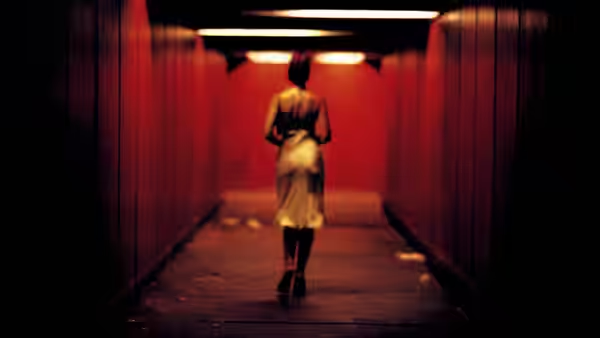
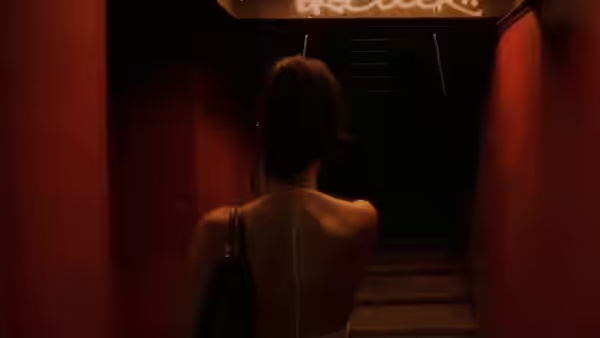
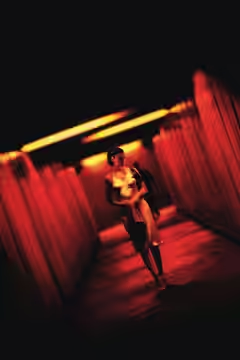
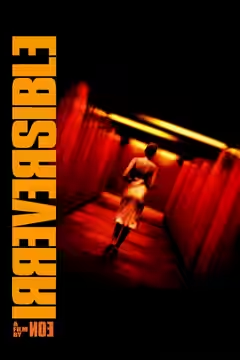
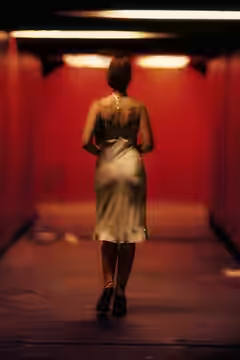
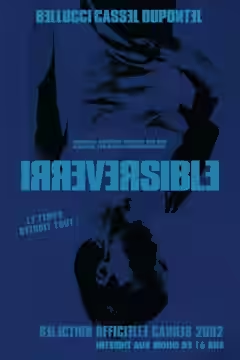
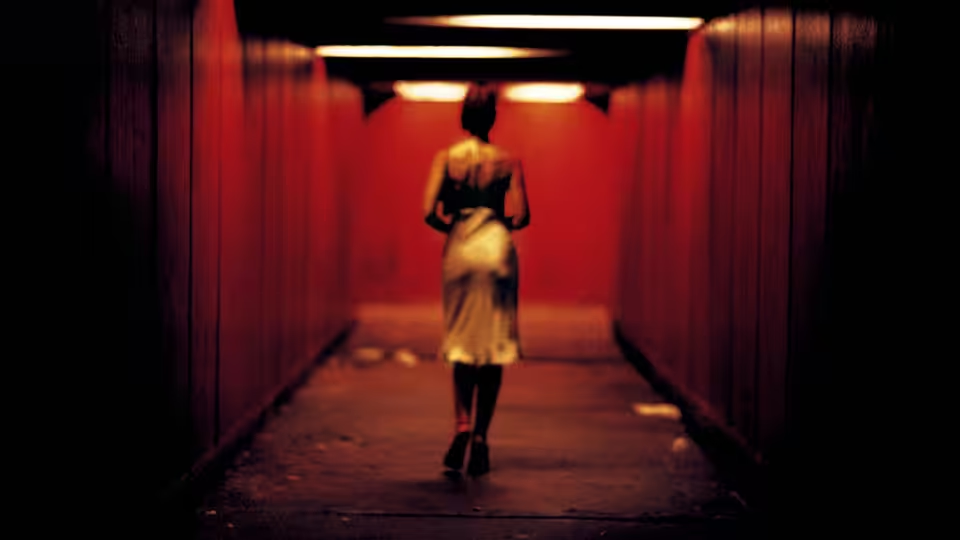
Alex (Monica Bellucci) walks through a red-lit underground passage
Film review

Irreversible

2002 · Directed by Gaspar Noé · 1h 37m · BBFC 18

In a sentenceA revenge film that makes looking away feel like the sensible decision

Irreversible follows Alex (Monica Bellucci), Marcus (Vincent Cassel) and Pierre (Albert Dupontel) through violence and revenge, with events presented in reverse order. The opening confronts the consequences before explaining what has brought the characters to them. Each successive passage moves further back, asking us to piece together actions whose outcomes have already appeared. The story includes graphic physical violence and a prolonged sexual assault, shown directly rather than left off screen. Its backwards movement gradually supplies the context withheld at the start.

Plays from YouTube when you press play; nothing loads from them until then.

Fi1m review

Gaspar Noé’s Irreversible is skilfully made and hard to defend. The reverse chronology gives its violence a disturbing weight, but the prolonged sexual assault overwhelms the people the film asks us to care about.

Gaspar Noé’s Irreversible is an accomplished film whose treatment of violence gives us more reason to object than to recommend it. Told in reverse, it asks us to reconsider what we have seen as it moves towards what came before. That gives a revenge thriller something worth exploring: our judgement can change as we discover more about the people involved. Noé is less convincing when he assumes that making the experience punishing will also make it profound.

Benoît Debie and Gaspar Noé share the cinematography credit, and the fluid camera movement makes the disorientation feel deliberate rather than clumsy. There is something disturbing about being guided so confidently through images we would rather not inspect. The reverse chronology is handled with equal assurance, allowing our understanding of an event to shift after we have watched it. Noé is also the film’s writer and editor.

Monica Bellucci and Vincent Cassel keep this from becoming merely a demonstration of technique. Bellucci makes Alex’s joy as credible as her fear, giving us some sense of a life beyond the film’s determination to distress us. Cassel gives Marcus a force that survives the deliberately confusing presentation, holding our attention when the violence threatens to exhaust it. These performances matter because they suggest people worth attending to even without the elaborate rearrangement of their story.

We were horrified by the prolonged sexual assault, and then angry at how insistently the film made us keep looking. Its duration prevents the crime from becoming the brisk excuse for revenge that it might be in a less demanding thriller. That is a defensible purpose, but it does not settle the question of what the extended exposure achieves. We understand that the suffering is intolerable well before Noé permits the scene to end, and the further insistence adds little to our understanding.

Alain Juteau’s production design and the music credited to André Bézu and Thomas Bangalter contribute to the oppressive experience. Neither contribution strikes us as careless, but both are difficult to appreciate apart from the violence that dominates our response. This is a problem for a drama whose performances deserve attention on their own terms. The film leaves us thinking about how hard it was to watch, long after we have stopped thinking about the people in it.

As a revenge thriller, the film deserves credit for making brutality so unappealing. The backwards movement also complicates the usual invitation to take sides, because we have to keep reconsidering what we know. But Noé gives the pain more attention than the people, and the seriousness of his approach cannot simply be taken on trust. The question of why we are being shown quite so much remains unanswered.

At 97 minutes, Irreversible can feel considerably longer. We would be wary of treating the endurance it requires as evidence that it has succeeded. We would reserve it for those interested enough in the reverse chronology to accept its excesses. If prolonged sexual violence is a limit, the formal skill is not a reason to make an exception.

Critical consensus AI synthesised

57
Positive
4
Mixed
2
Negative
2

The reviews are sharply divided, with praise outnumbering outright rejection but little agreement on what the film achieves. Favourable reviews find its distressing material emotionally forceful and thought-provoking, with praise clustering around Noé’s camerawork, the reverse chronology and the performances of Monica Bellucci and Vincent Cassel. Bellucci receives particular attention for her responses to both danger and happiness. Even admirers describe the violence as difficult, sometimes nearly impossible, to watch.

The disagreement concerns whether that ordeal serves a purpose. The Guardian finds the violence squalid and the reversed chronology less effective than earlier examples; the Los Angeles Times regards the film as exploitative shock cinema, objecting especially to the prolonged, voyeuristic depiction of rape. These are substantial objections to choices that supporters find meaningful, rather than minor reservations. The available excerpts from two further reviews offer no clear verdict, limiting what can be said about the middle ground.

Radio Times
★★★★ · Sloan Freer
80

The critic describes the film as an intense, haunting nightmare that is difficult to watch but hard to forget. They praise Vincent Cassel and Monica Bellucci for their powerful performances.

Read the full review →
Variety
24 May 2002 · festival review · Lisa Nesselson
78*

Nesselson finds the film demanding but rewarding, calling it an emotionally devastating work of art. She especially praises Noé’s controlled, fluid camerawork and the performances, singling out Bellucci’s responses to peril and joy.

Read the full review →
Empire
1 January 2000 · Alan Morrison
75*

The review calls the film distressing but important and thought-provoking. It praises the reverse structure as meaningful social art.

Read the full review →
Screen Daily
29 May 2002 · Sheila Johnston
64*

The page identifies this as a review, but its verdict is hidden behind the paywall. The visible text gives no praise or complaint.

Read the full review →
Time Out
· NB
64*

The available excerpt plunges the viewer into a violent, disorienting experience. It singles out the graphic violence and the film’s narrative reversal, but gives no clear verdict.

Read the full review →
The Guardian
3 February 2003 · Philip French
20*

French finds the film squalid and pretentious rather than an effective story of revenge. He objects particularly to its graphic violence and says its reverse chronology is less effective than earlier examples.

Read the full review →

Straight answers AI written, from our review

Is Irreversible worth watching?
Irreversible earns 55/100 from us: skilfully made, but worth considering only for adults with a particular interest in its reverse chronology and a tolerance for graphic violence. Its backwards structure makes us reconsider what we see, but the prolonged sexual assault overwhelms the characters, and we find too little justification for its insistence on making us watch.
How long is Irreversible, and what is it rated?
Irreversible runs 1h 37m and is rated 18 by the BBFC in the UK. It is a drama and thriller film.
Where can I watch Irreversible in the UK?
Irreversible is streaming on Amazon Prime Video in the UK. Availability is checked daily; the links above go straight to each service.
How violent or frightening is Irreversible, and is it suitable for children?
Irreversible carries a UK 18 certificate and is unsuitable for children, with graphic physical violence and a prolonged sexual assault shown directly. We find the sustained attention to suffering horrifying and oppressive; squeamish viewers should avoid it, and anyone for whom sexual violence is a limit has no reason to make an exception for its formal skill.
How does Irreversible compare to Memento?
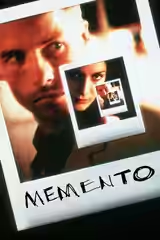
Irreversible and Memento both ask us to reconstruct events, but we recommend Memento as the more rewarding backwards thriller. Its structure makes Leonard’s memory loss frightening and gives the puzzle a stronger purpose, while Irreversible uses reverse chronology to complicate our judgement of violence and revenge. We find its prolonged brutality harder to justify than its elaborate storytelling.
What should I watch after Irreversible?
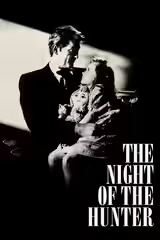
After Irreversible, try Memento (2000, Fi1m 88): Another fractured chronology, with a stronger reason for making us reconstruct events. Then The Vanishing (1988, Fi1m 88): A patient account of obsession that disturbs without relying on sustained graphic violence; and The Night of the Hunter (1955, Fi1m 91): Terror shaped through shadow and performance, with considerably more care for the vulnerable.

Cast

If you liked this, try…

  1. Memento (2000, Fi1m 88)Another fractured chronology, with a stronger reason for making us reconstruct events.

  2. Peppermint Candy (1999) · not on Fi1m yetReverse chronology gives private distress and public history room to complicate each other.

  3. The Vanishing (1988, Fi1m 88)A patient account of obsession that disturbs without relying on sustained graphic violence.

  4. Cure (1997) · not on Fi1m yetAn unsettling crime film that lets uncertainty do much of the damage.

  5. The Night of the Hunter (1955, Fi1m 91)Terror shaped through shadow and performance, with considerably more care for the vulnerable.