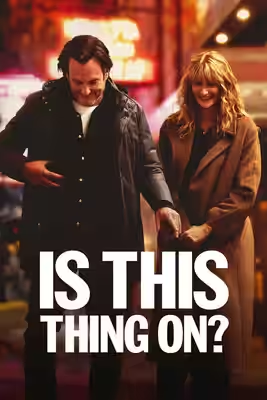
Bradley Cooper’s third film as director is a small, kind and often funny account of a marriage coming apart and a man finding his voice at an open mic. Arnett and Dern are excellent; the script is softer than they are.
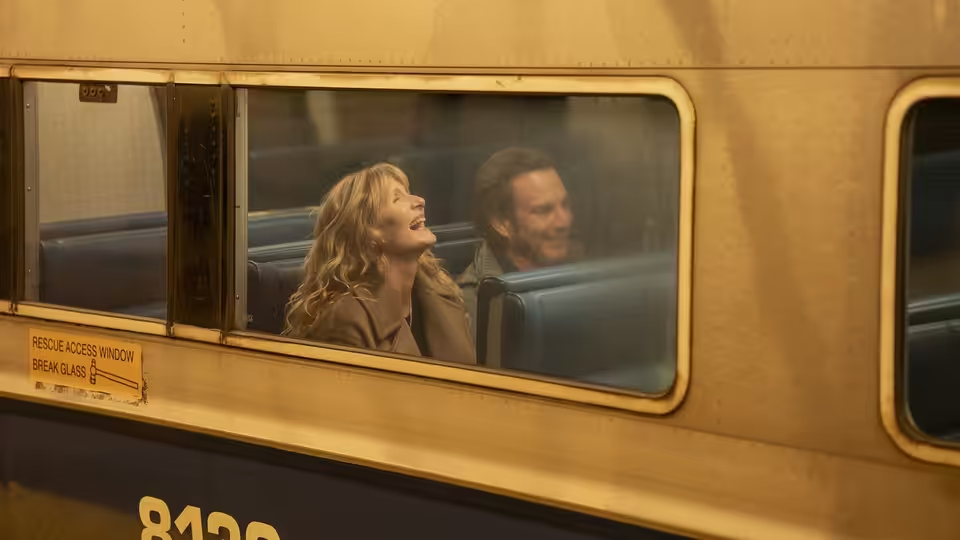
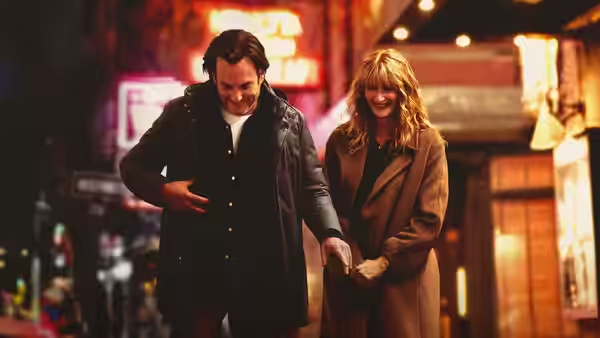
Alex Novak (Will Arnett) is a man in his forties whose marriage is over and who has not yet found the words for it. Then he wanders into an open-mic night, gets up, and finds that saying the worst of it out loud to a room of strangers is easier than saying it at home. That is the whole idea, and Bradley Cooper’s third film as director, after A Star Is Born (2018) and Maestro (2023), is content to stay that size. The story comes from the British comedian John Bishop, who shares the story credit with Arnett and Mark Chappell; the screenplay is by Arnett, Cooper and Chappell. It is a warm, well-acted evening, and it is softer than it needs to be.
Arnett has spent most of his career being loud and certain for laughs. Here he is quiet and unsure, and it suits him better than we would have guessed. The film is honest about how bad a first open mic is: Alex’s early sets are more confession than routine, he loses his place, and the laughs he gets are the uncomfortable kind. Arnett plays the sets without winking at us, and plays the kitchen scenes with Dern as a man who keeps arriving at the sentence and then not saying it. It is as good as he has been on screen.
Laura Dern has the harder part, because Tess is the one who has to be reasonable while the film’s attention is elsewhere, and she makes something of it. Tess is not written as the wife who is wrong; she has a life she wants back and the film lets her want it. Dern does much of her work listening. There is a scene in the second half we will not describe in which she says almost nothing, and it moved us more than we were ready for, because everything she had been holding in for an hour was suddenly on her face and she still did not raise her voice. We were slightly embarrassed to be got at so completely by something so small.
Cooper casts himself as Balls, Alex’s friend, and the scenes between him and Arnett have the ease of two men who have known each other for twenty years, which they have. Andra Day gives Christine a steadiness the men around her lack. Christine Ebersole and Ciarán Hinds get a handful of scenes as Marilyn and Jan and are good in them; Amy Sedaris and Sean Hayes are on hand for noise. Peyton Manning turns up as Laird and is about as surprising as that sounds.
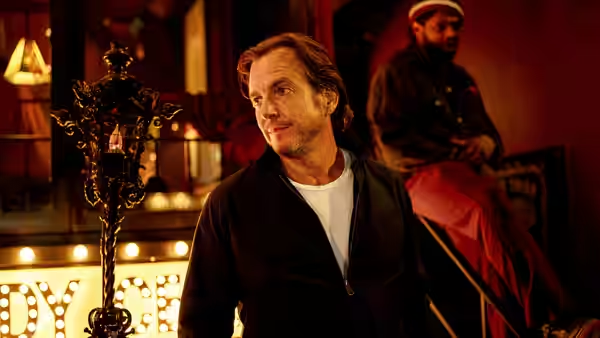
Matthew Libatique shoots most of it close and in dim rooms, the club and the kitchen lit about the same, so that Arnett’s face fills the frame and there is not much else to look at. For an hour that is the right choice. Kevin Thompson’s production design gives the Novaks a house that looks lived in rather than dressed, and Gali Noy’s costumes do not draw the eye, which here is the job. Charlie Greene cuts the stand-up sets so that we sit through the pauses rather than skipping to the punchline. James Newberry’s score is mostly quiet, and when it does step forward it tends to tell us we are being moved after Dern had already seen to it.
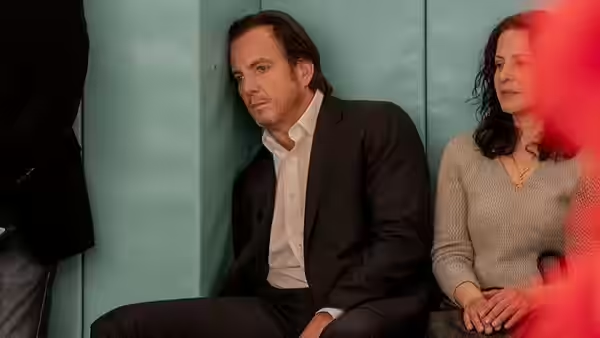
The trouble is the script. Arnett, Cooper and Chappell have written a divorce in which nobody behaves badly for long, nobody says the unforgivable thing, and every scene ends a beat kinder than the one before. We kept waiting for the fight and it kept being put off. The camera’s closeness to Alex has a cost too: we know his side of the marriage in detail and Tess’s mostly by inference, and the film seems to know it without being able to fix it. The stand-up thread thins as the film goes on, and the question of whether Alex is any good is left hanging, which is a fair choice for a film about therapy and a frustrating one for a film about comedy. At 121 minutes it is twenty too long for a story this small.
Set against Maestro, which was busy and loud and always performing, this is a relief. Cooper has shown he can sit still in a room with two actors and trust them, and the film is at its best when that is all it does. See it with someone you have argued with; the kitchen scenes will do the rest. It runs 121 minutes and carries a 15.