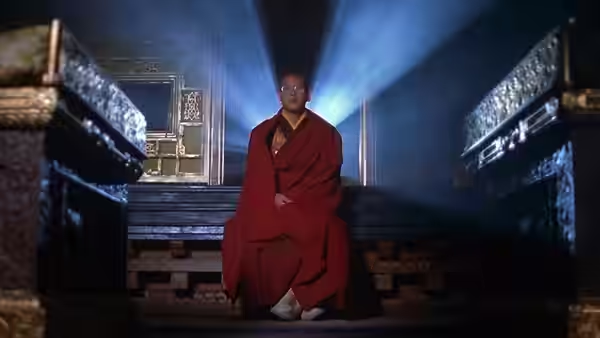
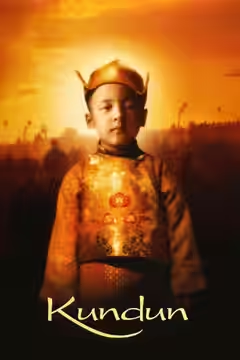
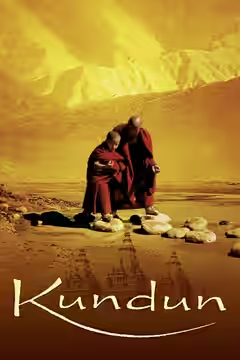
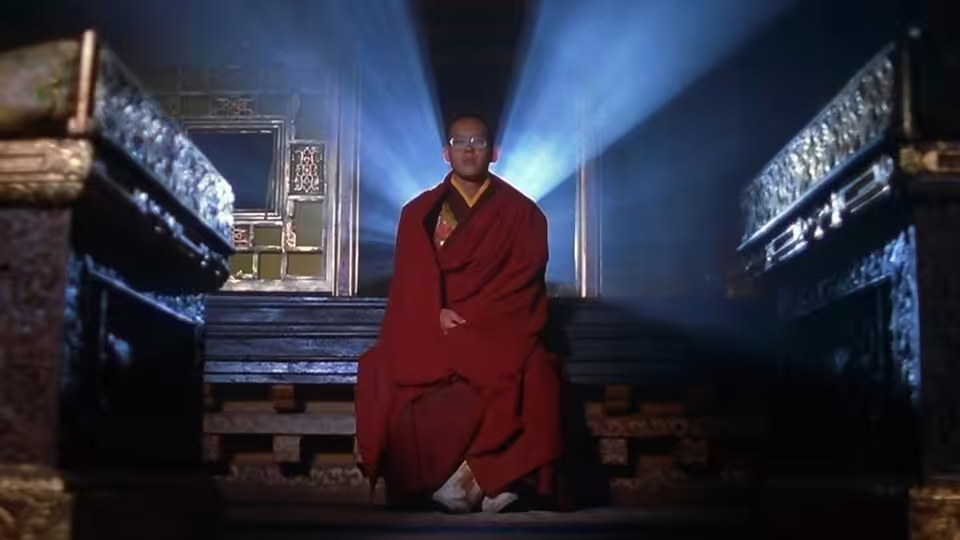
The adult Dalai Lama sits alone on a raised platform between ornate temple furnishings
Film review

Kundun

1997 · Directed by Martin Scorsese · 2h 14m

In a sentencePhilip Glass does quite a lot of the talking for the Dalai Lama

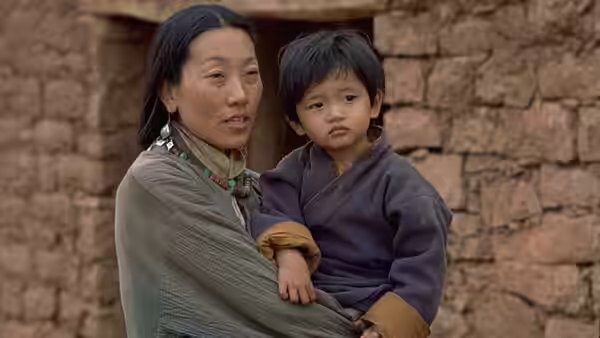
Kundun follows the Dalai Lama from early childhood, with Tenzin Yeshi Paichang playing him at two and Tulku Jamyang Kunga Tenzin at five. His mother (Tencho Gyalpo) and father (Tsewang Migyur Khangsar) place family life alongside the religious leadership that will define his adulthood. The story stays close to the child’s understanding, allowing political events to emerge through his limited view. Gyurme Tethong plays the Dalai Lama at twelve, before Tenzin Thuthob Tsarong takes the adult role in Martin Scorsese’s account of his formative years.

Fi1m review

Martin Scorsese’s Kundun is absorbing when it trusts pictures and music to convey the Dalai Lama’s unease. The dutiful dialogue and reverence can be tiring, but there is enough feeling here to reward patience.

Martin Scorsese’s Kundun is worth seeing for the feeling it finds in a life its screenplay often treats too respectfully. It asks us to stay near the Dalai Lama’s understanding of events, accepting that much will remain beyond his knowledge and ours. That restricted view gives the historical drama a useful uncertainty, even if the dialogue seldom does. The film holds our attention most securely when its images suggest something its central figure cannot comfortably express.

Tenzin Thuthob Tsarong plays the adult Dalai Lama with a restraint that suits this approach. His composure allows us to watch without being told at every moment what he is thinking, and the performance benefits from that freedom. The difficulty comes when the writing relies on the actor to supply almost everything that might distinguish a person from a revered public figure. He remains an absorbing presence, though we sometimes want a less carefully protected acquaintance with him.

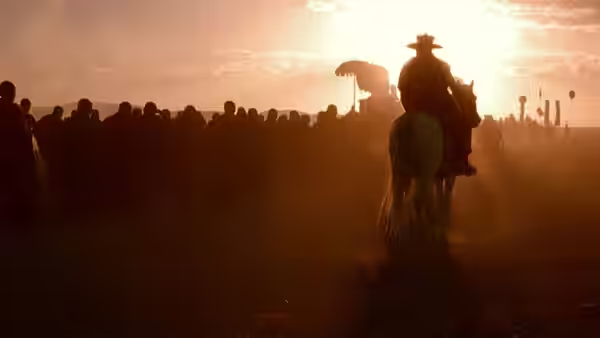
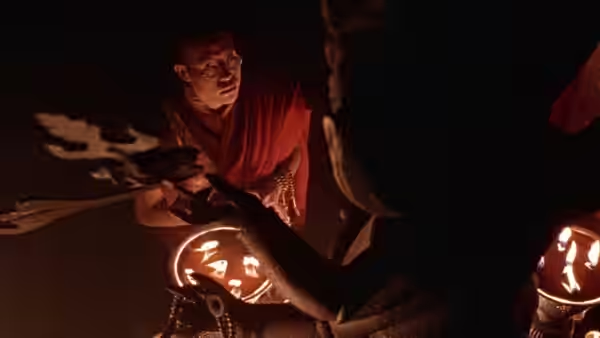
The dream passages give Roger Deakins’s cinematography a purpose beyond making the film handsome: they allow anxiety to disturb its otherwise respectful account. Dante Ferretti’s production design rewards attention, with a degree of care that sometimes makes the surroundings more absorbing than the conversations. He also designs the costumes, contributing to the film’s unusually coherent appearance. The richness of that visible world helps sustain passages in which the storytelling becomes thin, although it cannot make every exchange interesting.

Thelma Schoonmaker’s editing does more to bring us close to the central character. Its impressionistic movement between images suggests an unsettled mind beneath his outward calm, making his composure feel like something that requires effort. We were moved by the private strain that the cutting makes perceptible. Philip Glass’s score strengthens that feeling, supplying emotional pressure without requiring another explanation from the screenplay. These passages make quiet attention feel worthwhile, and they linger longer than the spoken exchanges.

Melissa Mathison’s screenplay is the persistent weakness. Its episodes do not always build on one another, and too often a scene establishes its place in the biography without making the next scene feel necessary. The dialogue can also be commonplace, leaving the actors to deliver information rather than discover anything through an exchange. A historical drama needs some explanation, but here the writing repeatedly interrupts work that the images and music are doing more effectively.

The reverence is harder to overlook because it restricts our acquaintance with the person at the centre. Keeping political events within his understanding is a defensible choice; it does not account for every unanswered question about his character. We wanted more room for awkwardness and contradiction. Still, the agitation conveyed through the dreams and editing gives us enough to care about, and keeps the film from settling into a succession of respectful illustrations.

At 134 minutes, this needs an evening when patience is available. Anyone expecting a historical drama driven by confrontation should allow for a slower, less direct experience, with stretches when the dialogue offers little help. We recommend it to those willing to give music, faces and the connections between images their full attention. Expect a biography that thoroughly explains its subject, however, and there is a fair chance of leaving frustrated.
Critical consensus AI synthesised

59
Positive
3
Mixed
4
Negative
3

The reviews of Kundun are mixed, with praise clustering around its images and music rather than its storytelling. Roger Deakins’s photography and Philip Glass’s score draw admiration even from critics who find the drama unpersuasive. Several reviews also praise the production design or performances. The broad agreement is that Scorsese creates a richly detailed film; there is much less agreement about how much it reveals about the Dalai Lama.

Reservations centre on a simplistic, episodic script, emotional distance and a reverence that limits scrutiny of its subject. The spread is wide: Slant Magazine reads the impressionistic editing as a way into the Dalai Lama’s inner turmoil, where less persuaded critics find him underdeveloped. Notably, Keith Phipps supplies two sharply different assessments: at The AV Club he finds the approach detached and aimless; at The Ringer he praises the dreamlike imagery and the portrayal of a leader whose understanding of political events is limited.

Slant Magazine
28 October 2019 · ★★★★½ · Jake Cole
90

Cole argues that Kundun is an underappreciated, standout entry in Scorsese’s work. He praises its impressionistic editing, which conveys the Dalai Lama’s inner turmoil beneath his outward calm.

Read the full review →
Empire
1 January 2000 · Ian Freer
70*

Freer finds the film difficult and demanding but ultimately thrilling, while noting it falls short of Scorsese’s highest standards. He praises Philip Glass’s score and the haunting beauty of the richly textured images.

Read the full review →
The New York Times
24 December 1997
65*

The page identifies this as a film review, but its text is unavailable. The critic’s verdict and specific praise or complaints cannot be verified.

Read the full review →
Time Out
· TCh
64*

The page presents the film as an unusually simple and strange Scorsese work. It characterizes the film as an act of self-imposed exile, but the available text gives no further verdict or specific praise.

Read the full review →
Total Film
3 April 1998 · ★★★ · Total Film
60

The review finds Kundun ambitious and reasonably absorbing, but weighed down by storytelling problems. It praises the visual splendour and performances, while faulting the simplistic script and episodic narrative.

Read the full review →
Variety
14 December 1997 · Emanuel Levy
50*

Levy finds the film hypnotic and visually stunning but ultimately not compelling or illuminating. He praises Roger Deakins’ imagery and Philip Glass’ score, while faulting the routine screenplay and commonplace dialogue.

Read the full review →

Straight answers AI written, from our review

Is Kundun worth watching?
Kundun is worth watching for patient admirers of historical drama, and we score it 73 out of 100. We find its strongest feeling in Philip Glass’s music, the dream passages and the editing; the dutiful dialogue and protective reverence make it less rewarding for anyone seeking confrontation or a fuller understanding of the Dalai Lama.
How long is Kundun, and what is it rated?
Kundun runs 2h 14m. It is a drama and history film.
Where can I watch Kundun in Ecuador?
Kundun is not on any streaming or rental service in Ecuador at the moment. Availability is checked daily.
How violent or frightening is Kundun, and is it suitable for children?
Kundun has a US rating advising parental caution for children under 13, rather than unrestricted family viewing. Its dream passages convey anxiety, though that alone does not establish how violent or frightening it is; the slow pace and 134-minute running time make it better suited to patient teenagers and adults than younger children.
How does Kundun compare to The Last Emperor?
Kundun shares The Last Emperor’s interest in a ruler’s childhood and restricted viewpoint, but we recommend the latter more readily as an absorbing historical drama. Both keep their central figures somewhat remote; Kundun particularly rewards viewers willing to let music, faces and editing carry feelings that its dialogue struggles to express.
What should I watch after Kundun?
After Kundun, try The Last Emperor (1987, Fi1m 80): A ruler’s childhood and restricted viewpoint shape another carefully composed historical life. Then Of Gods and Men (2010, Fi1m 84): Patient attention to religious community makes difficult choices feel personal and immediate.

Cast

Awards

Academy Awards, 1998

Nominated
Best Cinematography
Nominated
Best Costume Design
Nominated
Best Original Dramatic Score
Nominated
Best Production Design

If you liked this, try…

  1. The Last Emperor (1987, Fi1m 80)A ruler’s childhood and restricted viewpoint shape another carefully composed historical life.

  2. The Gospel According to St Matthew (1964) · not on Fi1m yetReligious conviction expressed through faces and images, with little patience for decoration.

  3. The Colour of Pomegranates (1969) · not on Fi1m yetA poet’s life told through concentrated images rather than the usual biographical checkpoints.

  4. The Burmese Harp (1956) · not on Fi1m yetMusic and Buddhist faith carry a sober account of war’s human cost.

  5. Of Gods and Men (2010, Fi1m 84)Patient attention to religious community makes difficult choices feel personal and immediate.

Kundun (1997) review: Moving images outweigh a dutiful script (Ecuador) | Fi1m