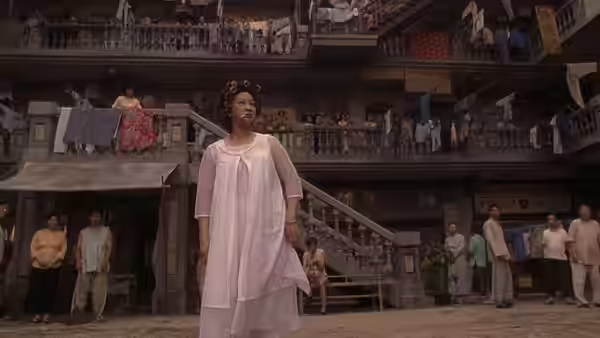
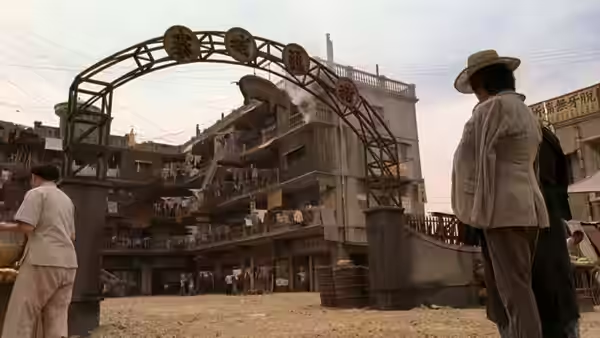
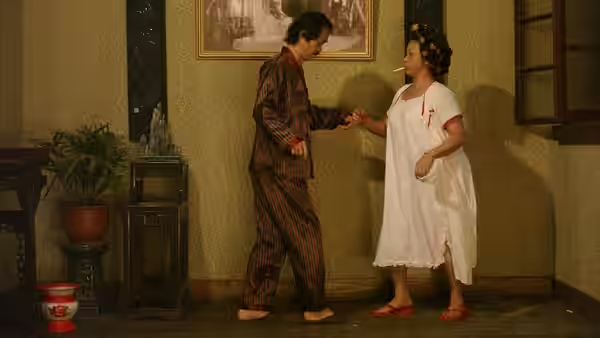
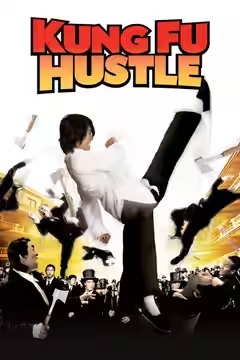
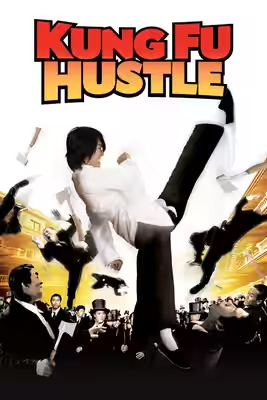
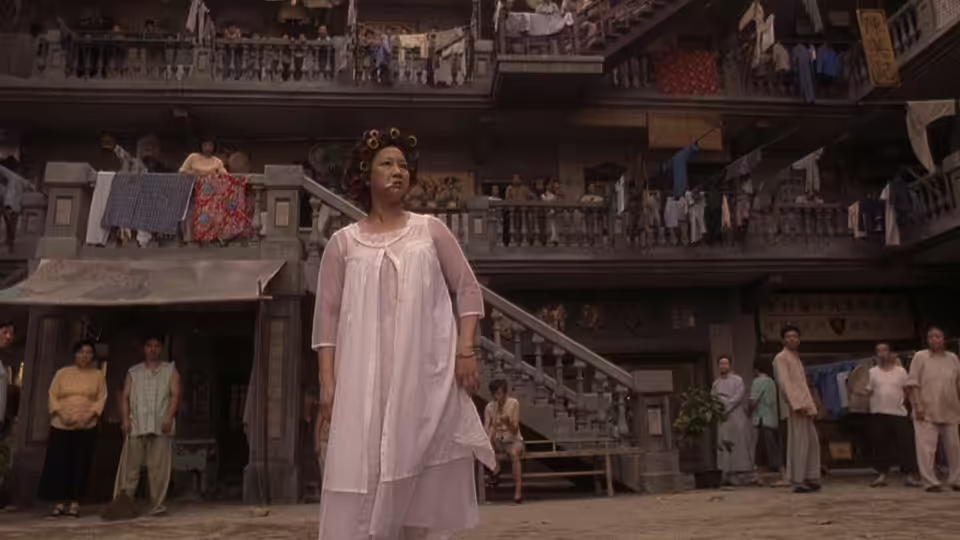
Landlady (Yuen Qiu) stands in her nightdress in the crowded Pig Sty Alley courtyard
Film review

Kung Fu Hustle

2004 · Directed by Stephen Chow · 1h 39m

In a sentenceThe Axe Gang dances, the Landlady smokes, and gravity is treated as a suggestion

Shanghai in the 1940s, where the Axe Gang, men in black suits who dance in the street after a killing, run everything worth running. Sing (Stephen Chow), a small-time chancer, and his sidekick (Lam Chi-chung) want to join the gang, and settle for impersonating it to shake down Pigsty Alley, a tenement so poor the real gangsters cannot be bothered with it. The Landlady (Yuen Qiu), in curlers and a dressing gown, and her Landlord (Yuen Wah) are not fooled for a moment. The scuffle Sing starts brings Brother Sum (Danny Chan) and the real Axe Gang to the alley, where a tailor, a coolie and a man called Donut put down their work and turn out to be retired kung fu masters. Sing, meanwhile, remembers a mute girl with a lollipop he once failed to protect.

Fi1m review

Stephen Chow builds a slum, hides three kung fu masters in it and sends the Axe Gang round to collect, and the result is one of the funniest martial-arts films we have seen. The story thins once the real fighting starts; the jokes do not.

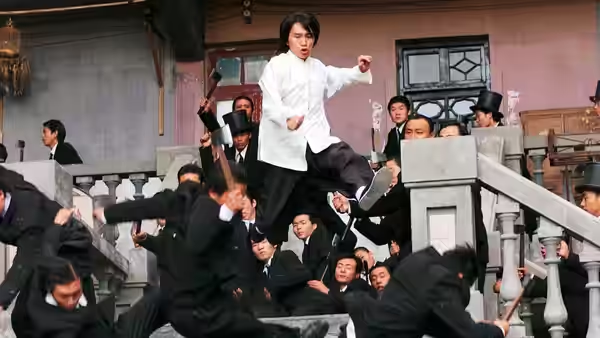
Stephen Chow has made a kung fu film in which the hero cannot fight. Sing, played by Chow himself, is a chancer in 1940s Shanghai who wants to join the Axe Gang, the men in black suits who run the city and dance in the street when they have killed someone. He is not good enough to be a gangster, so he picks on Pigsty Alley, a tenement so poor even the gangsters leave it alone, and finds that three of its tenants are retired masters. That is the whole engine of Kung Fu Hustle, and for most of its 99 minutes it is enough. We recommend it warmly, with one caveat: the film runs out of story some way before it runs out of fights.

Oliver Wong’s production design does half the work. Pigsty Alley is a courtyard of balconies, washing lines and flaking plaster, with a single tap the Landlady turns off when she feels like it, and every tenant can see into every other tenant’s life. Poon Hang-Sang shoots it in dust and warm sun, and shoots the Axe Gang’s world in black, marble and night, so the two halves of the film look like two different cities. Angie Lam cuts like a cartoon editor: she holds the wide shot until the gag has fully landed, then cuts hard to the reaction. The pace never slackens and never hurries.

The set piece we will still be describing to people in ten years is a chase. Sing has tried to throw knives at the Landlady and they have gone everywhere but where he aimed, and now she is after him, in rollers and a dressing gown with a cigarette in her mouth, both of them running down an empty road with their legs a blur and the landscape streaming past. It is a Road Runner cartoon made with people. We laughed until it hurt, and what did it was the patience: Chow lets each knife arrive on its own, a beat late, so the joke is in the waiting rather than the impact.

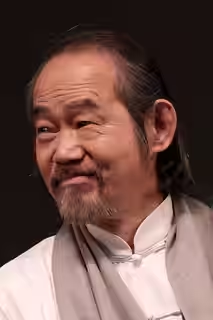
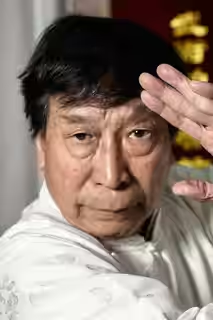
Yuen Qiu’s Landlady is the best thing in the film. She is every landlady anyone has ever had, loud, mean about the rent and immovable, and the film loves her for it. Yuen Wah’s Landlord is a henpecked lecher who keeps getting caught peering at the lodgers. Chiu Chi-Ling’s Tailor, Xing Yu’s Coolie and Zhihua Dong’s Donut spend the opening as men hauling sacks and stretching dough, and when the gang arrives they simply put the work down and start hitting people, and nobody stops to explain. Danny Chan’s Brother Sum leads the gang with a dancer’s vanity. Lam Chi-chung is a round, loyal sidekick, and Bruce Leung’s Beast, who turns up in the second half in a vest and flip-flops, we will leave alone.

The weaknesses are real. Sing disappears from his own film for stretches of twenty minutes while the masters fight, and when he comes back the script has to work hard to make him matter. Huang Shengyi’s Fong, the mute ice-cream seller Sing knew as a child, is meant to be the heart of the thing and gets one flashback and a handful of silent scenes. The computer effects, which are of their time, hold up in the grounded gags and wobble in the later fights, where bodies turn rubbery and the camera swoops through spaces that do not exist. The screenplay by Chow, Tsang Kan-Cheong, Chan Man-Keung and Lola Huo Xin cares about the alley and not much about structure.

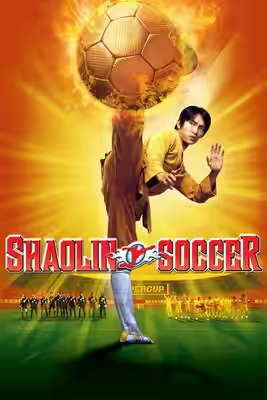
One trade critic found the film flat and the effects a substitute for people. We see the complaint and think it is aimed at the wrong film. Nobody here is pretending to drama; the score, credited to Chow, Xian Luo Zong, Raymond Wong and Hang Yi, hammers Chinese percussion over the fights and swells into full melodrama for the lollipop, and plays both with a straight face, which is the right choice. Set against Chow’s own Shaolin Soccer, this is broader, bigger and less reliant on dialogue, which is why it travelled as far as it did.

Watch it with other people and with the sound up. It carries a 15 certificate and the violence is of the kind where an axe connects and the man gets up again, and that is the right tone for a film that treats a slum as a playground. The plot will not survive the conversation afterwards. The Landlady’s chase will.
Critical consensus AI synthesised

75
Positive
7
Mixed
2
Negative
1

Most critics come away delighted. The reviews describe a manic, inventive action-comedy, and the praise clusters on Stephen Chow’s imagination: his comic timing, his slapstick, and fight scenes that more than one reviewer describes as a cartoon come to life. Critics repeatedly admire how the film mixes computer effects with practical martial-arts traditions, and how it plays with Hong Kong cinema history alongside Hollywood and Looney Tunes. A few also find it unexpectedly sweet beneath the cartoon violence.

The reservations gather around the story. Several reviewers admit the plot is hard to follow or comes apart after the halfway point, though most treat that as a small price for the set pieces. The spread is wide rather than even: enthusiasm at one end and a single firm rejection at the other. Variety, writing from a festival, finds the film emotionally flat and says the effects-heavy action stands in for character and human drama. Nobody else shares that complaint.

The AV Club
14 October 2010 · Scott Tobias
90*

Tobias gives the film an enthusiastic verdict, calling it a manic and exhilarating action-comedy. He especially praises how Chow combines CGI with practical martial-arts traditions to create a distinctive live-action cartoon.

Read the full review →
The Guardian
28 October 2005 · Rob Mackie
88*

Mackie finds the film a deliriously inventive delight, despite plots that can be hard to follow. He singles out Chow’s wild imagination, comic timing and gravity-defying action for praise.

Read the full review →
Empire
1 January 2000 · Simon Crook
85*

Crook gives the film an enthusiastic verdict, calling it invigorating, bombastic and very funny. He especially praises its inventive, absurd fight scenes and slapstick energy.

Read the full review →
Los Angeles Times
8 April 2005 · Carina Chocano
85*

The critic finds the film lively, witty, and surprisingly sweet despite its extreme cartoonish violence. She praises its brilliantly choreographed action and playful mix of Hong Kong cinema, Hollywood, and Looney Tunes influences.

Read the full review →
Radio Times
★★★★ · Karen Krizanovich
80

The critic gives the film a positive assessment. They single out Chow’s distinctive, kung-fu-infused comic style and the film’s impressive martial-arts action.

Read the full review →
Slant Magazine
11 February 2005 · ★★★/4 · Ed Gonzalez
75

Gonzalez praises the film’s social perspective and goofy, inventive humor, even as its plot falls apart after the halfway point. He singles out the humor’s playful elegance and the way its pop-cultural references illuminate social roles and collective camaraderie.

Read the full review →

Straight answers AI written, from our review

Is Kung Fu Hustle worth watching?
Kung Fu Hustle is worth watching for anyone who likes martial-arts comedy, and we scored it 83. Stephen Chow hides three retired kung fu masters in a Shanghai slum and sends the Axe Gang round to collect, and the result is one of the funniest fight films we have seen. The story thins once the serious fighting starts, but the jokes keep coming.
How long is Kung Fu Hustle, and what is it rated?
Kung Fu Hustle runs 1h 39m. It is an action and comedy film.
Where can I watch Kung Fu Hustle in the Philippines?
Kung Fu Hustle is streaming on Netflix in the Philippines. Availability is checked daily; the links above go straight to each service.
How violent or frightening is Kung Fu Hustle, and is it suitable for children?
Kung Fu Hustle carries a UK 15 certificate, and its violence is cartoonish rather than cruel: an axe connects and the man gets up again. There is a good deal of hitting, some blood and a gang that dances after a killing, so it is not for young children. Teenagers who can take a Road Runner cartoon made with people will be fine.
How does Kung Fu Hustle compare to Scott Pilgrim vs. the World?
Kung Fu Hustle is the broader and funnier of the two, and we prefer it to Scott Pilgrim vs. the World. Edgar Wright's film builds its cartoon fights around romantic immaturity and Michael Cera's selfish slacker, and the fights grow repetitive. Chow's film has less plot but better physical comedy, and Yuen Qiu's Landlady alone outlasts anything in Wright's.
What should I watch after Kung Fu Hustle?
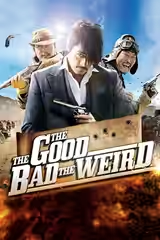
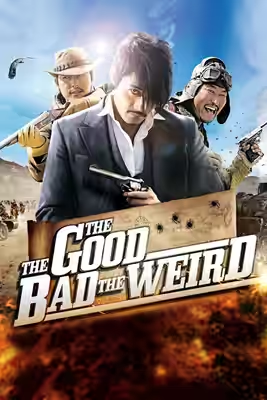
After Kung Fu Hustle, try Scott Pilgrim vs. the World (2010, Fi1m 81): Edgar Wright’s cartoon fight film, where every punch arrives with its own sound effect. Then The Good, the Bad, the Weird (2008, Fi1m 74): A Korean western of chases and shoot-outs that treats plot as something other people worry about.

Cast

Awards

Golden Horse Award for Best Feature Film, 2005

Won
Golden Horse Award for Best Feature Film

If you liked this, try…

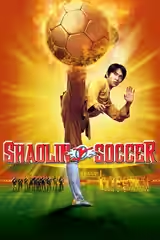
  1. Shaolin Soccer (2001) · not reviewed yetChow’s previous film: the same slapstick kung fu, applied to a football team of failures.

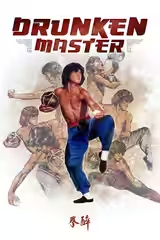
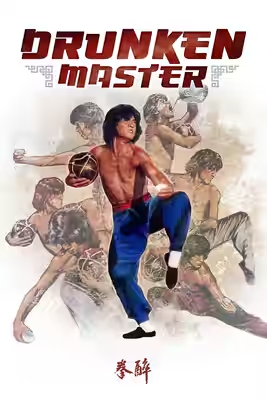
  2. Drunken Master (1978) · not reviewed yetJackie Chan, young and rubbery, in the comedy kung fu film everything since has borrowed from.

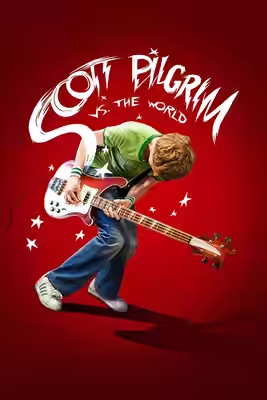
  3. Scott Pilgrim vs. the World (2010, Fi1m 81)Edgar Wright’s cartoon fight film, where every punch arrives with its own sound effect.

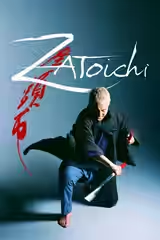
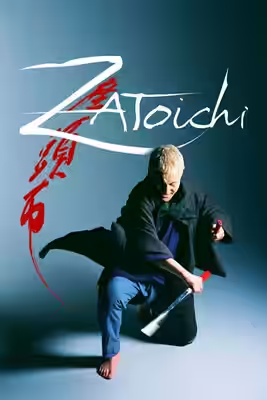
  4. Zatoichi (2003) · not reviewed yetTakeshi Kitano’s blind swordsman film, deadpan where Chow is loud, ending in a tap dance.

  5. The Good, the Bad, the Weird (2008, Fi1m 74)A Korean western of chases and shoot-outs that treats plot as something other people worry about.

Free account

Know what to watch tonight

Two lists that know where things are streaming, collections you can share, your own score beside ours, and Discover that remembers what you have seen.

  • Want to see, sorted by what is streaming now
  • Seen, with your score out of ten
  • No adverts, ever