William Oldroyd’s debut takes the corsets and the drawing room and drains them of every comfort, and Florence Pugh is remarkable in it. It is cold on purpose, and the cold costs it something near the end.
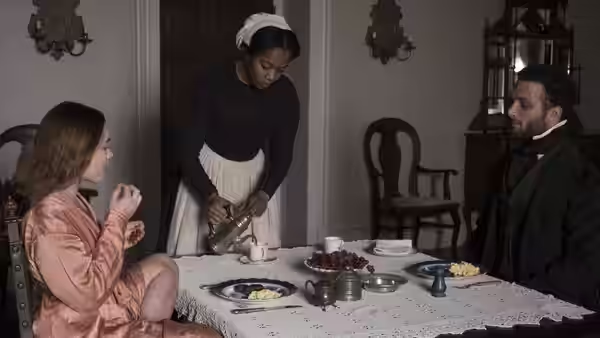
Nikolai Leskov’s novel is Russian and set among merchants; Alice Birch moves it to a stone house on the English moors and William Oldroyd, directing his first feature, films it with the doors shut. Katherine (Florence Pugh) has been bought along with a parcel of land and married to Alexander Lester (Paul Hilton), an older man who wants nothing from her but silence. His father Boris (Christopher Fairbank) wants an heir and says so at breakfast. The film is 86 minutes long and does not waste one of them.
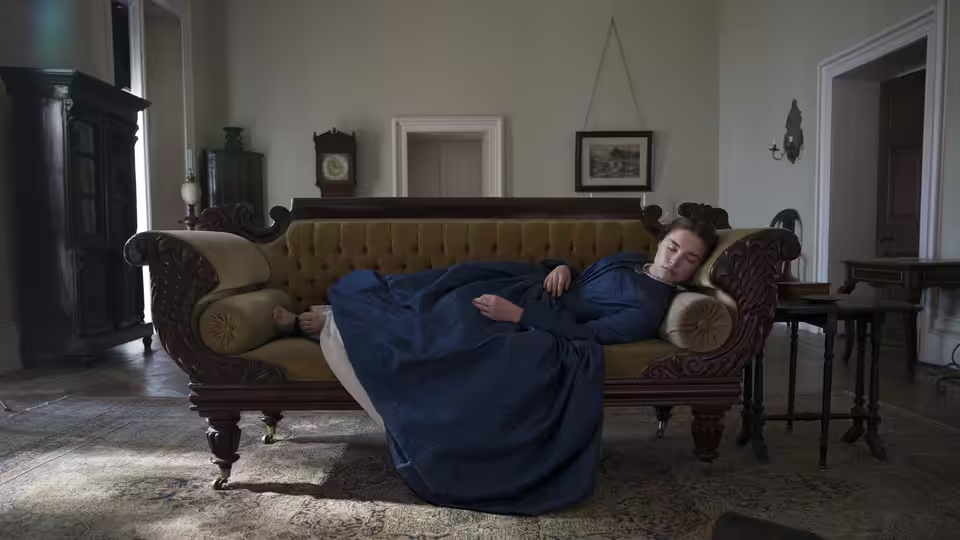
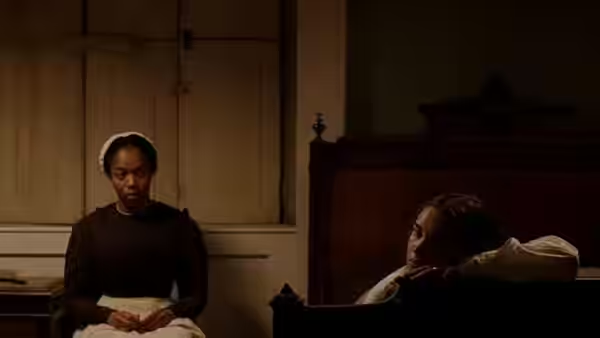
Pugh plays Katherine as a girl who decided, some time before the film starts, that she is cleverer than everyone in the house and is only waiting to prove it. She is told to stay indoors and does; she is told to face the wall and undress and does; she is told not to fall asleep at dinner and, splendidly, does. Then the men are called away, and she walks out onto the moor in her nightclothes and eats her breakfast in her own time, and Pugh lets the whole face open. We have rarely seen an actor do so much sitting still on a sofa. When Boris tells her he knows what she is up to, she looks at him the way one looks at a delayed train.
Ari Wegner shoots the house head-on and dead centre, so that Katherine on her sofa sits in the middle of the frame like a specimen, and she lights the rooms only from the windows, so they go grey-green in the afternoon and near black by dusk. Jacqueline Abrahams strips the sets almost bare: a few chairs, a clock, a bell pull, a great deal of wall. Holly Waddington puts Katherine in one blue dress for most of the film and makes us watch Anna (Naomi Ackie) lace her into it each morning, so the corset becomes one of the routines of the house, like prayers. Dan Jones’s score is barely there, a low tone under a handful of scenes, and for long stretches the only sound is wind, the clock and a skirt on the stair. Nick Emerson cuts hard and early, so scenes stop before they have finished, and the film gets its pace from that alone.
The lover is Sebastian (Cosmo Jarvis), a groom, and we meet him in the yard with the other men, who have hoisted Anna off the ground in a sling to weigh her like a sow and are laughing. We flinched, and the film meant us to, because it is telling us straight away what sort of man Katherine is about to choose. Jarvis plays him as a big, unlettered, physically confident man who is less clever than he thinks and works this out about halfway through. Ackie gives the film’s second great performance and does it almost without lines. Anna sees everything and is blamed for most of it, and the film understands that in this house a black servant has fewer ways out than the white wife she dresses. It does not need a speech to say so and does not make one.
The trouble is the cold, and the film has chosen it. Birch’s script gives Katherine almost no interior; we see what she does and never what she tells herself. For an hour that is a strength, because we lean forward to guess. The second half takes a turn we will not describe, and in its last stretch something happens that we found hard to watch, and we mean hard: we were shocked, not in the way a thriller sells shock but in a way that left us wanting a door out, and the film simply stares back and offers none. Some will call that rigour. We thought it was the one moment the film needed to let us in, and it kept us on the sofa.
Most costume dramas want you to admire the wallpaper. This one has taken the wallpaper down. Set against the Sunday-night serials and Brontë adaptations it resembles from a distance, it is meaner, shorter and far more alive, and set against other first features it is unusually sure of what it is doing. It carries a 15 certificate and earns it. See it for Pugh, and for Ackie, who is nearly as good with far fewer words, and see it knowing the house will not let you out until the credits and will not tell you what to think when it does.