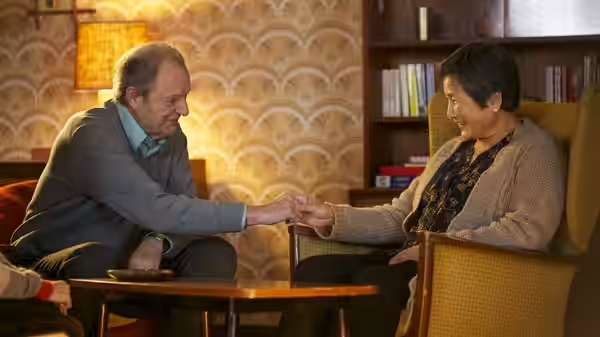
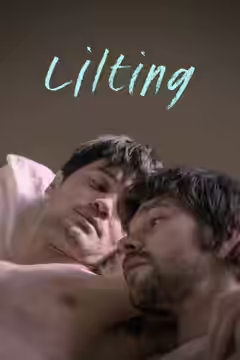
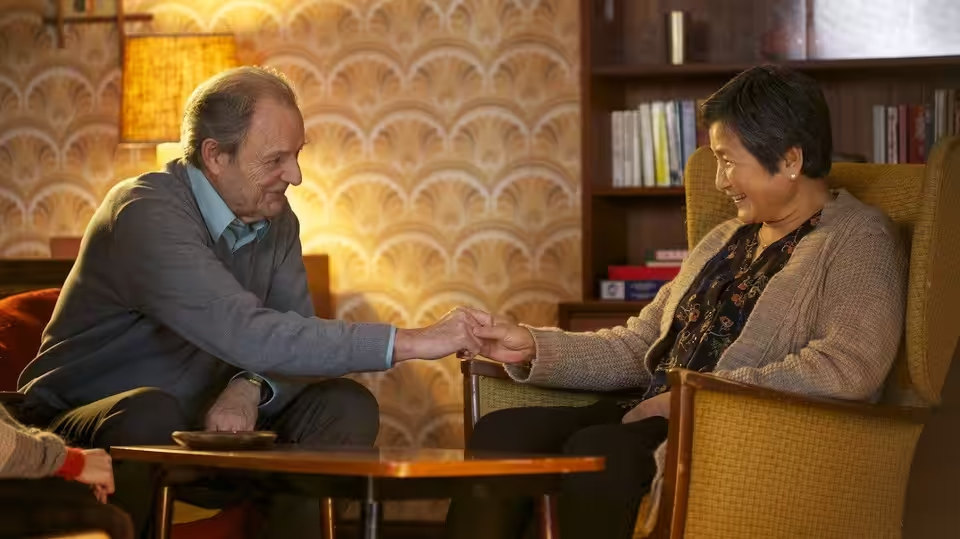
Alan (Peter Bowles) reaches for Junn's hand as they sit together in her living room
Film review

Lilting

2014 · Directed by Hong Khaou · 1h 31m

In a sentenceBen Whishaw makes finishing a sentence look harder than most films make saving the world

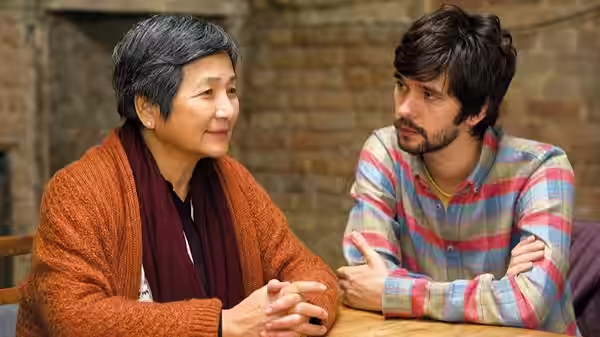
In London, Richard (Ben Whishaw) and Junn (Cheng Pei-pei) are grieving Kai (Andrew Leung). Richard wants to find a way to connect with Junn, but a language barrier complicates their conversations. Their shared loss does not mean they understand each other, and memories of Kai sit alongside their attempts to speak in the present. Junn also has a relationship with Alan (Peter Bowles), bringing another set of difficulties in communication. As Richard tries to get closer, both struggle to explain what the person they have lost means to them.

Plays from YouTube when you press play; nothing loads from them until then.

Fi1m review

Hong Khaou’s Lilting is worth seeing for Ben Whishaw and Cheng Pei-pei, whose performances make its quiet study of grief affecting. The contrived conversations and slow stretches are harder to forgive.

Lilting is a small drama about grief that earns our attention through its actors, even when its conversations feel arranged. Hong Khaou, who writes and directs, asks how people can begin to understand one another when language is already an obstacle. Richard and Junn have sorrow in common, but that gives them no easy way to speak. The film is good at allowing each to be difficult without treating either as a problem to be solved.

Ben Whishaw gives Richard a vulnerability that makes even the more direct dialogue bearable. We were moved by Richard’s attempts to speak to Junn: the effort seems exhausting, and getting the words out offers little immediate relief. Cheng Pei-pei gives Junn enough resistance to prevent these exchanges becoming a series of invitations to feel sorry for Richard. Her reserve requires us to pay attention to her separately, and helps keep their scenes from belonging entirely to him.

Urszula Pontikos’s cinematography gives the film a softness that suits its returns to memory. Miren Marañón’s production design helps keep the surroundings as carefully considered as the performances, without demanding that we admire them separately. The beauty works when it encourages us to stay with a hesitant exchange and notice what is going unsaid. It becomes less helpful when the scene has already communicated its feeling and the director seems reluctant to let it end.

Mark Towns’s editing gives the flashbacks an unforced rhythm, allowing recollection to interrupt the present without making every interruption feel like an explanation. That is a useful choice for a film concerned with people who cannot simply put their loss behind them. Stuart Earl’s music is sympathetic, though the performances need little help making the sadness felt. Between the images, the cutting and the score, the film sometimes settles into a gentleness that makes different scenes feel too much alike.

Junn’s relationship with Alan, played by Peter Bowles, is the clearest example of the writing trying too hard. It offers another way of considering intimacy and misunderstanding, but the connection feels contrived and receives more attention than it can sustain. Hong Khaou also lets some dialogue state feelings that the actors have already made apparent. We can still believe in the characters, though we become conscious of how carefully their conversations have been arranged.

What keeps Lilting above the dutiful grief drama is its willingness to let communication remain awkward. A language barrier is an obvious dramatic device, and there are stretches when its use here feels mechanical. Yet the actors find enough embarrassment, hurt and stubbornness in the exchanges to keep the subject from becoming an illustrated lesson in understanding. Their performances make the difficulty of reaching another person worth watching in itself.

At 91 minutes, it still has passages that feel prolonged, so this is not the choice for an evening that needs much pace. We would see it for the two leads, who make the conversations matter even when the writing is too deliberate. Allow for a little impatience with the film’s insistence on being gentle.

Critical consensus AI synthesised

66
Positive
7
Mixed
6
Negative
2

The reviews lean towards a qualified welcome for Lilting, with praise clustering around its sensitive treatment of grief, loneliness and connection across a language divide. Ben Whishaw’s performance draws the most consistent admiration for its vulnerability and emotional force, while several critics also praise Cheng Pei-pei and the rapport between them. The cinematography and fluid movement through memory receive favourable notices, giving the film’s quiet approach much of its appeal.

The spread is wide, however: what some find moving and delicately handled, others find emotionally remote or dramatically slow. Reservations centre on contrived relationships, stilted or overly direct dialogue, and a tendency to let mood weaken momentum. The performances also divide opinion. Slant Magazine praises Whishaw but finds Cheng’s expressiveness limited; HeyUGuys, among the least persuaded by the film, singles out Cheng and the portrayal of Junn’s isolation as its strongest elements.

IndieWire
17 January 2014 · A- · Mary Sollosi
90

The review finds the film moving and lyrical, with Ben Whishaw’s sensitive performance providing much of its emotional intensity. It praises Hong Khaou’s rhythmic, memory-like flashbacks, though it feels Junn’s relationship with Alan goes on too long.

Read the full review →
Sight and Sound
8 August 2014 · Ashley Clark
85*

Clark finds the film a tender, confident study of grief and loneliness, despite some acting imbalance and a potentially manipulative delay in revealing how Kai died. He particularly praises Ben Whishaw’s extraordinarily moving portrayal of grief.

Read the full review →
Empire
31 July 2014 · Patrick Peters
80*

Peters finds the film intimate, delicate and delightful. He particularly praises the strong performances by Ben Whishaw and Cheng Pei-Pei.

Read the full review →
Evening Standard
8 August 2014 · Guy Lodge
75*

Lodge finds the drama compassionate and emotionally delicate, with Whishaw giving his strongest showcase role in years. He singles out the palpable chemistry between Whishaw and Cheng Pei-pei, while noting that some dialogue is too direct.

Read the full review →
The Guardian
7 August 2014 · Peter Bradshaw
75*

Bradshaw finds the film heartfelt, intelligent and affecting. He praises its emotional story, while noting that Junn and Alan’s relationship feels slightly contrived.

Read the full review →
Variety
17 January 2014 · festival review · Justin Chang
75*

Chang finds the film a quietly resonant, delicately handled drama, though its modest scale and restrained ending may limit its impact. He especially praises the performances and the film’s sensitive portrayal of grief across a language and cultural divide.

Read the full review →

Straight answers AI written, from our review

Is Lilting worth watching?
Lilting is worth watching for Ben Whishaw and Cheng Pei-pei’s affecting performances, and we score it 73 out of 100. We are moved by the effort of their characters’ conversations across a language barrier, though the writing sometimes feels contrived. It suits an evening for quiet drama about grief, provided slow stretches are not a deal-breaker.
How long is Lilting, and what is it rated?
Lilting runs 1h 31m. It is a drama film.
Where can I watch Lilting in Hungary?
Lilting is not on any streaming or rental service in Hungary at the moment. It is available in 9 other countries; change your country at the top of the page to see where. Availability is checked daily.
How does Lilting compare to Ordinary People?
Lilting and Ordinary People both make awkward family affection affecting, with performances we find more persuasive than some of the writing. We favour Lilting for its close attention to grief complicated by a language barrier, and Ordinary People for Mary Tyler Moore’s difficult, compelling mother. Both sometimes explain feelings their actors have already made clear.
What should I watch after Lilting?
After Lilting, try Ordinary People (1980, Fi1m 81): For another grief drama that allows family affection to be awkward. Then The Wedding Banquet (1993, Fi1m 81): For family expectations and queer love handled with more comic bustle; and A Single Man (2009, Fi1m 72): Another closely observed performance of bereavement, with a much more polished surface.

Cast

If you liked this, try…

  1. Ordinary People (1980, Fi1m 81)For another grief drama that allows family affection to be awkward.

  2. Still Walking (2008) · not on Fi1m yetA family gathering where grief persists in ordinary talk and small irritations.

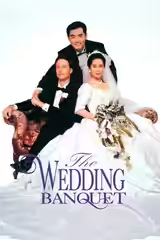
  3. The Wedding Banquet (1993, Fi1m 81)For family expectations and queer love handled with more comic bustle.

  4. A Single Man (2009, Fi1m 72)Another closely observed performance of bereavement, with a much more polished surface.

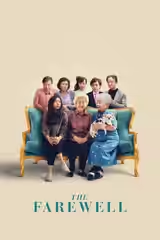
  5. The Farewell (2019, Fi1m 84)For the uneasy work of translating love across languages and generations.