Frank Oz’s film of the Ashman and Menken musical has better songs than most film musicals manage, a heartbreaking Ellen Greene and a monstrous Steve Martin. Between the numbers it is stagey and a little slack, and Rick Moranis is a soft centre.
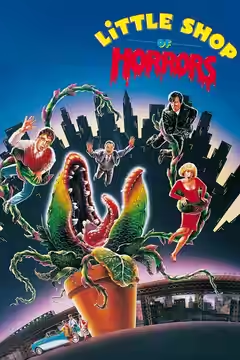
Frank Oz, who had spent the better part of two decades with his hand inside Muppets, was the obvious choice to film a musical whose star is a puppet. Little Shop of Horrors comes from the off-Broadway show by Howard Ashman and Alan Menken, which in turn came from Roger Corman’s cheap 1960 comedy, and Ashman wrote the screenplay himself. The result is a bright, loud, slightly stagebound 94 minutes with four or five songs most film musicals would kill for and a middle stretch that goes slack between them. We liked it a great deal. We did not love all of it.
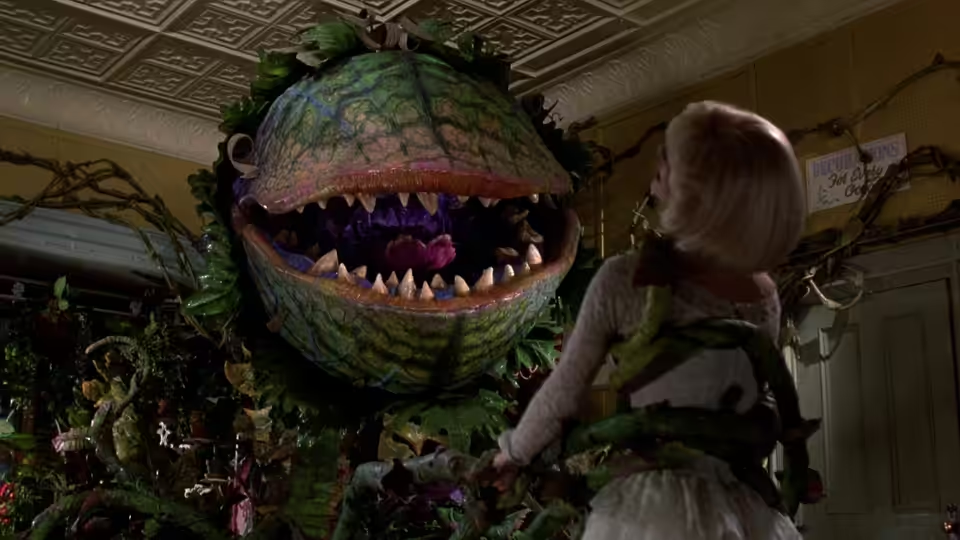
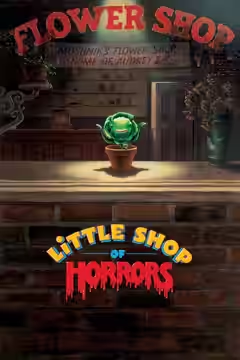
The setting is Skid Row, and Roy Walker builds it as one enormous set: a street, a tenement, a shop, a fire escape, a sky painted the colour of old dishwater. Nobody pretends it is a real place and the film is better for that. Robert Paynter lights it hard and flat, like a stage, so that when Audrey sings about a tract house in the suburbs the picture goes soft and pastel and you can feel the whole crew exhaling. Marit Allen puts Seymour in cardigans a size too big and Audrey in leopard print and heels she cannot walk in.
Ellen Greene played Audrey on stage, and it shows in the best way. Her speaking voice is a whisper with a New York hinge in it; her singing voice comes out of the same small frame like a foghorn, and the gap between them is the joke and the heartbreak at once. “Somewhere That’s Green” moved us far more than a song about a chain-link fence and a plastic-covered sofa has any right to, because Greene sings it as a woman who has decided this is the most she is allowed to want. Oz knows it is the film’s centre. He holds on her face and lets the set do the rest.
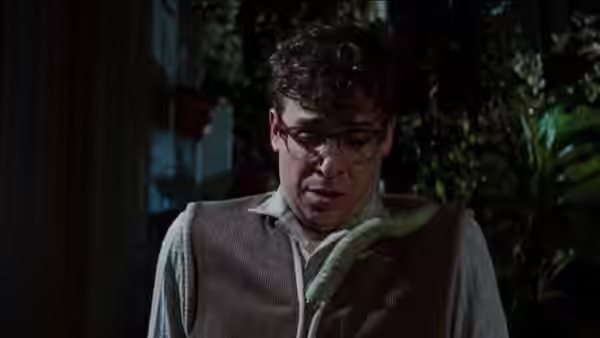
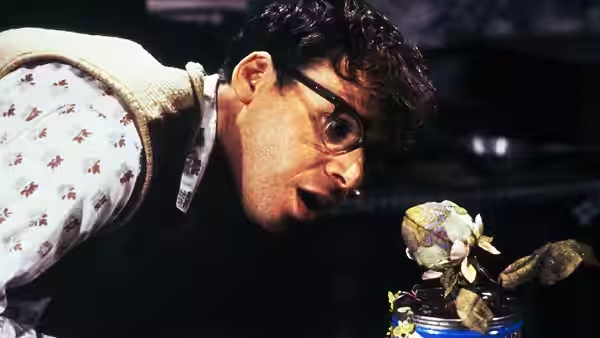
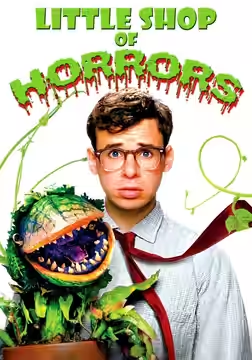
Rick Moranis is a gentler matter. He is sweet, he sings capably, and he plays Seymour as a man to whom things happen. That is the part as written, but it leaves the film soft exactly where its lead should be, and for long stretches we found ourselves waiting for someone else to come back on. Vincent Gardenia’s Mushnik grumbles nicely. Tichina Arnold, Michelle Weeks and Tisha Campbell, as the three girls who narrate from the kerb, are the film’s engine, turning up in doorways and on fire escapes to sing what everyone else is too polite to say, and every scene picks up when they do.
Then there is Steve Martin. His Orin Scrivello, a dentist who chose the profession because he likes hurting people, arrives on a motorcycle, sings his dentist number in a black leather jacket, and gasses himself for pleasure in front of a patient (Bill Murray) who turns out to enjoy the drill even more than he does. We laughed until we had to look away, then felt slightly grubby about it, because Orin also hits Audrey and the film does not let us forget that. Martin plays the menace and the idiocy at the same volume, and his are the funniest twenty minutes in the picture.
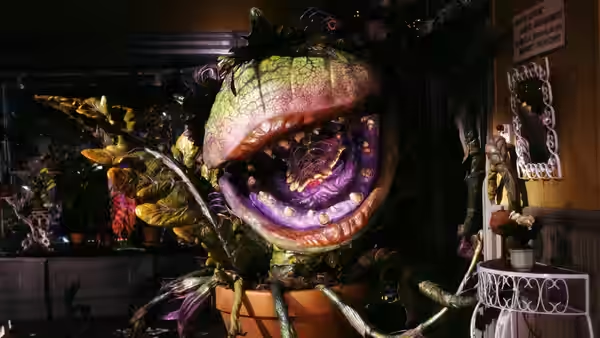
The plant is a puppet and behaves like one: heavy, wet-looking and magnificently rude. Levi Stubbs gives Audrey II a baritone that could sell you a car, and when it sings “Feed Me” it is as much a performance as anything the humans are doing. It also moves a fraction slower than the people around it, and in the long central stretch, when the songs stop and the plot has to be carried in dialogue, John Jympson’s cutting cannot hide that the film is waiting for its next number. Menken’s songs, arranged for the screen with Miles Goodman, are so strong that the spoken scenes between them feel like intervals.
The second half goes darker than the poster suggests, and there is a director’s cut with a different ending that we will not describe; Oz’s original finish was changed before release. Either way this is a horror comedy that plays the horror straight enough to sting, and it carries a PG. Small children will love the plant and not quite understand why the dentist is frightening. That is about the right response.