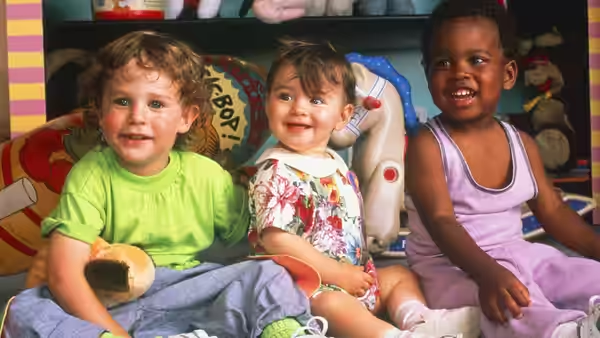
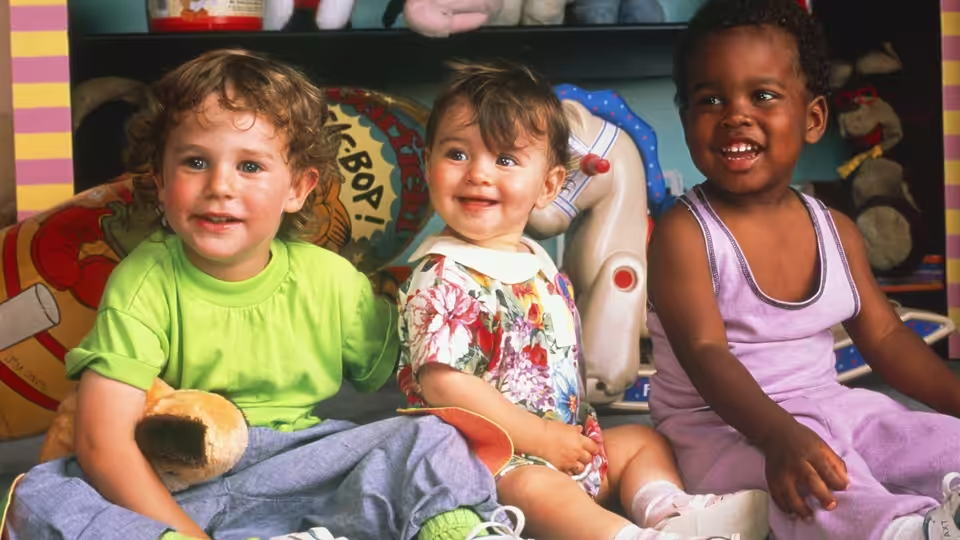
Three young children sit together among toys and cushions
Film review

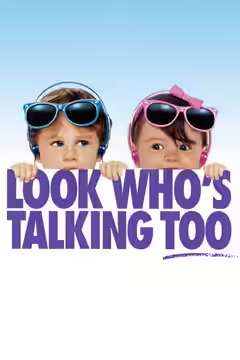
Look Who's Talking Too

1990 · Directed by Amy Heckerling · 1h 21m · ACB M

In a sentenceA film that gives the toilet a voice and the adults little to say

Mikey (Lorne Sussman, with the voice of Bruce Willis) has a new sister, Julie (voiced by Roseanne Barr), and is not ready to share. Her arrival changes his place in a family that includes James (John Travolta) and Mollie (Kirstie Alley). Mikey wants to keep the attention he has been getting, but Julie now has claims of her own. The big brother and his baby sister cannot conduct their arguments out loud: adult voices give us their thoughts while the grown-ups deal with the children in front of them.

Fi1m review

John Travolta brings some warmth to a thin sequel whose extra baby voices wear out a small joke. Amy Heckerling’s comedy has a few amiable moments, but the toilet humour and weak story overwhelm them.

Amy Heckerling’s Look Who’s Talking Too adds a sister to Mikey’s life and another adult voice to the cast, hoping sibling rivalry will keep the talking-baby joke going. It is a poor sequel, short of a story and much too dependent on familiar people saying unsuitable things through small children. There is a workable comedy in a child discovering that the family’s attention is no longer his alone. Heckerling and co-writer Neal Israel keep interrupting it to deliver another remark.

Bruce Willis supplies Mikey’s voice with enough casual ease to make some of the material sound better than it is. Roseanne Barr, voicing Julie, brings a sharper impatience, but the contrast soon becomes wearing because both children seem so ready with a response. The pleasure ought to come from recognising a baby’s bewilderment in words the baby could never manage. Too often we are simply waiting for the next adult wisecrack.

The toilet humour makes that problem harder to ignore. Mel Brooks is credited as the voice of Mr. Toilet Man, which gives a fair indication of how much comic mileage the film expects from bodily functions. We became bored by the repeated baby commentary, because the voices kept explaining reactions that were already plain enough. Heckerling and Israel rarely let a childish difficulty develop without making certain that someone has supplied the joke for it.

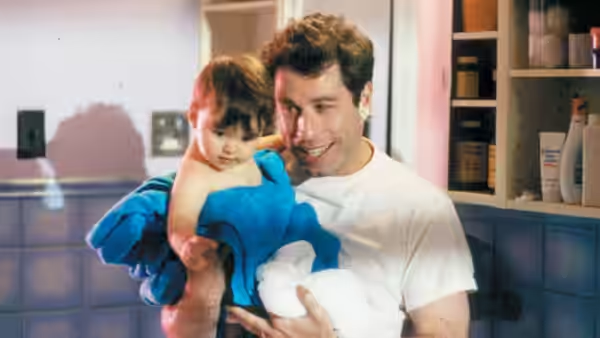
John Travolta and Kirstie Alley, as James and Mollie, give the film some much-needed human warmth. Travolta’s playgroup dance is an agreeable reminder of how much comedy can come from letting a performer move. We smiled at his willingness to look silly; the scene briefly relieves the dependence on wisecracks. Alley is an easy presence alongside him, though neither actor can make the scattered sketches add up to much.

Thomas Del Ruth’s photography has to compete with dialogue that keeps deciding what the children mean before we can make much of their expressions. The images seldom get to carry a joke unaided, and that leaves the film looking more ordinary than its premise suggests. Reuben Freed’s production design is similarly easy to overlook beneath the commentary. The children’s surroundings offer little comic interest of their own, so another useful way of varying the humour goes largely unused.

Debra Chiate’s editing keeps the individual exchanges moving, but cannot give the sequence of sketches much momentum. At 81 minutes, the film has little excuse for feeling stretched, yet the repetitions make us conscious of how little is changing between jokes. David Kitay’s score does not make those exchanges feel any lighter; the voices already leave scant room for the music to help. The film keeps trying to rouse a laugh when it needs to spend longer setting one up.

A family comedy can get a long way with affection for its adults and curiosity about its children, and there are traces of both here. They are regularly crowded out by the need to give the babies another line, until even their squabbling feels like an obligation. Consider it for Travolta if his easy company is enough; do not expect the new arrival to freshen the routine.
Critical consensus AI synthesised

34
Positive
0
Mixed
1
Negative
5

Most critics find Look Who’s Talking Too a weak sequel, with a recycled premise and too few sustained laughs. The limited praise centres on the performers rather than the story. Empire notes the returning cast’s ease and singles out Travolta’s playgroup dance as an amusing sketch; Variety credits Bruce Willis with carrying much of the comedy. Neither finds those contributions enough to make the film work.

The reservations differ mainly in emphasis. Radio Times faults the repetition, while Variety objects to the toilet humour and expletives, finding the film pitched more towards adolescents than families. The Los Angeles Times is harsher about the talking-baby voices, particularly Roseanne Barr’s abrasive delivery. The recorded scores range from mixed to strongly negative, but there is no clear favourable counterargument: Time Out’s review text is unavailable, so its comparatively generous score cannot establish what, if anything, it praises.

Time Out
· CM
64*

The page identifies itself as a review of the film, but the review text is unavailable. Its verdict and any specific praise or complaint cannot be determined.

Read the full review →
Radio Times
★★ · John Ferguson
40

Ferguson calls the sequel a pallid retread of the original. He faults its recycled premise, despite the return of the first film’s stars.

Read the full review →
Empire
1 January 2000 · Jo Berry
30*

Berry finds the sequel weak overall, with a plot that flags despite the returning cast’s ease. She singles out Travolta’s dance at the playgroup as one of the amusing comic sketches.

Read the full review →
The New York Times
14 December 1990 · Janet Maslin
30*

The review appears negative, judging by its headline’s emphasis on the film’s toilet humor. The headline singles out that humor as the focus of the film’s talk.

Read the full review →
Variety
31 December 1989 · Variety Staff
25*

The review finds the sequel rushed and aimed more at adolescents than families. It faults the overemphasis on toilet humor and expletives, while noting that Bruce Willis carries much of the comedy.

Read the full review →
Los Angeles Times
14 December 1990 · MICHAEL WILMINGTON
15*

Wilmington finds the sequel stale, strained, and driven by financial motives rather than creative inspiration. He particularly faults the excess of talking-baby voices and says Roseanne Barr’s abrasive delivery undermines the film’s mood.

Read the full review →

Straight answers AI written, from our review

How long is Look Who's Talking Too, and what is it rated?
Look Who's Talking Too runs 1h 21m and is rated M by the ACB in Australia. It is a romance and comedy film.
Where can I watch Look Who's Talking Too in Australia?
Look Who's Talking Too is streaming on Amazon Prime Video in Australia, and it is also available to rent from Amazon Prime Video from A$4.99. Availability is checked daily; the links above go straight to each service.
What should I watch after Look Who's Talking Too?
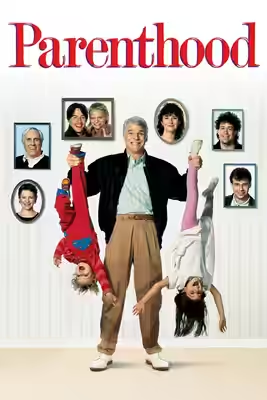
After Look Who's Talking Too, try Parenthood (1989, Fi1m 78): Family friction gets room to become funny without turning everyone into a punchline. Then Raising Arizona (1987, Fi1m 84): A baby provokes domestic chaos in a comedy with far stranger ideas; and Tokyo Godfathers (2003, Fi1m 82): An abandoned baby brings three outsiders together, with tenderness beneath the commotion.

Cast

Awards

Golden Raspberry Award for Worst Supporting Actor - Razzie Award, 1991

Nominated
Golden Raspberry Award for Worst Supporting Actor - Razzie Award

Golden Raspberry Award for Worst Supporting Actress, 1991

Nominated
Golden Raspberry Award for Worst Supporting Actress

If you liked this, try…

  1. Parenthood (1989, Fi1m 78)Family friction gets room to become funny without turning everyone into a punchline.

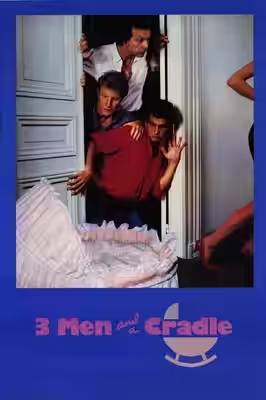
  2. Three Men and a Cradle (1985) · not reviewed yetMore baby logistics, with the adults allowed to supply the comedy.

  3. Raising Arizona (1987, Fi1m 84)A baby provokes domestic chaos in a comedy with far stranger ideas.

  4. Tokyo Godfathers (2003, Fi1m 82)An abandoned baby brings three outsiders together, with tenderness beneath the commotion.

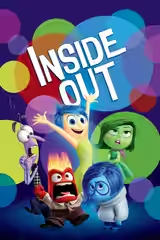
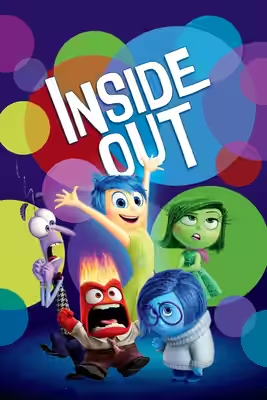
  5. Inside Out (2015, Fi1m 87)A child’s inner voices get distinct personalities and a story that needs them.

Free account

Know what to watch tonight

Two lists that know where things are streaming, collections you can share, your own score beside ours, and Discover that remembers what you have seen.

  • Want to see, sorted by what is streaming now
  • Seen, with your score out of ten
  • No adverts, ever