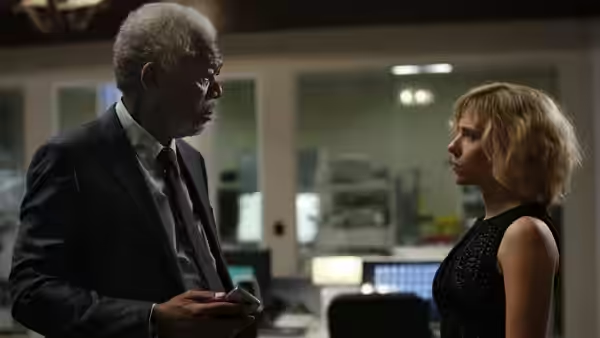
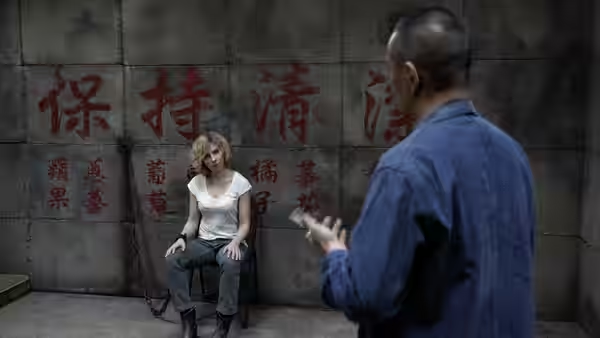
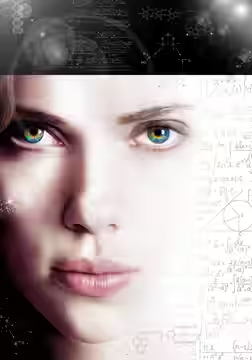
Lucy (Scarlett Johansson) holds a phone to her ear in close-up
Film review

Lucy

2014 · Directed by Luc Besson · 1h 29m · ACB MA 15+

In a sentenceJohansson gets cleverer by the minute and the script cannot keep up

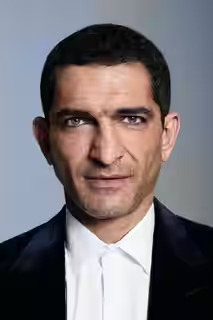
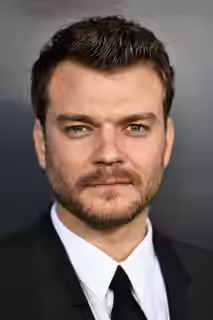
Taipei. Lucy (Scarlett Johansson), a student, is handcuffed to a briefcase by Richard (Pilou Asbæk), a boyfriend of a week, and sent into a hotel lobby to deliver it to a Korean gangster, Mr. Jang (Choi Min-sik). The case holds four bags of a synthetic drug, CPH4. Jang’s men sew one into Lucy’s stomach and the others into three mules bound for Europe. A kick in a holding cell ruptures her bag, and the drug floods her system. In Paris, Professor Norman (Morgan Freeman) lectures on what a human might do with more than ten per cent of the brain; Lucy, who is now using rather more than that, rings him. She also rings a police captain, Pierre Del Rio (Amr Waked), to tell him where the other three bags are.

Plays from YouTube when you press play; nothing loads from them until then.

Fi1m review

Luc Besson’s thriller about a woman who can use all of her brain is fast, silly and good fun for forty minutes, with Scarlett Johansson holding it together. Then it starts explaining itself, and the explanations are the silliest thing in it.

Luc Besson has written and directed a thriller built on the old saw that people use only ten per cent of their brains. A young woman has a bag of a new drug burst inside her, starts using twenty per cent, then thirty, and the film follows her up the scale, pausing at each step to tell us the number. It is nonsense, and Besson plainly knows it is nonsense, and for about forty minutes that is a workable arrangement. Then he starts to believe it.

The opening is the best thing he has shot in years. Lucy (Scarlett Johansson), a student in Taipei, is handcuffed to a briefcase by a boyfriend she has known a week (Pilou Asbæk, cheerful and doomed) and sent into a hotel lobby to deliver it to Mr. Jang (Choi Min-sik). Julien Rey cuts in wildlife footage of a cheetah stalking an antelope as she crosses the marble, which is crude and works. Choi, who was the man with the hammer in Oldboy, arrives with blood on his face and washes it off with bottled water before he says a word. Thierry Arbogast lights the hotel hard and glassy, so that Johansson, in a leopard-print top and tears, looks like the only soft thing in the building.

Johansson plays the frightened woman well, all nervous laughter and bargaining, which matters because the second Lucy has none of it. After the bag ruptures she comes back with a flat voice, a steady stare and no interest in anyone’s feelings, including her own. The scene that caught us off guard is a phone call from an operating table: she rings her mother and, while a surgeon cuts the bag out of her, describes remembering the taste of her milk and the feel of a cat’s fur against her face as a baby. It moved us more than we expected, because Johansson plays it as a woman losing something she can suddenly see all of. A few minutes earlier she had shot a patient on the next table because he was not going to make it, and we laughed, and then felt slightly ashamed of ourselves. The film can do both in one room, for a while.

The trouble is Professor Norman. Morgan Freeman is given a lecture hall in Paris and a slideshow, and he tells a polite audience, and us, what a person might do at forty per cent, sixty, ninety. Every time the film cuts back to him, it stops. Besson the writer has decided the ideas need a spokesman, when the images were already doing the job: Lucy pinning a corridor of gunmen to the ceiling, or diagnosing a man from his X-rays at a glance. The percentages appear on screen as title cards.

The plot around her has the same problem. Pierre Del Rio (Amr Waked), a Paris police captain, is told to round up the three other mules, and he does it, and then he stands near Lucy for the rest of the film holding a gun she does not need. Jang and his men follow her to Europe for reasons that amount to pride, and Besson stages a car chase against the traffic through Paris that is cut clean and fast and would be exciting if the woman at the wheel could not already stop bullets. Éric Serra’s score, a low electronic throb under a choir, swells whenever a car accelerates.

The second half goes somewhere we will not describe, except to say that Hugues Tissandier’s sets and the effects crew get bigger ideas and the wildlife footage comes back in bulk. Somewhere around the hour mark we noticed that we had stopped caring what happened to Lucy, because Lucy had stopped caring, and the film seemed to think that was the point. Most critics have forgiven this stretch. We found it handsome and empty.

Besson has done this before and done it better. Nikita (1990) made a woman into a weapon and never let us forget what it cost her; Léon (1994) had the same cold hero, but gave him a girl to be awkward around. Lucy has nobody. Johansson is the reason to watch, and she is a good enough reason for forty minutes. At 89 minutes and a 15 certificate it is at least quick about it, and the first half makes a decent evening if you are prepared to stop listening when the professor starts talking.


Critical consensus AI synthesised

64
Positive
13
Mixed
11
Negative
3

Most critics lean positive on Lucy, though hardly anyone treats it as sensible. The reviews agree that the film is preposterous and that this is largely the point: a brisk flight of fancy that Besson keeps moving. Praise clusters around Scarlett Johansson, whose transformation is singled out again and again as the reason to keep watching. The energetic first half, the bloody action and the inventive imagery of Lucy’s growing powers draw the warmest notices, and several critics call it Besson’s best work in years.

The reservations gather in the second half. Many critics find the film overexplains its pseudoscience, grows pompous and loses interest as its heroine nears omniscience, and the abstract ending is a common complaint. The spread is wide: the Los Angeles Times finds it quickly dull, and The Hollywood Reporter calls the storytelling too weak to carry the premise. Only three reviews are negative, but the mixed middle is large.

IndieWire
23 July 2014 · B+ · Gabe Toro
83

Toro praises the film as an ideal summer movie, despite its unevenly lyrical execution. He singles out Johansson’s performance and the inventive depiction of Lucy’s growing powers.

Read the full review →
The AV Club
24 July 2014 · B+ · Ignatiy Vishnevetsky
83

The critic finds the film an imaginatively goofy, brisk flight of fancy rather than ordinary dumb fun. He praises its energetic first half and weird imagery, while noting that the second half overexplains its premise.

Read the full review →
Little White Lies
21 August 2014 · 2/4/4 · David Ehrlich
80

Ehrlich calls the film an exciting, wildly ambitious action movie and a welcome return to form for Besson. He praises its audacious visual style and the way it fuses familiar genre influences into a chaotic, exhilarating whole.

Read the full review →
Total Film
22 August 2014 · ★★★★ · Kate Stables
80

Stables finds the film preposterous but exhilarating, praising its controlled blend of action, pop science and metaphysical ideas. She especially applauds Scarlett Johansson, whose performance makes Lucy’s transformation compulsively watchable.

Read the full review →
Slant Magazine
23 July 2014 · ★★★/4 · Abhimanyu Das
75

The critic finds the film’s absurdity entertaining, despite its failure to fully realize its metaphysical ambition. They praise Johansson’s mesmerizing performance and the film’s visually coherent, exuberantly bloody action.

Read the full review →
Evening Standard
4 October 2014 · David Sexton
70*

The critic finds Lucy an entertaining, visually striking comic-book romp, though it loses interest as its heroine approaches omniscience. He praises Scarlett Johansson’s performance, especially her convincing shifts into unnatural intelligence.

Read the full review →

Straight answers AI written, from our review

Is Lucy worth watching?
Lucy is worth watching for its first forty minutes and for Scarlett Johansson, and we scored it 58. The opening in Taipei is fast, silly and good fun, but once Morgan Freeman's professor starts explaining the brain percentages the film stops dead and the second half is handsome and empty. At 89 minutes it is at least quick about it.
How long is Lucy, and what is it rated?
Lucy runs 1h 29m and is rated MA 15+ by the ACB in Australia. It is an action and science fiction film.
Where can I watch Lucy in Australia?
Lucy is streaming on Netflix in Australia, and it is also available to rent from Amazon Prime Video and Apple TV from A$4.99. It leaves Netflix on 10 October. Availability is checked daily; the links above go straight to each service.
How violent or frightening is Lucy, and is it suitable for children?
Lucy is a 15 certificate in the UK and R in the US, and it is not for children. The violence is frequent and casual: a drug bag is sewn into Lucy's stomach, she shoots a patient on an operating table because he will not survive, and gunmen are pinned to a ceiling. It is more cold than frightening, so older teenagers who can take Besson's bloodshed will be fine.
How does Lucy compare to Nikita?
Lucy is the weaker of the two: Nikita is the film we recommend beside it. Both are Besson thrillers about a woman turned into a weapon, but Nikita never lets us forget what it costs her, while Lucy stops caring about herself and the film thinks that is the point. Watch Lucy for Johansson's first half; watch Nikita for the whole thing.
What should I watch after Lucy?
After Lucy, try Nikita (1990, Fi1m 76): Besson’s earlier woman-turned-weapon, and this time the cost of it shows on her face. Then Under the Skin (2013, Fi1m 81): Johansson as something not quite human, watching people; quiet where this one shouts; and Akira (1988, Fi1m 83): A mind outgrowing its body in Neo-Tokyo, and the animation keeps pace with the idea.

Cast

If you liked this, try…

  1. Nikita (1990, Fi1m 76)Besson’s earlier woman-turned-weapon, and this time the cost of it shows on her face.

  2. Under the Skin (2013, Fi1m 81)Johansson as something not quite human, watching people; quiet where this one shouts.

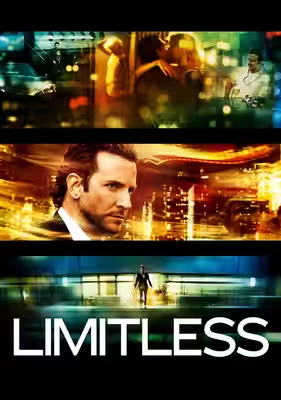
  3. Limitless (2011) · not reviewed yetThe same pill-makes-you-clever premise, played as a thriller rather than a sermon.

  4. Akira (1988, Fi1m 83)A mind outgrowing its body in Neo-Tokyo, and the animation keeps pace with the idea.

  5. Scanners (1981) · not reviewed yetCronenberg’s telepaths in grey Canadian offices; cheap, nasty and far more frightening.

Free account

Know what to watch tonight

Two lists that know where things are streaming, collections you can share, your own score beside ours, and Discover that remembers what you have seen.

  • Want to see, sorted by what is streaming now
  • Seen, with your score out of ten
  • No adverts, ever