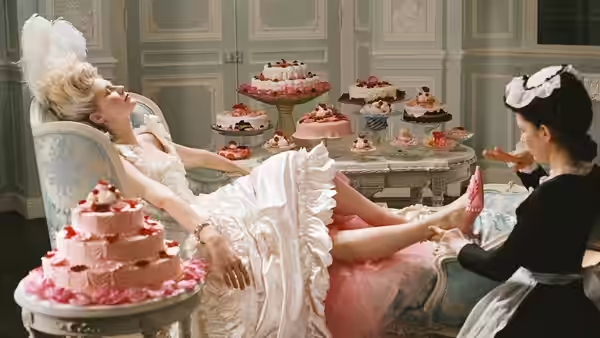
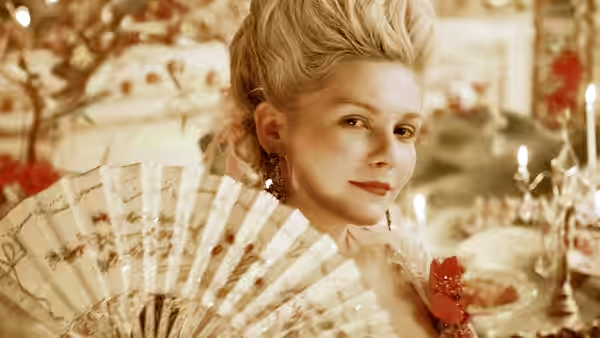
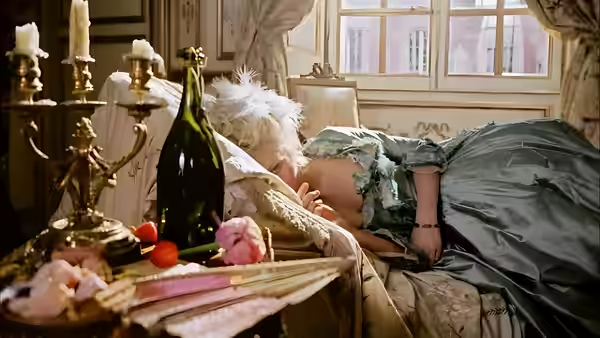
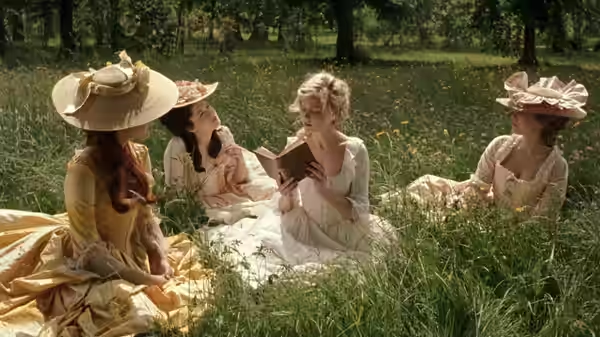
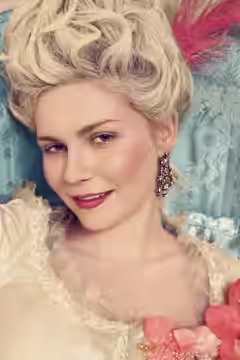
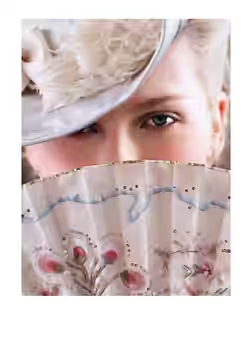
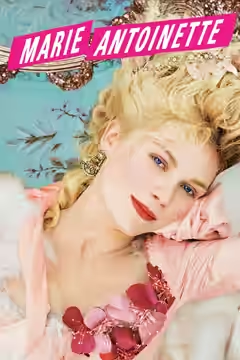
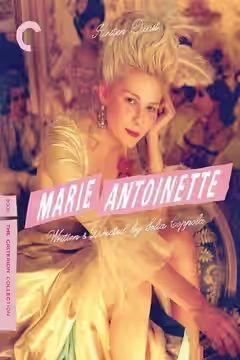
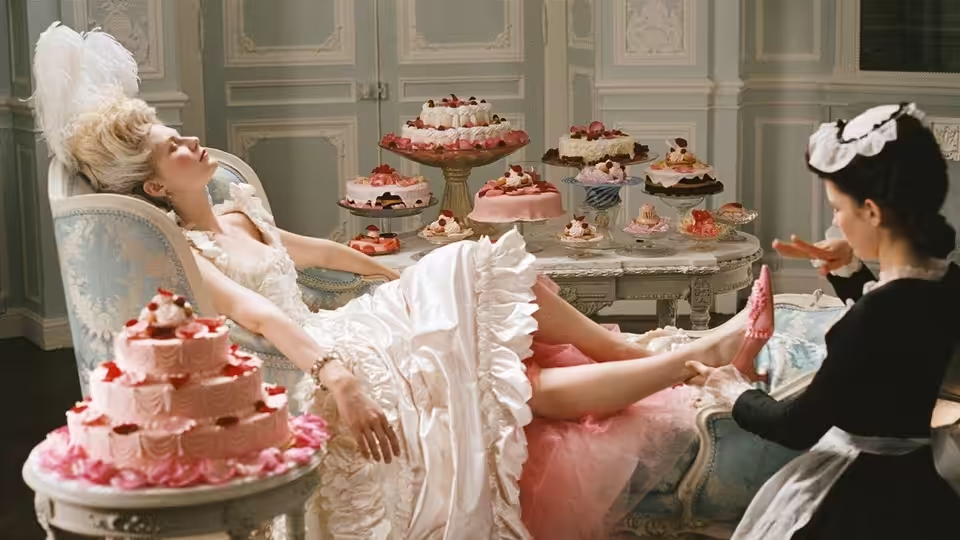
Marie Antoinette (Kirsten Dunst) reclines as a servant tends her feet among cakes
Film review

Marie Antoinette

2006 · Directed by Sofia Coppola · 2h 03m

In a sentenceAll those rooms at Versailles, and nowhere to be left alone

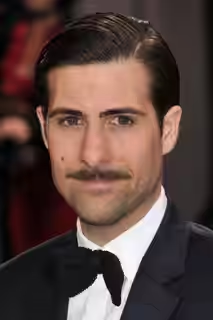
At Versailles, Marie Antoinette (Kirsten Dunst) looks for pleasure and some freedom within the routines of court life. Around her are Louis XVI (Jason Schwartzman), Ambassador Mercy (Steve Coogan) and Comtesse de Noailles (Judy Davis), in a society governed by rank and formal obligations. Clothes and confectionery provide distractions, but being surrounded by luxuries does not give Marie much control over her life. The court subjects her to scrutiny while allowing her few ways to step outside her allotted role. She tries to enjoy what her position offers as its obligations begin to press upon her.

Fi1m review

Sofia Coppola’s intimate portrait is worth seeing for Kirsten Dunst and the way clothes, rooms and modern songs convey a constrained life. The history is hurried, and Marie’s thoughts deserve more attention.

Marie Antoinette is a good film about having everything within reach except much say in your own life. Sofia Coppola concentrates on the comforts and restrictions of court life, keeping close to a woman whom other people are always assessing. We recommend it as an intimate period drama, with a warning for anyone expecting a substantial account of the politics. Those limits become frustrating, but there is enough feeling here to justify the narrow view.

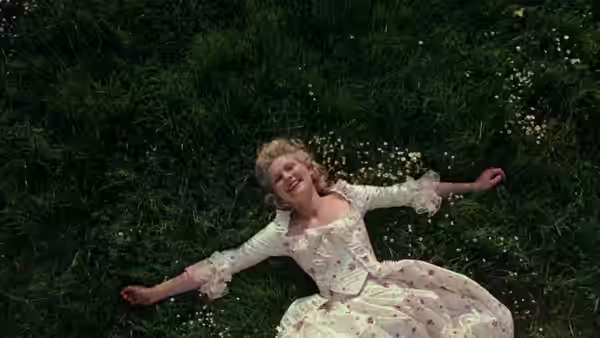
Kirsten Dunst gives Marie Antoinette a watchfulness that keeps the pleasures from looking entirely carefree. Her performance lets us see someone enjoying the advantages of her position without suggesting that enjoyment has settled every worry. We felt unexpectedly protective of her amid the costumes and confectionery, because she makes Marie seem so unsure of how she is meant to behave. That uncertainty earns our sympathy, even when the screenplay gives us less of her thinking than we would like.

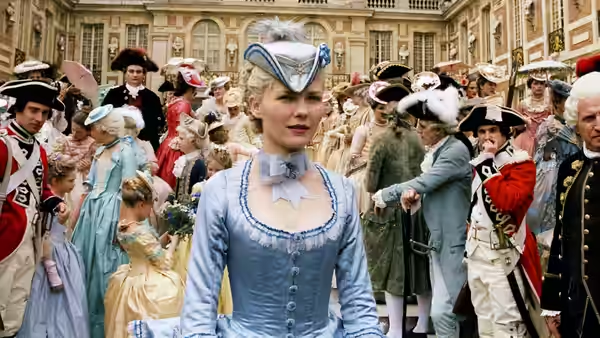
Lance Acord’s cinematography gives Versailles enough room to dwarf the person we are meant to be watching. The compositions make Marie look uncomfortable in surroundings that ought to please her. K.K. Barrett’s production design keeps the court’s abundance in view, and Milena Canonero’s costumes make the demands of display visible on the people themselves. We can enjoy the clothes while noticing how little ease they seem to allow. These departments give the director something to work with beyond attractive backgrounds.

The modern soundtrack is the choice that makes the most sense of this approach. Dustin O’Halloran’s music is restrained enough for the more private passages, while the modern songs make the pursuit of pleasure feel immediate. Sarah Flack’s editing follows those pleasures readily, although the movement from one diversion to another gradually becomes too familiar. The energy is welcome, but another burst of music cannot always make the next diversion interesting.

The difficulty is that Sofia Coppola’s screenplay does not develop Marie as fully as Kirsten Dunst’s performance encourages us to expect. Her restrictions become clear well before the film has finished showing us their effects, and the courtly diversions begin to repeat themselves. At 123 minutes, it has time to let her thinking grow more complicated. Too often, another attractive passage arrives where a sharper exchange or a difficult choice might have helped.

By the standards of the historical drama, the weak point is the world beyond Versailles. The director has chosen to stay with Marie’s limited understanding of her circumstances, which is a reasonable starting point for a portrait. But when wider events require attention, the film hurries through material that needs more explanation. We understand how sheltered Marie is without learning enough about what she is sheltered from.

Still, we would not trade Kirsten Dunst’s hesitant, pleasure-seeking Marie for a more efficient history lesson. The performance gives the film warmth, and the director allows her heroine ordinary weaknesses without making every indulgence a charge against her. There is room for that kind of attention in a period drama, even one this underwritten. Choose it for the woman trying to settle into those clothes, and accept that the explanation of France will have to come from elsewhere.
Critical consensus AI synthesised

65
Positive
5
Mixed
7
Negative
2

The reviews lean towards qualified approval of Coppola’s Marie Antoinette, with more mixed responses than outright endorsements. Praise clusters around the costumes, settings and visual style, which impress even several critics left cold by the drama. Kirsten Dunst’s performance earns repeated approval, while the modern soundtrack is often praised for bringing Marie’s feelings closer to a contemporary audience. The more enthusiastic reviews find an empathetic portrait of a young woman constrained by privilege.

The spread is wide, however, and the central disagreement concerns how much feeling and insight lie beneath the courtly pleasures. IndieWire reads the film as compassionate rather than indulgent; Little White Lies finds Marie’s inner life neglected. Reservations elsewhere centre on thin characterisation, limited political context and a loss of momentum when historical events intrude. Even the soundtrack divides opinion: The Skinny finds that it competes with the dialogue and visual style rather than helping them.

IndieWire
25 September 2006 · festival review · twhalliii
95*

The critic strongly praises Coppola’s film as a compelling, empathetic portrait rather than a celebration of privilege. They single out its modern music as a vivid way to convey Marie’s inner life.

Read the full review →
The New Yorker
9 August 2016 · Richard Brody
85*

Brody praises Coppola’s bold, insightful reimagining of Marie Antoinette beyond historical cliché. He singles out her exquisite visual style and close attention to women’s subjectivity.

Read the full review →
Empire
29 September 2006 · ★★★★ · Ian Freer
80

Freer finds the film a gorgeous, giddy, imaginative romp, though it loses momentum when history disrupts Marie’s courtly life. He particularly praises the exuberant filmmaking, Dunst’s performance, and the lively soundtrack.

Read the full review →
Total Film
20 October 2006 · ★★★★ · Total Film
80

The review finds Coppola’s film mesmerizing, elegant, and emotionally rewarding despite its loose approach to history. It praises Kirsten Dunst’s performance and the soundtrack, while faulting the rushed historical events in the final stretch.

Read the full review →
Screen Daily
25 May 2006 · Allan Hunter
65*

Hunter describes Coppola’s take on Marie Antoinette as a frivolous, fun-filled attempt to make Versailles accessible to modern audiences. He singles out the heroine’s shallow, celebrity-like portrayal.

Read the full review →
Little White Lies
9 October 2006 · 5/3/2 · Matt Bochenski
60

The review finds the film visually seductive but emotionally thin, arguing its rich story deserved more. It praises the sumptuous cinematography and design, while faulting Coppola for neglecting Marie Antoinette’s inner life and dramatic transformation.

Read the full review →

Straight answers AI written, from our review

Is Marie Antoinette worth watching?
Marie Antoinette is worth watching for Kirsten Dunst’s performance and its intimate view of court life; we scored it 74 out of 100. We recommend it to anyone drawn to period dramas about private unhappiness beneath fine clothes, with a warning that the diversions grow repetitive and the wider history receives too little attention.
How long is Marie Antoinette, and what is it rated?
Marie Antoinette runs 2h 03m. It is a drama and history film.
Where can I watch Marie Antoinette in the Philippines?
Marie Antoinette is not on any streaming or rental service in the Philippines at the moment. It is available in 40 other countries; change your country at the top of the page to see where. Availability is checked daily.
How violent or frightening is Marie Antoinette, and is it suitable for children?
Marie Antoinette has a UK 12 certificate, so it is not a straightforward choice for younger children. We recommend it to older viewers interested in court life and social pressure, but the certificate alone does not establish how intense any violence or frightening material is.
How does Marie Antoinette compare to The Age of Innocence?
Marie Antoinette is the more narrowly focused portrait, while we recommend The Age of Innocence as the more persuasive drama about the damage done by social expectations. Both make fine clothes and strict manners matter, but Coppola follows pleasure and confinement where Scorsese develops romance and suppressed desire. Choose Coppola for Dunst’s uncertain heroine, Scorsese for the stronger emotional drama.
What should I watch after Marie Antoinette?
After Marie Antoinette, try The Age of Innocence (1993, Fi1m 86): Fine clothes and strict manners conceal the damage done by social expectations. Then The Earrings of Madame de… (1953, Fi1m 87): Jewellery and social ritual reveal how little freedom expensive surroundings can buy; and The Last Emperor (1987, Fi1m 80): A sheltered royal life gets the wider historical attention missing from this portrait.

Cast

Awards

Academy Awards, 2007

Won
Best Costume Design

If you liked this, try…

  1. The Age of Innocence (1993, Fi1m 86)Fine clothes and strict manners conceal the damage done by social expectations.

  2. Daisies (1966) · not on Fi1m yetTwo young women turn appetite and bad behaviour into a wilfully disruptive comedy.

  3. The Earrings of Madame de… (1953, Fi1m 87)Jewellery and social ritual reveal how little freedom expensive surroundings can buy.

  4. The Last Emperor (1987, Fi1m 80)A sheltered royal life gets the wider historical attention missing from this portrait.

  5. Spencer (2021) · not on Fi1m yetRoyal routine becomes suffocating, with another young woman watched at every turn.