Celine Song’s second film treats dating as a marketplace and says so, in dialogue sharper than most romances manage. It is clever, well cast and a little cold, and when it finally asks us to feel something, it has not done the groundwork.
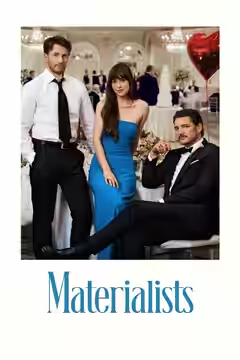
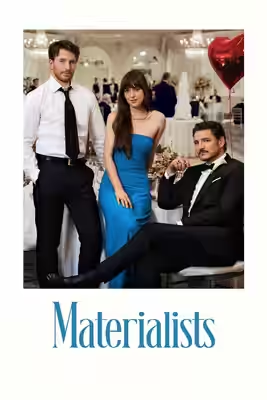
Celine Song’s first film, Past Lives (2023), was about two people who could not be together and said almost nothing about it. Her second is about three people who could be together and talk about little else. Lucy (Dakota Johnson) is a New York matchmaker who sorts her clients by height, salary and age and says marriage is a deal like any other. At a wedding she meets Harry (Pedro Pascal), the groom’s brother, who has money, and finds John (Chris Evans), the actor she left years ago, handing round the drinks. Materialists wants to be a romantic comedy that tells the truth about money. For an hour it is, and that honesty is also why it never gets warm.
The matchmaking scenes are where Song is sharpest. Clients sit across from Lucy and list what they will and will not accept, and she writes it down without a flicker, then goes home to a flat she cannot afford. Johnson plays her flat and quick, a woman who has turned her voice into a sales tool and cannot switch it off at dinner. Pascal gives Harry the ease of a man who has never been refused anything and is curious to see what it feels like. Their first dinner, in which she tells him to his face what he is worth on the market and he takes it as a compliment, is the best scene in the film. We laughed, then winced, because Lucy was pricing herself too.
Shabier Kirchner shoots the city in soft, late-afternoon light and stays close on faces. Anthony Gasparro’s design does the film’s class argument for it: Harry’s flat is a grey box of glass and stone with nothing on the surfaces, and John’s is a shared one with a sink full of dishes. Katina Danabassis puts Lucy in careful neutral tailoring, the wardrobe of someone dressing for the life she wants rather than the one she can pay for. Daniel Pemberton’s score is quiet and mostly keeps out of the way. Keith Fraase lets conversations run in long takes and leaves the pauses in, which suits the talk when the talk is good.
The trouble is John, or rather what the film has decided John is for. Evans plays him gently and well, a decent man who is broke and knows what it costs him, but the script gives him little to do beyond being poor and being kind. Johnson and Evans together are pleasant, and no more than that; we did not believe these two had once torn each other apart over a restaurant bill. When the film asks us to weigh him against Harry, the writing has already tilted the scales, and not in the direction the film thinks.
Song also has a habit of having people say the theme. Lucy tells Harry what she is worth; Harry tells Lucy what he is worth; a client tells Lucy what everybody is worth. The first time it is bracing. By the fifth it is a lecture with better lighting. A subplot involving one of Lucy’s clients, Sophie (Zoë Winters), takes the film somewhere darker than the rest of it can carry. Winters is excellent, but her scenes sit in the film like a serious essay stapled to a comedy, and the comedy does not know how to pick up afterwards.
Here is what we felt. For an hour we leaned forward, amused and slightly stung, because Song is right about how people talk about each other now and has the nerve to write it down. Then, somewhere past the ninety-minute mark, the film asked us to be moved, and we found we were watching from a distance, admiring how tidily it had arranged its pieces. We wanted to be got at. We were not.
Past Lives trusted silence and a look across a bar to carry everything. Materialists trusts argument, which is what it does best, so when the romance arrives it feels like a concession. It runs 116 minutes and carries a 15. See it with someone you have disagreed with about money. You will have the disagreement again on the way home, and it will be livelier than the one on screen.